
Including thoughts on the “productivity puzzle”, bond yields, monetary policy credibility, and how the government’s clumsy interventions are still costing jobs and adding to rental inflation…
Theme of the Week
This week’s most interesting economic story was worth a piece of its own: “Six questions and answers on the new productivity data”.
In short, the ONS has solved the UK’s “productivity puzzle”, at least partially. New data suggests that output per hour has held up much better than previously thought in the wake of the Global Financial Crisis of 2008 (and, whisper it, since the vote to leave the EU in 2016).
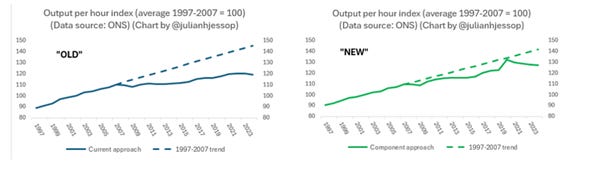
This is mainly because alternative data sources suggest that hours worked fell more than assumed, which explains why stronger hourly productivity did not produce stronger output or tax revenues.
The most immediate question is what this might mean for the upcoming Budget? Possibly nothing.
Hours and output per hour both shape forecasts of potential output, growth and the public finances. The OBR may judge that higher hourly productivity will again be offset by fewer hours, leaving potential output unchanged. The OBR may also want more evidence before revising its projections again, as the new analysis ends in 2024.
But the new data should still be helpful, whether now or in the future.
The OBR’s 1.0% trend productivity estimate is below the ONS’s new 1.3% average for 2009–19. Moreover, the ONS has already published alternative-source productivity data up until the second quarter of 2026. As I have noted before, the green line in the chart below suggests that productivity rose further after 2024.
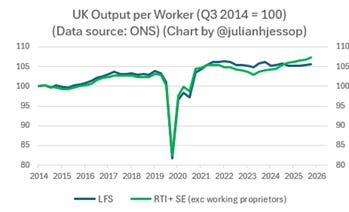
Fiscal implications aside, this is (mostly) good news. One way of thinking about the new data is that people are taking more of the benefits of higher productivity in the form of additional time off rather than additional incomes.
More fundamentally, there are some underlying structural changes and trends here which are likely to persist; an ageing population, more working parents, greater access to flexible working, and rising wealth, may all enable or encourage some people to work fewer hours.
Monday 14 September
Another bad day in the bond markets, with 30-year gilt yields approaching 6%. I made three points that often apply on other days too.
First, Monday’s jump in the cost of UK government borrowing was led by shorter maturities. This was mainly driven by expectations that the surge in energy prices will prompt more hikes in official rates from the Bank of England.

Second, the jump in yields was not unique to the UK. So, while it may well be tempting to blame all of this on a “Burnham penalty”, this is still primarily a global move.
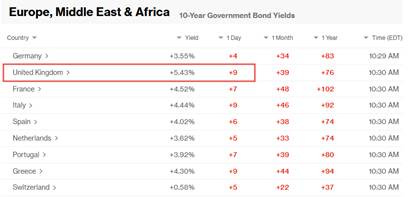
Third, though, regardless of exactly what has driven yields on any particular day, the UK government’s cost of borrowing has consistently been the highest in the G7 since Labour came to power. This is a major blow to the public finances.
Tuesday 15 September
Some disappointing news from the labour market, where the stabilisation in the latest recruitment surveys is yet to show in the official data.
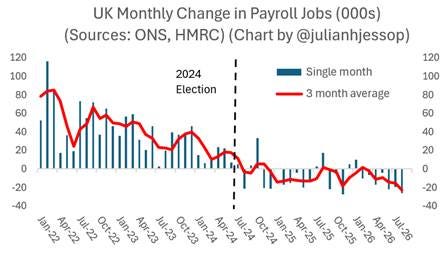
The latest figures from the ONS showed a net loss of another 26,000 payroll jobs in August, with July’s fall revised from a loss of 13,000 to a loss of 19,000. And over the past two years, the UK economy has shed over 200,000 jobs, partly as a result of government policies which have added to the costs of employing people.
What’s more, annual average regular earnings growth was 6.3% for the public sector but just 2.9% for the private sector. The breakdown of the private sector data is revealing too: regular pay in construction rose just 0.3%, underlining the weakness in a key industry.
Wednesday 16 September
UK consumer price inflation rose to 3.1% in August, from 2.9%, as expected, driven by motor fuels (with more to come here).
However, there was not much change in the other components, including food inflation (which remained at 1.3%). This provided a little more reassurance that the “second round” effects from higher energy prices are still limited.
Strong competition is also capping the prices of clothing and household goods. Market forces are doing a far better job of keeping inflation down than any amount of clumsy state intervention.
Just to ram that last point home, the second biggest contributor to headline inflation (after motor fuels) was housing, which includes rents.
Rental inflation normally follows general inflation, with a lag as new agreements take effect. But it is notable that rents have risen relatively quickly in the past couple of years and especially more recently.
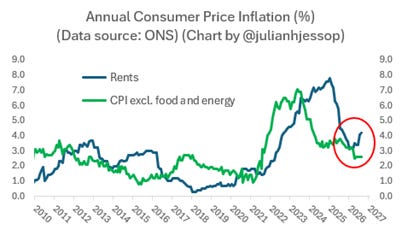
The obvious explanation is the ongoing assault on private landlords, notably via the “Renters’ Rights Act”.
Multiple sources have report additional upward pressure on rents as landlords exit the market. For example, this is from the latest RICS Residential Market Survey…
“the landlord instructions indicator remains in negative territory, registering a net balance of -14% and continuing to point to constrained supply. Short-term rental price expectations increased noticeably in August…”
Or in the words of one disgruntled estate agent…

If your solution is an outright freeze on rents, or even just conventional rent controls, there is overwhelming evidence that these don’t work as intended either. See, for example, this recent report from the IFS.
The only sustainable solution to high rents is to increase supply and reduce costs. This government has been doing the opposite (and the Greens would go even further in the wrong direction).
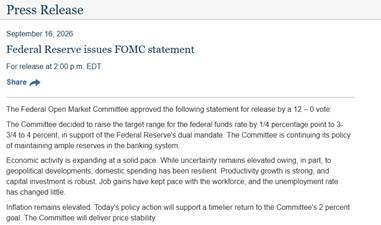
Meanwhile, the Fed raised US interest rates by a quarter point (the vote on the FOMC was a resounding 12-0). Just as with the ECB decision in the previous week, many of the arguments could apply equally to the UK.
Thursday 17 September
A big day. The ONS published its new analysis of the productivity data, as discussed earlier, and the Bank of England’s Monetary Policy Committee held rates, for now.
I had posted a piece earlier in the week arguing that the MPC should raise interest rates and I wrote a follow-up for the Telegraph after the decision reiterating that view.
In a nutshell, a small increase in rates now would have helped to safeguard credibility and reduce the need for larger increases later. There are strong arguments against raising UK interest rates as many as the four or five times that the markets have been pricing in.
But, in my view, these arguments fail to justify the decision not to raise interest rates at all. In particular, consumer price inflation is now expected to exceed 4% in the first quarter of next year, twice the MPC’s 2% target.
inflation has already been above this target for most of the last five years. The argument that policymakers can continue to look past “temporary” shocks is therefore wearing increasingly thin.
Admittedly, the MPC’s choices this week appear to have played well in the bond markets, where the cost of government borrowing fell. This does not scream a loss of credibility.
But most of the action on Thursday was in the longer maturities, reflecting the decision to halt the sales of long-dated gilts, rather than in the shorter maturities which are more sensitive to the outlook for official rates. Expectations for a change in official rates this week were also already low.
Moreover, this other decision carries risks to credibility too. The MPC needs to avoid the impression that it is trying to bail out the government. Bond prices have not become detached from fundamentals and markets are not “disorderly”.
Instead, investors are rightly worried about economic and fiscal policies, and the amount of bond issuance. Equally, the many supply-side problems in the UK economy, notably in the labour, housing and energy markets, cannot be solved by keeping interest rates down.
Governments need to address those concerns first, and central banks should leave them to it.
The bottom line is that the MPC’s primary responsibility is to control inflation. The many poor policy choices made by politicians may make that job harder, but they should not divert attention away from it.
Friday 18 September
August retail sales were more resilient than expected (and suggested by the BRC and CBI surveys), rising by 0.5% in volume terms. On a 3m/3m basis, sales by rose 0.9%, maintaining the upward trend since early 2025.
it will be interesting to see whether this upward trend survives a downturn in real incomes – prices are now almost certainly rising faster than wages, at least in the private sector.
Consumer confidence has also improved, but is that just another temporary “Burnham bounce”? We will find out more about that in the coming week: the S&P Global Consumer Sentiment Index is released on Monday 21 and the more closely watched GfK polls comes out on Friday 24.
And finally…
You can follow me on X (formerly Twitter) @julianhjessop and on Bluesky @julianhjessop.bsky.social.
I also post regularly on Substack

