
The OECD is not really in the forecasting business and its projections are no more interesting than any others. But the consistent policy messages from the OECD and IMF might carry more weight.
Frankly, my advice is to ignore the latest OECD projections – they don’t tell us anything that we don’t already know, and the only forecasts that really matter are the ones that the OBR will produce for next month’s Budget! But I’m often asked to comment, so here are some thoughts…
First, the revisions to the OECD’s forecasts for the UK GDP were trivial.
Projected growth in 2026 was revised up 0.2% to 1.1%, which was just catching up with the stronger than expected start to the year. 2027 was nudged down 0.1% to 1.0%. Taking the two years together, the net change to the forecasts is just a rounding error
Second, this is not a surprise.
The OECD forecasts are rarely far from the consensus, and these are no exception. The new projections are close to the averages in the latest HM Treasury survey of independent UK forecasters. (The HMT survey is published monthly and worth following for more timely updates.)
Third, the UK does not stand out.
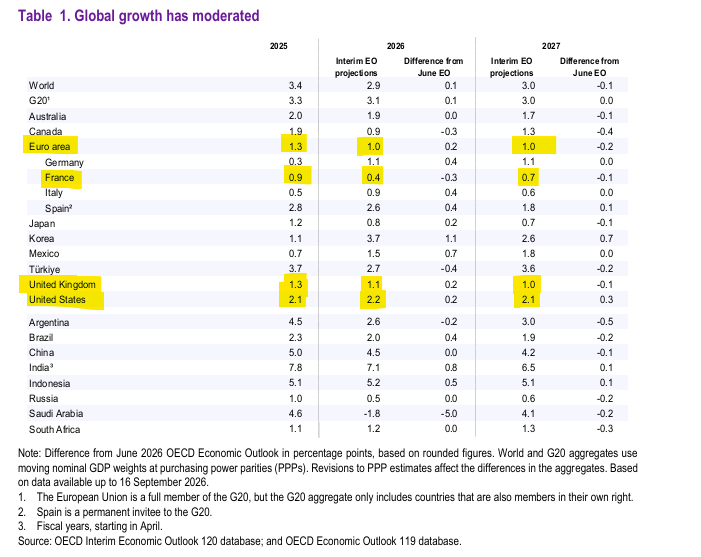
Other countries saw similar revisions, so the big picture is the same. The UK (aka “Brexit Britain”) is still expected to match or outpace growth in the euro area again both this year and next, with France replacing Germany as the problem child. (That must have hurt the Paris-based OECD…)
But Europe as a whole will continue to lag well behind the more dynamic US economy, which rather begs the question of why the UK would want to tie itself more closely again to a failing economic bloc.
Fourth, though, the OECD numbers still look optimistic, especially for UK inflation (3.1% in 2026, 2.6% in 2027), given the more recent surge in global energy prices and other cost pressures.
But this is not unusual either. As an official organisation, the OECD is sort of obliged to assume that the Bank of England eventually hits its 2% target!
I was a bit more interested in the strikingly consistent policy messages from the IMF and OECD today – though again these were nothing that the bond markets are not already screaming.
The IMF’s Managing Director Kristalina Georgieva was quoted by the BBC as saying…
“There are these two things that must be done: bring debt levels down, put fiscal consolidation as a priority, and make sure that the central banks deliver on their mandate for price stability”
(Arguably that’s three things, but I’ll let that go…)
The OECD made the same points, leading with monetary policy…
“Central banks need to ensure that inflation expectations stay well anchored”
“Governments need to double down on efforts to ensure public finance sustainability”
To my mind, this is a clear warning that both fiscal policy and monetary policy may need to be tightened – adding to the downside risks to growth. But we do not need either the IMF or the OECD to tell us that.

