
Mark Carney’s vision for Canada’s future relationship with the EU and Tony Blair’s ambition for the UK to rejoin the bloc are delusional in similar ways. This blog explains why…
Earlier this month, Canadian Prime Minister Mark Carney and European Commission President Ursula von der Leyen made a coordinated push to promote the idea that Canada should become the first “associate member” of the European Union.
Today, the Tony Blair Institute for Global Change (TBI) published a paper called “Beyond Leave and Remain: A Path to Rejoining a Reformed Europe”. In the words of the paper, “Britain must reshape its Europe strategy, aiming to rejoin a reformed EU and enhance collective power through strategic cooperation in tech, energy and defence”.
The two plans are not unrelated. As Tony Blair himself wrote in the forward to the TBI report, “the recent openness of Europe to “associate membership” for Canada shows a newfound flexibility…”.
However, neither plan is remotely convincing.
To be clear, this is not a personal attack on the credibility of either Mark Carney or Tony Blair. But they do both have form here.
Carney consistently made unhelpful interventions in debates about the UK’s relations with the EU. For example, in a FT interview back in 2022 he made the obviously misleading claim that Brexit had shrunk the UK economy from 90% the size of Germany’s to less than 70%. This duff statistic was quickly debunked by every serious economist who looked at it, but not before it was gleefully recycled by all the usual suspects.
As for Tony Blair, he was keen to take the UK into the euro when he was Prime Minister, but we can at least thank the then-Chancellor Gordon Brown for keeping us out.
Let’s start with the Carney / von der Leyen plan.
The first problem is that there is no such thing as “associate membership” of the EU and no-one can satisfactorily explain what it means.
Some Europhiles have suggested that Canada would become “an EU state in all but name”, and that this status could even be extended to Japan and South Korea (as well, of course, as the UK). This is unlikely to appeal to any of these parties, even if it were allowed in the EU Treaties.
Or it could mean nothing at all. Many countries (including the UK) already have bespoke deals with the EU covering trade, or other issues such as security and climate change. But EU officials have always resisted attempts to build formal alliances with non-member states and only offered deals on terms which are far more favourable to the EU.
For example, the EU has been crystal clear that it will resist any form of cherry-picking on access to the Single Market. Only full members of the EU can participate fully.
Switzerland’s deal is perhaps the best example of the sort of selective access that might be on the table, based on a series of bilateral treaties. But it only covers some industrial goods and excludes most agricultural products. Even then, Switzerland has to accept freedom of movement of people and become in, effect, a rule taker.
There are at least three specific problems in Canada’s case.
First, von der Leyen’s offer to Canada is a classic example of overreach which has blindsided other EU leaders. As Reuters reported, one EU diplomat expressed surprise at von der Leyen’s proposal and added there were concerns that the European Commission chief “is overpromising and won’t be able to deliver.”
Second, there are plenty of obstacles to closer economic cooperation on both sides. As Politico reported, “further alignment than currently planned would create new issues around steel, cars, genetically modified crops and other substantive issues, diplomats said…“
Third, relations between the US and Canada are obviously strained right now, but Donald Trump will not be President forever, and trade with the US is (and always will be) far more important to Canada. The table below is from the latest annual report on Canada’s international trade.
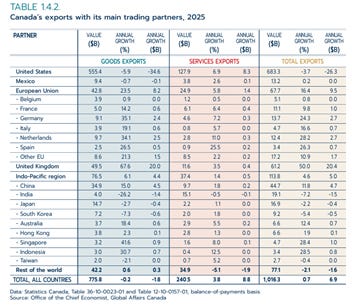
(Note that Canada exported more goods to the UK last year than to the entire EU, but these numbers are heavily distorted by movements of gold.)
Closer alignment with the EU would also undermine other more important relationships, such as Canada’s membership of the CPTPP trading bloc.
As for Tony Blair’s plan, this has already been widely criticised by those who understands how the EU actually works.
To be fair, the report itself says that “Britain shouldn’t rejoin the EU as it is”. But this makes claims that this intervention is a game-changer for the UK’s debate over Brexit look even sillier.
Instead, the report argues that Britain “should rejoin the one that must come next for today’s world: a superpower built through radical reform that can compete with the likes of the US and China”.
Or as Andrew Lilico waggishly posted on X, “So we should rejoin the EU if it agrees to stop being the EU? *That’s* the plan??”.
More seriously, the TBI report shows a fundamental misunderstanding of how the EU works and the potential for a non-member state to influence the direction of travel, even a state on a path to join – or rejoin.
The EU has been failing to reform for the past forty years. Why should the next ten or twenty be any different? Even more closely aligned states like Norway complain about the lack of influence over EU rule-making.
And the precedents are not great. David Cameron failed to get much change out of the EU when he tried to negotiate a better deal ahead of the 2016 Referendum. Blair himself did no better when he was Prime Minister (notably on the Common Agricultural Policy), despite his evident enthusiasm for all things European.
More recently, the EU refused to properly engage with the UK on the terms of Brexit until the last possible moment. The current state of the so-called UK-EU “reset” negotiations is hardly encouraging either.
Indeed, even the TBI report seems unconvinced that real change is deliverable any time soon. It says, “over the next decade, Britain should work towards the ambition of rejoining a significantly reformed EU…”, which is hardly a rousing call to action.
In short, the UK should focus on putting its own house in order. This would include making the most of the new Brexit freedoms to lower barriers to trade with the rest of the world and to improve regulations at home. If the EU chooses to follow suit and copy any of this, all the better.
But it would be naïve to assume that either the UK or Canada would gain more influence or secure a better deal from the EU through some half-baked “associate membership” or a woolly decade-long “ambition” to rejoin.
You can follow me on X (formerly Twitter) @julianhjessop and on Bluesky @julianhjessop.bsky.social.
I also post regularly on Substack

