
Also including thoughts on the latest Budget speculation, paying interest on reserves, the latest from the OECD and IMF, Carney and Blair’s EU fantasies, and what’s really happening to consumer confidence…
Theme of the Week
It’s party conference season, so politicians will not let a mere fiscal crisis disrupt the usual competition to see who can offer the biggest (or worst) tax cut. But some of the recent proposals are better than others.
The Tory plan to restore VAT-free tourist shopping creeps into the ‘good’ category. It is at least a proper evidence-based policy – see this report from the CEBR – which could boost the economy and be self-financing.
(The same point applies to the Tory plan to scrap stamp duty on property, which hopefully will be extended soon to share transactions.)
Then there are the ‘bad’. The LibDems had two here.
The first is another “temporary” 10p reduction in fuel duty. This may well be popular, but it is not clear why people who happen to drive petrol cars, whether rich or poor, should be a priority group for tax cuts.
(Diesel is a separate story and more action may be justified here given the prospect that supply from the US may soon dry up too.)
The LibDems’ second bad idea is a new “Online Crime Levy”. This might raise another £250 million a year by increasing the rate and scope of the existing Digital Services Tax. But the DST is already a bad tax on economic activity, and any further increase is likely to prompt trade retaliation from the US. Simply not worth it.
Then there are the ‘ugly’. The LibDems have offered to “take 2.5 million people out of paying income tax altogether” by raising the tax-free personal allowance to £15,000”. This is also clearly a popular idea and is already Reform party policy.
Labour donor Dale Vince has pushed a big increase in the personal allowance too, even claiming it could deliver “30% GDP growth”. I think he meant it could boost the rate of GDP growth by 30%, say from 1.0% to 1.3%, but who knows (certainly not Dale Vince!).
But again, this is not good economics. Increasing the personal allowance is a relatively costly way to lower the tax burden, with few supply-side benefits, and which helps everyone who pays income tax regardless of need.
It is not obvious anyway that having many more people pay no income tax at all would be a “good thing”, as they would then have less incentive to support policies that are fiscally responsible.
Incidentally, Dale Vince proposed funding the increase in personal allowances by stopping the Bank of England from paying interest on reserves. The financial journalist Paul Lewis has also caught up with the idea, and something similar is already Reform party policy too.
This idea has actually been doing the rounds for many years. Indeed, I’ve also argued that the Bank (and hence the taxpayer) could save some money by introducing some form of tiered interest on reserves.
But the likes of Vince and Lewis are wrong to say that the Bank could save the full amount. The point they and many others are missing is that central banks have to pay some interest on something if they want to influence the cost of borrowing in the rest of the economy. This still happens in the euro area and is only less of an issue for the Swiss National Bank because the policy rate in Switzerland is zero!
Monday 21 September
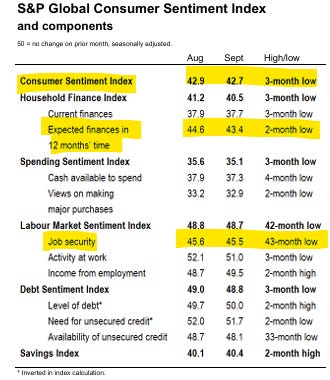
More evidence that any “Burnham bounce” is already fading? S&P Global’s UK Consumer Sentiment Index fell back to a 3-month low in September, with “job security” at a 43-month low. But some other surveys are still more positive – jump ahead to Friday’s commentary for a full rundown.
Tuesday 22 September
More bad news on the public finances: total borrowing was £8.1bn above the OBR forecast in the year to August, with a £4.8bn overshoot on the current budget (the targeted measure, covering borrowing to fund day-to-day spending).
In August itself, borrowing was £3.5bn above forecast, partly reflecting the higher cost of government borrowing (including the direct impact of higher inflation on the cost of index-linked debt).
Needless to say, this backdrop makes it even more important that John Healey delivers a credible Budget. This means he needs to ignore the calls for damaging tax increases and reassure the markets that he is serious about controlling spending. Vague promises are not enough…
Talking of a lack of credibility, the LibDems are claiming that the cost of their plan to increase personal allowances would be more than covered by a fantastical new “Growth and Defence Partnership with the EU” which “will secure a growth dividend worth £27bn a year”.
This plan involves rejoining the Single Market and forming a new UK-EU Customs Union, giving up all the Brexit freedoms. The £27bn figure is a new one on me, but it is at least far lower than the £90bn (+/-) in “lost tax revenues” that LibDem MPs usually parrot.
However, it still does not appear to take any account of the additional fiscal costs of the new “Partnership”, including increased contributions to the EU budget, which could easily wipe out any fiscal benefits.
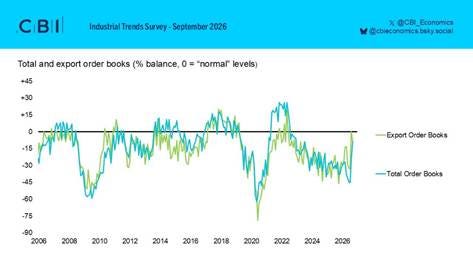
There was some better news from the manufacturing sector. The CBI’s latest Industrial Trends Survey showed a further improvement in order books in September, though this is perhaps best described as “stabilisation” rather than any sort of bounce.
Wednesday 23 September
I went on Times Radio to discuss the latest OECD forecasts and comments from the IMF. Frankly, my advice is just to ignore them since they are not telling us anything we did not already know. But as many ask I did manage to spin out a separate blog.
In short, the OECD is not really in the forecasting business, and its projections are no more interesting than any others. However, the consistent policy messages from the OECD and IMF might carry more weight.
The IMF’s Managing Director Kristalina Georgieva was quoted by the BBC as saying…
“There are these two things that must be done: bring debt levels down, put fiscal consolidation as a priority, and make sure that the central banks deliver on their mandate for price stability”
(Arguably that’s three things, but I’ll let that go…)
The OECD made the same points, leading with monetary policy…
“Central banks need to ensure that inflation expectations stay well anchored”
“Governments need to double down on efforts to ensure public finance sustainability”
To my mind, this is a clear warning that both fiscal policy and monetary policy may need to be tightened – adding to the downside risks to growth.
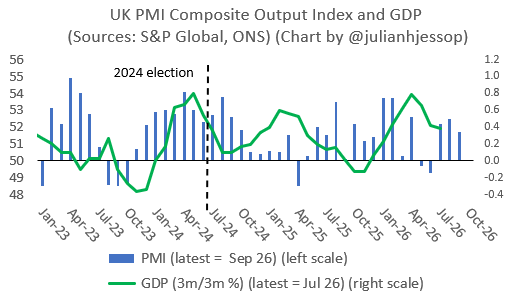
Meanwhile, the UK PMI Composite Output Index edged down to a 3-month low of 51.7 in September. As the chart below shows, this is still consistent with decent GDP grow, but the headwinds are building, including a renewed pick up in price pressures; inflation, taxes and interest rates all look set to rise this autumn.
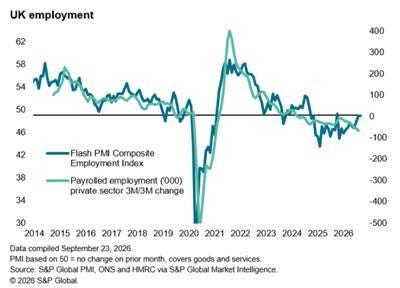
One glimmer of hope is that the employment component of the PMI is still consistent with a stabilisation of private sector payrolls, ending the run of falls since Labour ramped up employment costs in Reeves’ first Budget in autumn 2024. But there was still no sign of this in the HMRC data for last month.
Thursday 24 September
The Financial Times reported that John Healey is considering allowing the fiscal headroom to shrink to avoid the need for bigger tax increases. I had three thoughts on this.
First, annoyance that the Treasury is flying kites again. Pre-Budget speculation is rarely helpful, even if it may sometimes be useful (as here?) to gauge potential market reaction.
Second, though, the investor responses gathered by FT suggest this idea is at least worth considering. A temporary reduction in the fiscal headroom could avoid further growth-damaging tax rises to close an arbitrary gap caused by what may be a temporary shock. After all, what is an emergency buffer for if it is never used?
But third and finally, it could also send a damaging signal about Healey’s and Burnham’s commitment to fiscal discipline at a time when markets are already on edge. The increased fiscal headroom of around £24bn that Healey inherited from Reeves is still relatively small by past standards.
To maintain credibility, investors would then demand stronger reassurance about the longer-term fiscal plans – something this government has yet to show it can deliver.
Meanwhile, the Tony Blair Institute (TBI) hit the headlines with the least convincing appeal to rejoin the EU, ever.
In the words of the report “over the next decade, Britain should work towards the ambition of rejoining a significantly reformed EU…”, which is hardly a rousing call to action.
This was my cue for another blog, which also took a pop at Mark Carney’s equally fantastical ideas for a new Canada-EU partnership.
Indeed, even the TBI report said that “Britain shouldn’t rejoin the EU as it is”. Instead, it argued that Britain “should rejoin the one that must come next for today’s world: a superpower built through radical reform that can compete with the likes of the US and China”.
Or as Andrew Lilico waggishly posted on X, “So we should rejoin the EU if it agrees to stop being the EU? *That’s* the plan??”.
Friday 25 September
The further improvement in the GfK measure of UK consumer confidence in September prompted me to do a quick trawl through all the leading surveys (shout if you think I’ve missed any!).
🙂 GfK: 2-year high in September
😐 S&P Global: 3-month low in September, with job security at a 43-month low
☹️ BRC-Opinium: expectations down sharply in September
🙂 YouGov/Cebr: up in August, still waiting for September
🙂 PWC (quarterly): 5-year high in August, but report emphasises that “consumer cheer [is] expected to fade fast”
In summary, there are mixed signals on the current strength of consumer confidence, but also a consensus that any improvement is set to fade as inflation (especially energy and food bills), borrowing costs and (probably) taxes all rise.
And finally…
You can follow me on X (formerly Twitter) @julianhjessop and on Bluesky @julianhjessop.bsky.social.

