
A large increase in the personal allowance would not be a good way to cut taxes, whether the goal is to boost economic growth or to help the poor, and regardless of how it would be financed.
There is now remarkably broad support for a large rise in the standard Personal Allowance (PA), which is the amount of income on which you do not have to pay tax. The PA has been frozen at £12,570 since 2021. Reform UK, the LibDems and prominent Labour supporters, notably Dale Vince, have all proposed a big increase.
I’ll focus on the Vince plan, which is summarised here…
“Let’s restore the personal income tax allowance, almost completely, we’ve modelled the sweet spot for maximum benefit to those in the lowest 20% income bracket – that’s a £3k a year rise, putting £600 a year back into the pockets of hard working families.
That creates significant growth, as well as tackling the cost of living crisis for millions of people – brings fairness into the tax system and results in a near half billion annual reduction in ‘in work benefits’.
The cost is £20 Billion a year – and it can be paid for by ending the payment of interest to banks for their deposits held with the Bank of England. This could save us £30 Billion a year.”
This is a lot to unpack. Vince is proposing a roughly £3,000 rise in the PA, to £15,750, which would restore about three-quarters of the fall in its real value since 2021.
This recommendation is said to be based on modelling by economists at NIESR, which suggested that “raising the PA by 20% can maximise the benefits to the bottom 20%, while minimising the costs”. Moreover, the NIESR report suggested that this tax cut could increase real GDP by 0.3% in the first year.
This figure seems to be the origin of Vince’s bizarre but often repeated claim that his proposal could deliver “30% GDP growth”.
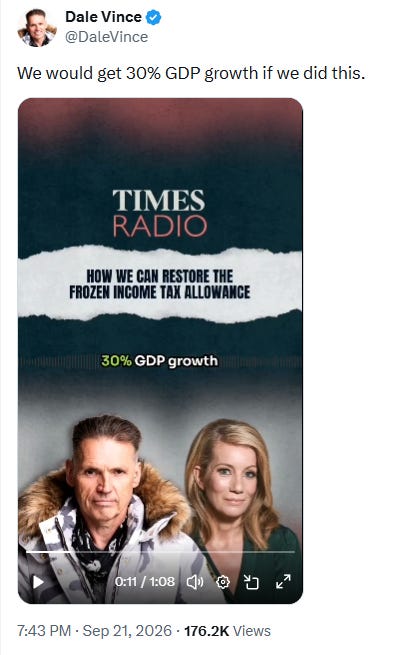
Whenever challenged, Vince says something to the effect of “well, duh, obviously I meant to say 30% more GDP growth”. An increase in growth from, say, 1.0% to 1.3% could indeed be described as a 30% boost, though of course most people wouldn’t see it that way! Moving quickly on…
Is the NIESR work reliable? Absolutely – as far as it goes. The NIESR team are serious economists and have used a proper economic model to run the numbers.
For what it’s worth, my own back-of-the-envelope workings can also produce a 0.3% increase in GDP. Using the standard HMRC ready reckoners, increasing the PA by 20% might indeed cost the government around £20 billion, or about 0.6% of GDP.
Apply the standard OBR fiscal multiplier for a tax cut (0.33 in the first year) might then give a 0.2% boost to the level of GDP. For a tax cut targeted at poorer households with a higher marginal propensity to consume, let’s be generous and say 0.3%.
So far, so good. But this is where it starts to unravel. There are three key points.
1. Any boost to GDP would only be temporary
First, as the NIESR report itself makes clear, the 0.3% boost to real GDP is only the first year impact. Over time, the impact would be expected to fade for all the usual reasons, including higher inflation, higher interest rates and the crowding out of private investment.
2. The government doesn’t have a spare £20 billion
Second, where would the money come from to fund a £20 billion tax cut? The answer is particularly important now given the dire state of the public finances. A bad answer could drive up the cost of government borrowing even further, wiping out any boost to GDP straightaway.
The first press reports suggested that Vince was proposing to find the money by increasing capital gains tax. This never made sense, as hiking CGT (without any other reforms) would actually cost the Exchequer money.
Instead, “Team Dale” suggests that the cost could be more than covered by “ending the payment of interest to banks for their deposits held with the Bank of England” which “could save us £30 billion a year.”
This idea has been doing the rounds for many years. I wrote a piece in The Telegraph about this back in 2022. In short, the Bank, and hence the taxpayer, could save some money by introducing some form of tiered interest on reserves.
But Vince is wrong to suggest the saving could be anywhere near as much as £30 billion. He’s not alone here. The perennially confused Labour peer Prem Sikka has jumped on this bandwagon in another error-strewn piece for Left Foot Forward. So has the financial journalist Paul Lewis, who also doesn’t seem to understand how banking works. Let me have a go…
Even at face value, this £30 billion figure is too high. This is mainly because it does not take account of the normalisation of the Bank of England’s balance sheet, which has reduced the stock of reserves on which interest is paid.
The amount of the saving would also depend on the overall level of interest rates, making it an unreliable way to finance a permanent tax cut.
Last but not least, Vince, Sikka and Lewis all appear unaware that central banks must pay some interest on something if they want to influence the cost of borrowing in the rest of the economy. This still happens in the euro area and it is only less of an issue for the Swiss National Bank because the policy rate in Switzerland is zero!
The LibDem answer to the question of where the money will come from is even more fanciful. They claim that the cost of their plan to increase personal allowances would be more than covered by a fantastical new “Growth and Defence Partnership with the EU” which “will secure a growth dividend worth £27 billion a year” – another figure seemingly plucked out of thin air.
3. Raising personal allowance would be the wrong tax cut anyway
The third point is potentially the most important: regardless of how it is financed, a large increase in the personal allowance would not be a good way to cut taxes, whether the goal is to boost growth or to help the poor
Of course, every tax cut has the potential to provide a short-term boost to growth. You could plug almost any fiscal stimulus into NIESR’s model and get a positive result, at least in year one. But there are many alternatives that could provide a bigger and more sustainable boost to growth than raising personal allowances, mainly because they would increase potential output as well as add to demand.
Dan Neidle has a great list here, and it is easy to think of others.
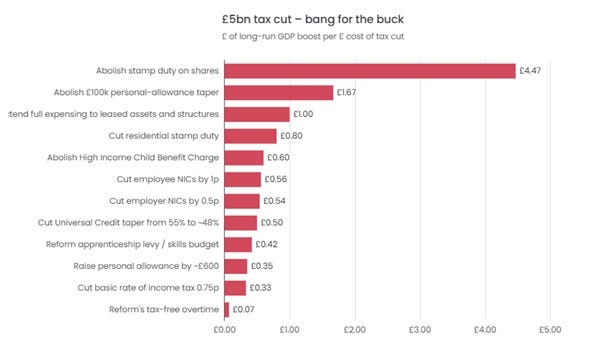
Most damning of all, increasing the personal allowance is not even a good way to target support on those on lower income.
As the IFS has explained,
“It is often assumed that increasing the personal allowance would be a progressive measure – in other words, that it would provide the greatest benefit (as a share of income) to poorer households. That is not the case. Instead, the distributional impact of increasing the personal allowance is broadly ‘n-shaped’, providing the greatest benefit (relative to household income) to upper-middle-income households while providing the smallest benefits to the poorest and richest households.”
If you want to help the poor, it would be far better to reform the tax and benefit system to tackle punitive marginal rates and disincentives to work, or reverse some of increases in the burden on employers which have cost so many jobs. Or you could even lower the personal allowance and cut the basic rate of income tax instead.
Anything, really, rather than what Dale Vince, Reform and the LibDems are all proposing.
You can follow me on X (formerly Twitter) @julianhjessop and on Bluesky @julianhjessop.bsky.social.

