
Reopening the Brexit debate is likely to prove toxic for Labour, while reviving uncertainty about Britain’s future relationship with the EU could undermine investment again – notably in the tech sector.
Andy Burnham’s comments on Brexit in his conference speech on Tuesday have at least been welcomed by those who want the UK to rejoin the EU. But he may soon come to regret them.
In short, the PM talked of the need to give Britain a “clear path” and to “restore a higher level of growth and prosperity”. He said he will use the upcoming UK-EU summit to “lay out to the country what I believe the different options are for Britain’s long-term relationship with our European partners”.
But if there were still any doubt about the direction he prefers, Burnham claimed that “Brexit has done more harm than good”.
And in a BBC interview on Wednesday he suggested there are three options: form a new customs union with the EU, rejoin the Single Market, or go all the way and become a full member of the EU again.
A fourth option – stay out and make the most of the Brexit freedoms – was conspicuously absent.
This is quite a U-turn. As recently as May, Burnham had promised not to re-run Brexit arguments – doubtless nervous of the fact that Makerfield voted ‘leave’.
Moreover, Labour’s 2024 manifesto stated, “With Labour, Britain will stay outside of the EU” and “There will be no return to the single market, the customs union, or freedom of movement.”
Of course, Burnham would be well within his rights to propose something different in the manifesto for the next General Election and try to win a new mandate for the next Parliament. But this path is still full of political and economic obstacles.
For a start, the more serious polling shows that any public support for rejoining the EU is weak and shallow.
Poll after poll has demonstrated that only a small minority of voters see reversing Brexit as a priority, and any enthusiasm for the EU falls away whenever the costs and conditions are presented.
Here are just a couple of recent examples (if you don’t like these, I have many others…).
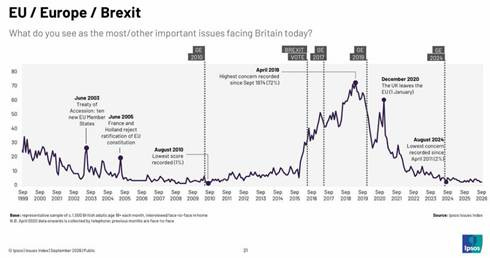
First, the latest Ipsos poll of 1,003 people found just 16 (less than 2%) who thought the “EU / Europe / Brexit” was an important issue facing the UK, and only four who thought it was the top priority! Almost everyone else has moved on.
Second, even recent polling for the pro-EU lobby group Best for Britain found that, when presented with a full range of options, just 35% of respondents supported full EU membership. In contrast, a total of 48% supported options that do not involve rejoining the EU. Excluding ‘don’t knows’, that’s 58% for ‘stay out’ and just 42% for ‘back in’!
Indeed, there is still substantial opposition to closer EU ties within the Labour movement itself.
The leader of the Unite trade union, Sharon Graham, has warned that campaigning to rejoin the EU “won’t go down well” for Labour. She noted that many aspects of the new government’s policy platform “like making sure we buy British, for example” will be much harder, if not impossible, if the UK realigns fully with EU rules.
There is a broader economic problem, too. Just like the general public, most businesses have also moved on. Again, here are just two examples…
First, speaking to the FT on the tenth anniversary of the 2016 referendum, CBI director-general Rain Newton-Smith stressed that businesses are focused on the future and do not want a rerun of the Brexit referendum.
Second, having initially been wary of Brexit, the City has swung in favour. This FT headline (from January) says it all.

The Starmer government agreed that financial services should be exclude from the so-called UK-EU ‘reset’, but good luck protecting the City if Burnham now wants to go further…
Finally, reopening the Brexit debate is likely to have real economic costs.
The initial uncertainty after the vote to leave, compounded by the unnecessarily prolonged exit negotiations, was a key factor explaining why UK business investment stalled after 2016. But since the UK has finally left the EU and Brexit-related uncertainty has faded away, business investment is recovering strongly.
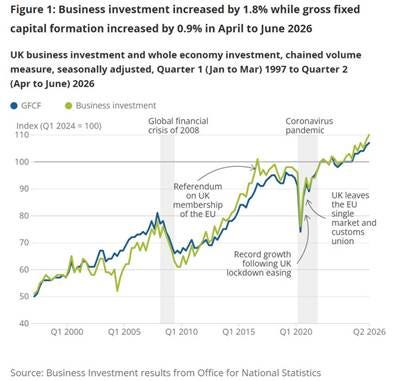
But this recovery is clearly at risk if Burnham is foolish enough to start the process all over again The tech sector is one of several that look particularly vulnerable to an increase in uncertainty, given fears that tighter EU rules will hold back investment in AI.
The UK will also now look like even more of a supplicant in the upcoming ‘reset’ negotiations, and the EU is sure to take full advantage. Bandwidth that might be spent, say, reforming welfare spending or kick-starting supply-side reforms, will be wasted instead in endless refighting of the Brexit battles.
In the meantime, ‘Brexit Britain’ is powering ahead. The UK economy outpaced the other major (G7) economies of Europe in the first half of 2026, as it did in the whole of 2025 and is expected to do so again next year as well. Productivity is picking up strongly too.
Why on earth would Burnham want to put all that at risk by realigning the UK with a failing bloc, while blowing a lot of his political capital along the way?
You can follow me on X (formerly Twitter) @julianhjessop and on Bluesky @julianhjessop.bsky.social.

