
A well-deserved defeat for Donald Trump and more dither and delay from Andy Burnham. At least the BoE delivered a decisive rate hike – the first of ‘two and done’? – and it was right to do so.
Theme of the Week
Global attention turned to the aftermath of the US mid-term elections, where Trump’s Republicans did even worse than expected and were splendidly thumped.
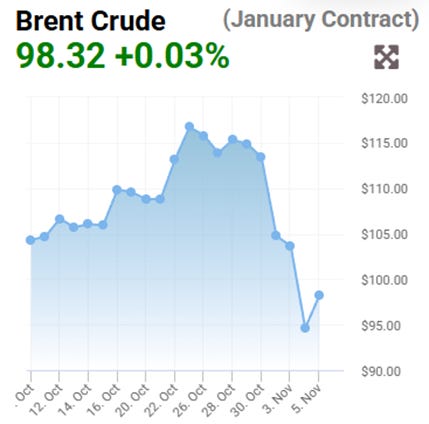
The other surprise was that the President failed to dispute the results, despite fears that that he might encourage civil unrest if the polls went against him. His apparent recognition of the inflationary impact of the Iran war also dragged crude oil prices sharply lower, though a barrel of Brent still costs nearly $100.
However, the attention soon moved on to the tech sector. The Democrats have exploited the antipathy towards AI in all its manifestations – tech billionaires, more data centres, and potential job losses – and this provided the trigger for a correction in the tech stocks. This correction might only be temporary, but it was surely overdue.
By the weekend, political jitters had also returned with the news that the President has appointed the controversial hardliner Stephen Miller as his new Chief of Staff. Hopes of a calmer second half to Trump’s second term appear to have been dashed.
Amd just to add to the drama, Trump has apparently approached mixed martial arts promoter Dana White (“a violent Fighter”) to be his new White House press secretary…
Back in the UK, the latest signs surrounding Burnham’s much-trailed ‘10 Year Plan’ were equally discouraging. Press reports (including this one in the FT) suggest it has been downgraded to little more than a “high-level overview”. That might still be enough for a pre-election pitch, but it has done nothing to dispel the impression of dithering, delay, and indecision.
Monday 2 November
Pensions minister Torsten Bell trumpeted a story in the Times headlined ‘Private sector staff to get right to a pension income for life’. Bell himself went for “We are going to resurrect genuine pensions for millions of private sector workers”.
Like many others, I initially struggled to understand what this all meant. Indeed, Bell is still having to clarify as I write this – on Saturday!
The answer turned out to be… ‘not a lot’. The official government announcement confirmed that this is simply about guiding members of private sector pension schemes towards a default option that aims to deliver a steady income in retirement. Crucially, they would still be free to do something else with their money.
Unfortunately, Bell oversold what could just be a gentle nudge. For a start, he implied that this change alone would close the gap between pensions in the private and the public sectors. This is misleading, not least because members of private schemes already have plenty of options that would deliver a steady income in retirement, including taking out an annuity.
He also implied that this change would ‘guarantee’ higher pensions for life. Again, this is misleading. It did not help that the new default option seemed to be bundled with the idea of promoting ‘Collective Defined Contribution’ (CDC) schemes, which pool contributions from members and employers to invest in riskier assets potentially delivering higher returns.
While a CDC scheme might aim to produce a target income for life, it cannot ‘guarantee’ a particular level of benefit (unlike the public sector schemes), or that this income would be higher than just buying a conventional annuity. Indeed, the income could still go down (as well as up).
In summary, if a headline sounds too good to be true, it probably is…
Tuesday 3 November
According to the Economist’s Hugo Gye. updated Treasury analysis will say that the proposed UK-EU ‘reset’ could boost the UK economy by ‘0.4%’. Andy Burnham apparently described this “a number that you cannot ignore”.
I’m looking forward to seeing the workings. But in the meantime, a long-term boost of just 0.4% seems an awfully small return for all the political capital that the Prime Minister will have to spend to get this deal over the line.
Moreover, I bet that the 0.4% doesn’t even begin to take proper account of all the economic costs involved, let alone the loss of sovereignty.
Watch this space…
Wednesday 4 November
I was one of the six members of CityAM’s Shadow Monetary Policy Committee who voted to raise rates by a quarter point, to 4%. The other three preferred to leave rates on hold. You can read the arguments on both sides here.
In a nutshell, my view was ‘if not now, then when?’. Inflation has been above the 2% target for most of the last five years and is heading for at least 4% in the New Year. The argument that policymakers should look past ‘temporary shocks’ is surely worn out by now.
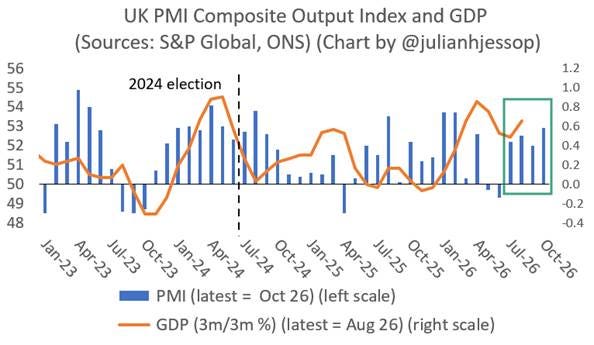
The final UK Composite PMI for October (covering manufacturing and services) provided more ammunition to support a rate hike: the output index was the strongest since February, the employment component turned positive for the first time since hiring was hit by Rachel Reeves’ first Budget, and input cost inflation accelerated again
Thursday 5 November
In the event, the real MPC also voted to hike rates by a quarter point, to 4%. But the 8-1 split was surprisingly hawkish, especially as the sole dissenter (Catherine Mann) preferred a larger increase, to 4.25%. I wrote a detailed response which backed the decision to raise rates.
This proved controversial. Many people have asked (quite reasonably) why it is appropriate to raise interest rates in response to a supply shock which has driven up the price of energy.
In short, nobody is suggesting that higher UK interest rates will have any impact on global commodity prices. But they could help to prevent an energy-led jump in headline inflation from becoming embedded in the economy, especially when underlying cost and price pressures are strong too.
This is about minimising the ‘second-round effects’, notably via inflation expectations and wages. If people expect inflation to be higher for longer, these expectations become self-fulfilling.
What’s more, even if the inflation pressures come from a shock to supply, it may still be necessary to dampen demand in order to bring the two back into balance. The risks of second-round effects are much the same.
The alternative runs the risk that inflation will stay high, eventually forcing the Bank to raise rates by more than it would otherwise have done, and leaving people far worse off.
And central to all of this, the Bank needs to protect credibility. Like it or not, the MPC’s job is to hit its 2% inflation target. It must therefore avoid the perception that it is prioritising growth, or bailing out the government.
In particular, monetary policy should not be constrained by the poor state of the public finances (aka ‘fiscal dominance’), or by the failure of successive governments to raise the productive potential of the economy.
This won’t convince everybody. If you want more, I suggest you read the arguments made by all nine members of the MPC and especially those of the traditional ‘doves’, Swati Dhingra and Alan Taylor. Both accepted the case for an ‘insurance hike’ given the risks to both inflation and credibility.
But both also stressed, in different ways, that this is not necessarily the start of a ‘hiking cycle’. I agree on both points. With a bit of luck, especially on energy prices, this could be a case of ‘two and done’, where rates rise just once more.
Nonetheless, the announcement prompted the usual lazy headlines about ‘mortgage misery for millions’.
In reality, the vast majority of residential mortgages (nearly 9 in 10) are now on fixed-rate deals. The costs of these depend on market expectations for the future path of interest rates (as reflected in ‘swap rates’) over the life of the fix.
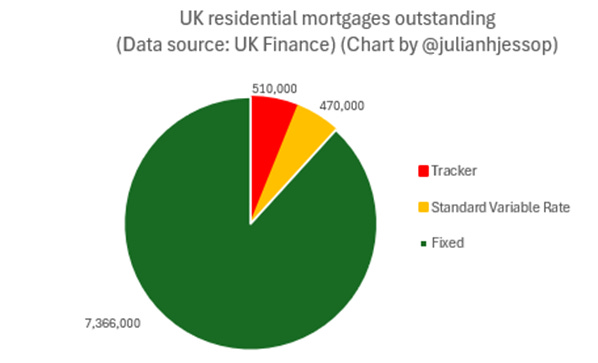
Crucially, these fixed rates have already risen sharply as the markets have priced in as many as four increases in official rates over the next 12 months.
If policymakers can persuade the markets that rates will not have to rise this far to get inflation back down, the cost of fixed-rate deals should actually fall, regardless of what happens to the Bank rate in the meantime.
There is one important caveat. The UK Finance analysis also shows that around 2.3 million fixed-rate deals will expire across 2027. Many of these will still have to be refinanced at higher rates than the expiring deal, even if rates fall from here.
But any suggestions that just one (or even two) quarter-point hikes will ‘wreck household finances’ or ‘cripple the housing market’ will hopefully be well wide of the mark.
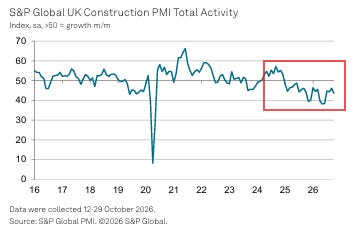
In the meantime, though, there are still few signs of life in the construction sector, where the S&P Global UK Construction PMI fell back again. As I have argued before, construction activity is a good bellwether of the success or (in this case) failure of Labour’s policies, as it covers the priority areas of housebuilding, infrastructure, and commercial investment.
Friday 6 November
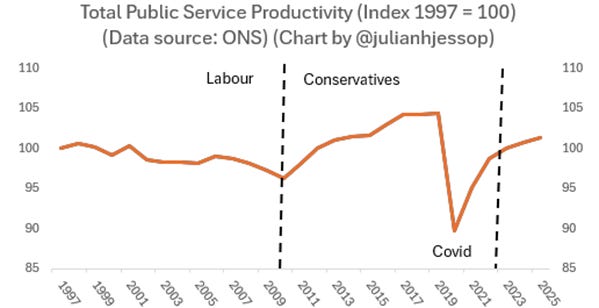
The latest estimates from the ONS underlined the long-term productivity crisis in public services. Total public service productivity (TPSP) grew by just 0.3% in the year to June, which was slower than the annual averages of 0.5% in 2025 and 0.7% in 2024.
Moreover, TPSP was still 2.9% lower in 2025 than the pre-Covid level in 2019, as the pandemic snuffed out the improving trend that had begun under the Tories in the early 2010s.
And finally…
Sometimes the consensus is right, after all.

You can also follow me on X (formerly Twitter) @julianhjessop and on Bluesky @julianhjessop.bsky.social.

