
Even the dodgy official estimates suggest that the proposed UK-EU ‘reset’ would boost the UK economy by no more than 0.4% in the long run. Rarely has so much been given away in return for so little.
Next Friday (20 November) brings a crucial summit aimed at approving a ‘reset’ of Britain’s relationship with the European Union. The process had appeared to be fairly innocuous, but no longer.
The terms of the existing Brexit deal – the – already provided for a review five years after it came into force in 2021. Even if the Conservatives were still in power, UK ministers would be sitting around a table with their EU counterparts around now.
Moreover, Labour’s 2024 manifesto promised to “deepen ties with our European friends”. There were specific references to “tearing down unnecessary barriers to trade” and to “an ambitious new UK-EU security pact”.
This provides the Labour government with at least a basic mandate to explore the options.
But the terms of engagement have changed. Andy Burnham has signalled his desire to go much further and to reverse Brexit more or less completely.
The Prime Minister has said he will use the UK-EU summit to “lay out to the country what I believe the different options are for Britain’s long-term relationship with our European partners”.
He has suggested there are essentially three options: form a new customs union, join the Single Market, or go all the way and become a full member of the EU again. Any of these options would cross the 2024 manifesto’s red lines.
Indeed, he has already stepped over one of them. The manifesto said that resetting the relationship would “not mean reopening the divisions of the past”. That all seems to be for the birds now. In the meantime, the EU is seizing the opportunity to wring out every possible concession.
This is proving to be politically toxic, even within Labour itself. The support of the wider electorate cannot be taken for granted either.
The campaign group Britain Unbound (on whose Advisory Council I sit) recently released new polling of voters in the Prime Minister’s Makerfield constituency.
The survey asked who should decide UK economic policy on ten different issues, ranging from medicine approval to state aid. In every case, a clear majority said policy should be decided by UK governments alone.
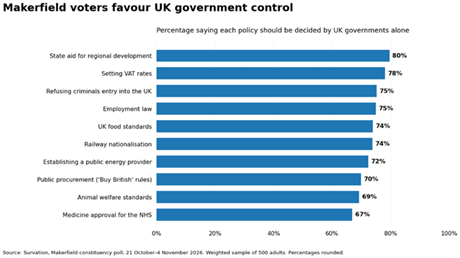
However, all the issues polled would in future be decided, wholly or in part, by the European Union if Britain were to rejoin the EU or the Single Market, or even if the UK simply agreed to ‘dynamically align’ with EU rules.
There are already some glaring inconsistencies in the Prime Minister’s position. For example, the government has rejected the idea of dynamic alignment for financial services and apparently now for AI too.
But if regulatory independence is right for the City and for the tech sector, why not the rest of the economy? And surely this stance is incompatible with rejoining the Single Market, let alone the whole EU?
The inevitable political fallout will have real economic costs as well. Business investment initially stalled after the 2016 referendum, but it has since rebounded as Brexit uncertainty has cleared. That recovery is now at risk.
In the meantime, huge amounts of political capital and energy will be diverted from tackling the UK’s real economic problems – and for what?
Even the dodgy official estimates suggest that the ‘reset’ would boost the UK economy by no more than 0.4% in the long run. Rarely has so much been given away in return for so little.
Almost every aspect of the ‘reset’ stinks, but here are just three.
First, the proposed agri-food deal will require the UK government to apply the relevant EU rules to the entire British economy, with all the associated costs, whether businesses trade with the EU or not.
For context, 74% of the voters polled in Makerfield said that UK food standards should be decided by the UK government alone.
This concession is supposed to be a price worth paying to boost food exports. But the UK has never been a major food exporter and never will be.
It is also not obvious how exporting more food to the EU is supposed to lower the cost of living at home. The UK can already reduce barriers to allow cheaper imports both from the EU and, thanks to Brexit, from the rest of the world.
Second, the proposed ‘youth mobility scheme’ is likely to be biased in favour of the EU. The number of young EU people coming to work or study in the UK will surely exceed the number of young UK people heading in the other direction, as it did before Brexit. UK universities will lose out too if fees for EU students are slashed.
Third, the UK is proposing to link with the EU’s emissions trading systems and participate in the EU’s single electricity market. Taken together, this is likely to increase the cost of energy.
Perhaps most galling of all, the EU is insisting that Britain should provide aid to poorer EU countries as part of the energy deal. Imagine how Canada would respond if asked to fund development projects in Mississippi in return for the right to trade just a little more energy with the United States.
In short, the UK-EU ‘reset’ will be both politically and economically toxic. The British government must therefore be willing to walk away from a very bad deal.
Looking further ahead, it must keep another option open: remaining outside the EU and all its works, while making much more of the Brexit freedoms instead.
This piece was first published by the Daily Telegraph on 13 November 2026

