
The surprising resilience of the UK economy is despite rather than because of anything the government has done. Plus thoughts on housing ‘wealth effects’, the latest Brexit polls, and the UK-EU reset.
Theme of the Week
Most commentators – myself among them – have been pleasantly surprised by the resilience of the UK economy in the face of the global shocks and domestic headwinds.
The latest official data, released on Thursday, showed that the economy grew by 0.7% in the third quarter, following growth of 0.5% in the second, with GDP now 1.9% higher than the same quarter a year ago.
Moreover, GDP per head is also estimated to have increased by 0.7% in Q3, and by 1.7% on a year earlier.
Labour cheerleaders in the media and ministers past and present – including Rachel Reeves – can therefore be forgiven a moment of triumph.
However, this resilience is despite rather than because of anything the government has done. When Labour folks try to claim credit for the UK economy’s not-as-bad-as-feared growth this year, can I suggest you ask them in what specific ways their policies have contributed?
The only one I could think of was Rachel Reeves’ decision to increase the fiscal headroom, which probably limited the upside for gilt yields and gave John Healey some welcome breathing space in last month’s Budget. But that was at the cost of the big increases in employers’ NI that are still being felt in the labour market today. And of course, the cost of UK government borrowing is still relatively high.
The GDP numbers were not all good, either. The persistent weakens of the construction sector (where output fell by another 0.7% in Q3) underlines the failure of Labour’s flagship policy to boost housebuilding.
The government’s clumsy interventions are also continuing to add to labour and housing costs, including rents (see the RICS survey, discussed further below).
Instead, the key driver of growth and business optimism has been the rollout of AI. This is an area that the government has not got round to messing up, though that may yet change (with a helping hand from the EU). In the meantime, the government is still borrowing more than expected and the private sector had shed a large number of jobs.
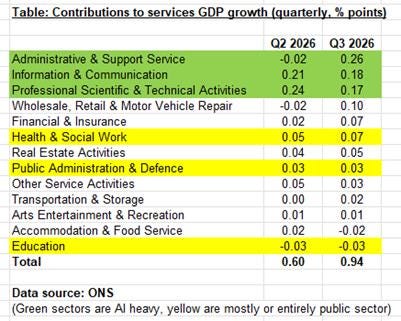
There is also a debate to be had about the extent to which the GDP numbers are being flattered by the surge in public spending. That is not a significant factor in the recent numbers, where growth has been led by private services.
My table below breaks down the increases in services output over the last two quarters. As you can see, this was led by AI-heavy activities in the private sector, rather than by those undertaken mostly or wholly in the public sector.
Nonetheless, if we step back a bit, GDP growth has been propped up by the public sector for many years – and especially since 2022. (The chart below was inspired by a point made by Simon French, Chief Economist at Panmure Liberum.)
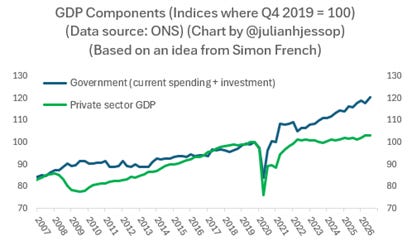
This is unhealthy and unsustainable. And it should be discouraging too for a government that promises good growth “in every post code”, not just in its own backyard.
Monday 9 November
The new cross-party campaign group Britain Unbound (on whose Advisory Council I sit) published some exclusive polling of the residents of Andy Burnham’s constituency in Makerfield.
The poll asked voters who should decide UK economic policy on ten different issues. In every case, a clear majority said policy should be decided by UK governments alone, with a range between 67% (medicine approval for the NHS) and 80% (state aid for regional development).
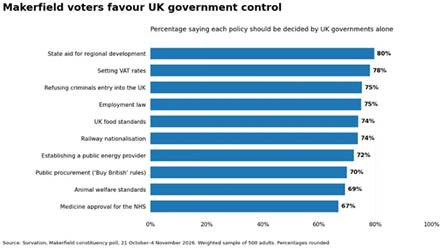
To my eye, this illustrates the political risks facing the Prime Minister as he tries to move the UK closer to the EU. All the issues polled would in future be decided, wholly or in part, by Brussels if Britain were to rejoin the EU or the Single Market, or even if the UK simply agreed to accept EU rules in these specific areas.
But back to economics…
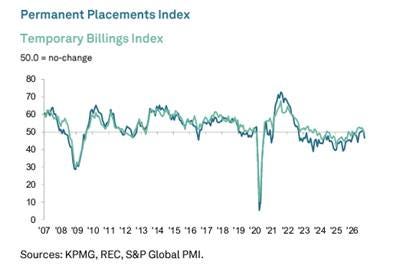
The latest KPMG and REC UK Report on Jobs suggested that economic uncertainty and rising costs hit recruitment again in October, after several months where the labour market appeared to be stabilising. It is too soon to panic – the trend still seems to be upwards – but this is definitely one to watch.
Tuesday 10 November
More signs of a poor start to the fourth quarter. The Brtiish Retail Consortium (BRC) survey suggested that retail spending also stalled in October. This isn’t surprising given the slump in consumer confidence last month. Since then, pre-Budget jitters should have eased. But worries about inflation and interest rates will surely persist.
David Smith had another thought-provoking column in The Times, this one looking at the risks to consumer spending from falling house prices.
For what it’s worth, though, I think the ‘wealth effects’ from changes in house prices are often exaggerated. The key point is that houses are different from financial assets, such as shares, because people also pay to live in them.
Some people will gain when house prices rise, typically older homeowners planning to downsize to a smaller property, or access the equity in their home.
But many others may feel worse off, including younger families hoping to trade up and those not yet on the housing ladder. High house prices are clearly not good for spending if potential first-time buyers have to save even more for a deposit.
The upshot is that it makes just as much sense to view a rise or fall in house prices as something that mainly redistributes wealth, rather than creates or destroys it.
Of course, falling house prices may be correlated with falling confidence and spending, but (as any student of economics should know!) that doesn’t prove causation.
House prices are falling because of wider economic uncertainty, rising interest rates, job insecurity, and so on. Crucially, these factors are all negative for spending in any case, even if they did not impact house prices and housing market activity too.
Wednesday 11 November
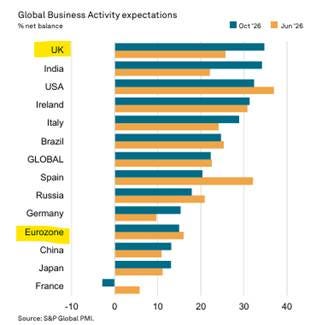
Some better news from the latest S&P Global Business Outlook surveys. The UK has regained top place, helped by optimism about AI rollout and the impact on productivity. In contrast, the euro area has fallen further behind ‘Brexit Britain’, with Spain and (especially) France hit hard this quarter by political and economic uncertainty.
Thursday 12 November
The day’s highlight was the GDP data, covered earlier.
I’d just add here the new data also supports the point that the OBR’s Budget forecast of 1.2% growth in 2026 is far too low. A full-year figure of around 1.6% now looks nailed on.
But the fact that growth has been stronger than the OBR assumed is not necessarily good news for the public finances. Remember, the government still borrowed more than expected even though growth was better than expected too.
Less positively, the latest RICS Residential Survey suggested that housing market is activity is set to remain weak as interest rate uncertainty drags on demand. Moreover, rental inflation still accelerating as government policies continue to target private landlords. As RICS put it…
“In the lettings market, the latest tenant demand figures point to a modest return to growth. The net balance rose to +7% from -1% previously, based on the quarterly seasonally adjusted rental market dataset. At the same time, respondents continue to report a decline in new landlord instructions, as reflected in a net balance of -30%. Against this backdrop of constrained supply and modestly rising tenant demand, rental growth expectations strengthened. The three-month ahead indicator reached a net balance of +41% in October, up from +29% previously and its strongest reading since early 2024.”
Friday 13 November
I wrote for the Daily Telegraph on the political, economic, and financial costs of the proposed UK-EU ‘reset’, which I turned into a blog here.
I also caught up with some recent polling by More in Common. At face value, the poll suggests a majority would accept ‘restoring freedom of movement. But when this is expressed as ‘removing limits on immigration’ there is a big swing the other way…
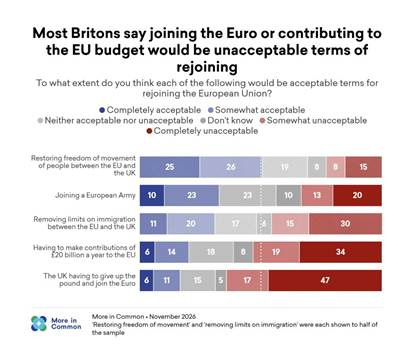
Moreover, an outright majority would reject having to pay £20 billion a year in contributions to the EU. In reality the bill is likely to be far larger than that (even in ‘net’ terms), given the expanding EU budget, new financial obligations, and the loss of the UK’s rebate.
And finally…
You can also follow me on X (formerly Twitter) @julianhjessop and on Bluesky @julianhjessop.bsky.social.

