
Including more thoughts on ‘doppelgangers’ and ‘confirmation bias’, Isabella Webber’s economics, Trump’s latest idiocies, and a schools presentation on leaving the European Union…
Theme of the Week
I’ve been playing around a lot with charts recently and would like to give a shout out to Our World in Data. Generally. I prefer to draw my own, but this is a great source that anyone can use, and which explains the numbers as well as just presents them.
Thanks for reading! Subscribe for free to receive new posts and support my work.
Here’s an example. This chart shows that, between 2016 and 2025, UK GDP per head has grown by about 5.5%, much less than the 14% in the EU. Or if you prefer, a shortfall of about 8%…
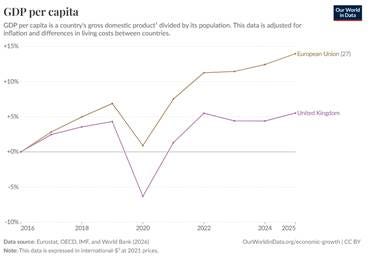
Must be due to Brexit, right? Wrong…
Let’s add a few more countries. Suddenly, ‘Brexit Britain’ is no longer such an outlier…
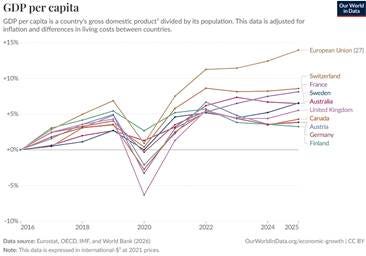
This should make you think about non-Brexit factors which might have affected growth in GDP per head, including relatively high energy prices (Germany) and immigration (Canada).
You can make your own selection using the link here.
Of course, Remainers may prefer to ‘cherry pick’ other countries, such as Italy, Spain, the Netherlands, or even Ireland (and then ignore the many non-Brexit factors which might explain why these have recently outperformed the UK!).
But there’s a serious point here.
The widely cited ‘doppelganger’ models select a group of countries whose performance happened to be close to that of the UK before 2016 and then assume that any divergence thereafter can only be due to Brexit, despite everything else that was going on.
In particular, this is the basis of the infamous NBER paper’s claim of an “8%” Brexit hit to UK GDP, which is still being parroted by all the usual suspects and – most outrageously – by the UK government itself. However, just a moment’s thought should show that this assumption is hopelessly unrealistic.
I would go further and say that this is a textbook case of ‘confirmation bias’. Or to go back to my earlier point, it “must be due to Brexit, right…”?
Monday 23 November
A mixed start to the data week.
The flash S&P Global Composite Output PMI (covering manufacturing and services) suggested that (most of) the UK economy was still going strong in November.
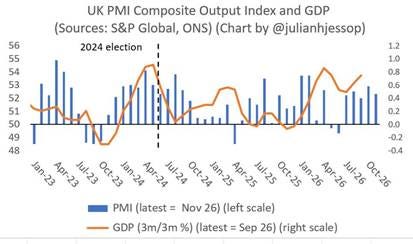
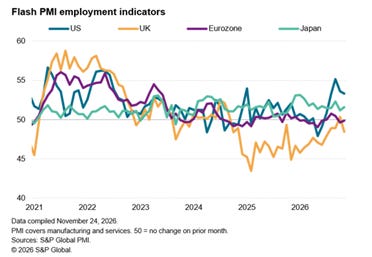
Nonetheless, the detailed commentary included some charts there are not so encouraging, especially on employment and on cost pressures, with little to ease fears that the Bank of England will have to hike rates again.
The international comparisons don’t look so great, either. In particular, the UK first fell behind on private sector jobs after Reeves’ first Budget in 2024 and was still an outlier in November. This is, of course, what happens when the government makes it much more expensive and riskier to hire people.
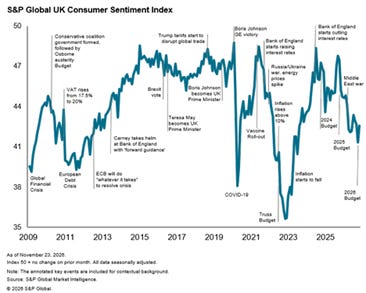
Otherwise, there was more evidence of a post-Budget bounce in confidence, albeit only a small one. S&P Global’s UK Consumer Sentiment Index improved marginally in November (just like the earlier GfK poll). But it remains historically weak, largely due to those persistent inflation and interest fears (ditto).
Tuesday 24 November
I joined the German economist Isabella Webber on the Channel 4 podcast to debate the ideas in her new book, “Anti-Fascist Economics”. She called for more government intervention in the face of the cost of living crisis, while I argued that markets could fix the problems if only they were given a chance.
Among other things, I’m not a fan of her attempts to explain inflation in terms of corporate profiteering, aka “greedflation”. The real driver of inflation is too much money chasing too few goods and services, and companies do not suddenly become more greedy in the wake of supply shocks.
Moreover, none of her proposed solutions are likely to be game-changers and many – notably the old chestnuts of rent controls and other price caps – are far more likely to make matters worse.
But if you’d like to read more, I recommend this (obviously gushing) review of Webber’s book in the Guardian and this more detailed rebuttal from Ryan Bourne.
We did at least agree that Trump’s intervention in the Nvidia affair (“affairs?”) was another gross abuse of power! Plus, she kindly signed a copy of her book for my dad, which was much appreciated…
Wednesday 25 November
The Trump administration threatened “new” tariffs on a wide range of countries, but this was not as big a deal as some headlines suggested.

The key point is that any “new” tariffs would essentially just replace old ones which have been struck down by US courts. Only the lame excuse has changed, from “forced labour” to “structural excess capacity”. It’s also uncertain whether these tariffs will ever be implemented.
Interestingly, though, the UK was not mentioned. This does not mean that the UK is getting off more lightly (remember, any new tariffs will essentially just replace old ones, and the UK is already subject to other tariffs).
But at least ‘Brexit Britain’ is not being lumped in with the EU as a target for Trump’s wrath. In this case, this is simply because the UK does not run a surplus in goods trade with the US and so is not seen as one of the “bad guys”.
Thursday 26 November
I presented at the IEA’s latest school’s conference, which took place in Hendon. The topic of my talk was “Brexit – what next?” and you can view the slides here…
Friday 27 November
I had a piece on the Daily Telegraph, prompted by a Torsten Bell blog on the pick-up in business investment.
Most of the discussion has focussed on the technical question of how best to measure the share of investment in GDP – constant or current prices?
But I’m more interested in why business investment has improved. You can read more here (spoiler – I argue that it is ‘despite’ rather than ‘because of’ anything the Labour government has done).
Elsewhere, the Times headlined a story with “Andrew Bailey: Banks may pass Labour tax rises on to customers“. Well, yes – this is how corporate taxes always work.
Companies are just legal entities and cannot bear the economic burden of tax themselves. In this case, “banks” don’t pay tax. People do…
And finally…
.
You can also follow me on X (formerly Twitter) @julianhjessop and on Bluesky @julianhjessop.bsky.social.

