
A friendly riposte to Torsten Bell’s take on the recovery in UK business investment (but yes Minister, please keep the blogs coming)…
Torsten Bell has a lot on his plate, serving jointly as a minister in the Treasury and the Department for Work and Pensions. Fortunately, he has still found time to launch a regular economics blog on the Substack platform, under the banner “Charting the Course”.
This is welcome. Bell is regarded as one of Labour’s leading economic thinkers, so it is good to know what is on his mind, and it is important that government policies are communicated well.
However, his latest post, “Britain is back in the investment game”, has managed to ruffle the feathers of many in the press, as well as fellow economists.
It started with two “facts” that Bell is certain we would not have heard before.
The first was that business investment is at its highest share of the economy in a decade. The second was that total investment as a share of the economy has recently reached its highest level since 1989.
However, there is a reason we may not have heard these “facts” before: they are not really “facts”. The numbers depend on how the investment shares are measured, and Bell’s method is not the one most economists would choose.
(I first saw this point in a post by Ben Zaranko, now Economics Editor at The Observer, and the IFS wrote an entertaining note on this back in 2001.)
In short, the Minister played an old Treasury trick here by calculating the investment shares using constant rather than current prices.
Put simply, this method assumes that businesses are paying the same prices for investment goods today as they were at some point in the past.
In this case, it makes more sense to calculate these shares using the prices that businesses are actually paying now.
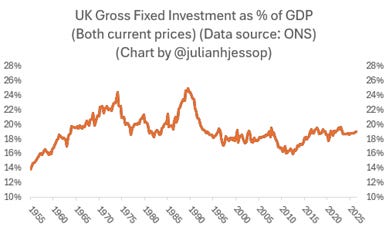
Measured this way, total investment is about 19pc of GDP, roughly where it has been for most of the past decade. Business investment is still hovering around 11pc. Neither share has changed significantly under Labour.
Even so, this should not obscure one point on which Bell is absolutely right: business investment has been a bright spot in the UK economy in recent years.
As Bell notes, business investment stalled in the wake of the vote to leave the EU in 2016 and the needlessly prolonged negotiations that followed. But it has since been recovering strongly as Brexit uncertainty has eased.
Throughout the last ten years, Britain continued to score relatively highly in surveys of attractiveness as a destination for foreign investment. Form is temporary, class is permanent.
The latest official estimates also suggest that our performance on productivity – measured by output per hour worked – was much better than previously thought.
Ironically, the government in which Bell serves now wants to reopen the Brexit debate and revive all that uncertainty – both economic and political – starting with the toxic UK-EU ‘reset’.
Many surveys show that the large majority of businesses have moved on and do not regard closer relations with the EU as a priority. In fact, many view the prospect of realigning with the EU as positively harmful.
This includes businesses in key sectors such as financial services and new technologies, from gene editing to the rollout of AI. These are, of course, all important drivers of the recent strength in economic activity more generally.
Aside from the easing of Brexit uncertainty and the contribution from AI, Bell has no good explanation for the recent pick-up in business investment.
Rather heroically, the Minister tries to claim some of the credit on behalf of the Labour government. Bell suggests that private sector investment has been supported by the marginal reduction in government borrowing. But this reduction relied on another big increase in the tax burden, including on businesses, and has not prevented the cost of borrowing from rising further.
Bell also suggests that the recent and planned increases in public investment have encouraged private businesses to invest more too. In reality, the relatively rapid growth of the public sector looks like a textbook case of “crowding out”.
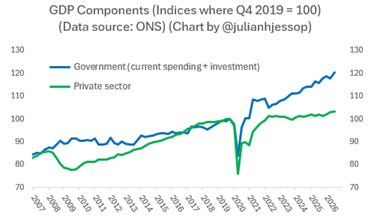
Since Labour came to power, GDP in the public sector (current spending plus investment) has grown more than four times faster than GDP in the private sector. This is neither healthy nor sustainable.
Moreover, if we are looking for specific policy interventions which have lifted business investment, the more obvious candidate is the previous (Conservative) government’s decisions on the tax treatment of capital spending.
Between April 2021 and March 2023, companies investing in qualifying assets could claim a 130pc “super-deduction”. This was replaced in April 2023 by “full expensing”, which was made permanent later that year. Both measures made investment more tax efficient and hence more attractive.
Business investment has continued to grow at a decent clip since 2024. But this is surely ‘despite’ rather than ‘because of’ anything the Labour government has done.
The exception might be something that ministers are reluctant to talk about; government policy choices that have made it more expensive and riskier to employ people may have encouraged businesses to invest more in technology instead.
But otherwise, the persistent weakness of the construction sector is a testament to Labour’s failure to boost investment in what was supposed to be a priority area – housebuilding.
In short, business investment has picked up, but Britain was never really out of the game. The UK’s world-leading companies have shown that they can still thrive. They just need to be allowed to play.
This piece was first published in the Daily Telegraph on 27 November 2026
You can follow me on X (formerly Twitter) @julianhjessop and on Bluesky @julianhjessop.bsky.social.

