
Short answer: ‘no’. Plus a quick take on the Milburn review (‘good in parts’), more on interest rates (still ‘two and done’?), and some better news on UK productivity (‘despite Brexit’)…
Theme of the Week
The week was dominated by the lead up to – and the fallout from – the much-hyped UK-EU Summit on Friday.
I wrote three sceptical pieces for the pro-Brexit campaign group ‘Britain Unbound’: “10 ways the ‘reset’ leaves Britons worse off”, “Will the ‘reset’ really boost UK GDP by 0.5%?” and “The EU Reset won’t make your food shop cheaper”. You get the idea…
I also joined the FT’s Peter Foster and the Institute for Government’s Jill Rutter – both excellent – on BBC Radio 4’s Briefing Room to discuss the topic “Can the UK reset its relationship with Europe?”.
Monday 16 November
I was invited on to BBC News to respond to the Prime Minister’s speech at the Lord Mayor’s Banquet, and I followed this up with a piece for CapX.
In short, my view is that the Andy Burnham is wrong to claim that Brexit has not worked.
The British people voted in 2016 to leave the EU and restore sovereignty to the UK government. Westminster has since regained control over laws and borders, run its own trade policy, and saved tens of billions of pounds in contributions to the EU budget. Brexit has therefore been a success.
This democratic choice has also laid the foundations for a stronger economy. Benefits can already be seen in many areas where the government has begun to use the Brexit freedoms. Whether Brexit ultimately strengthens or weakens the British economy will depend on the choices the UK government makes – which is as it should be.
Tuesday 17 November
Another (disappointingly) weak set of labour market data…
The only positive was the surprise fall in the headline unemployment rate. But even the ONS still doesn’t put much faith in the Labour Force Survey (LFS) on which this is based. Indeed, the official statisticians added an extra caveat on the latest data (relating to the rotation of the sample).
The more timely hard data (from HMRC) show a renewed decline in payrolls in October, with 95,000 fewer jobs than a year ago and 215,000 fewer than two years ago. Vacancies also fell further and private sector pay growth remains subdued.
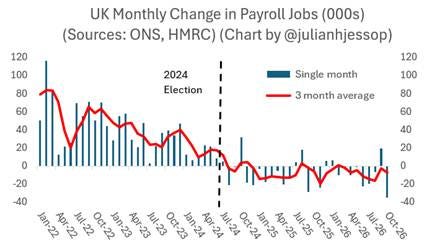
The employment components of the PMI surveys are more encouraging, but this adds to other evidence that confidence and activity stalled last month. And worryingly, the labour market has been persistently weak at a time when the economy was supposed to be ‘booming’.
More positively, the latest ONS estimates blow another hole in claims that Brexit has hamstrung UK productivity (the basis of the OBR’s “4%” hit to GDP, trotted out again by the PM on Monday night).
As the ONS notes, output per hour growth in the UK was the second strongest in the G7 in the ten years to 2025 – behind only the US.
Last but not least, I was interviewed by Times Radio on the Milburn review into young people and work. In brief, I think it’s a ‘curate’s egg’ – good in parts, including the attempt to find joined-up solutions and the mix of carrots and sticks
But fundamentally it falls short, because there is still too little recognition that the government itself has caused most of the problems. The review’s recommendations (if adopted) will therefore just layer more intervention on top of intervention.
For more on this I recommend these posts on the IEA’s Economic Affairs: “Milburn’s tax tweak won’t get young people working” by Matthew Bowles, and “The Milburn Review diagnoses the disease but won’t prescribe the cure” by Professor Len Shackleton and Maeve Halligan.
Wednesday 18 November
I had a glass-half-full take on the latest inflation data.
The uptick in the CPI measure to 3.6% in October was led by fuel prices and tobacco (duty went up a month earlier this year) and was already widely expected.
The breakdown provided some more reassurance that inflation is unlikely to spiral out of control. Both services and core inflation (excluding food and energy) were unchanged, while food price inflation has actually declined.
This is reassuring for interest rates too, particularly given the more recent declines in global energy prices. Nonetheless, headline inflation is still heading above 4% in the coming months, especially with domestic energy bill set for another ”steep rise” in January.
Overall, the latest inflation data are consistent with the view that the Bank of England will raise rates just once more (’two and done’).
This would be less aggressive than currently priced into the markets. In turn, this should ease the upward pressure on mortgage rates and the cost of government borrowing.
It is also still possible that the Bank will hold rates at 4% (’one and done’). However, that outcome would probably require some much worse news on economic activity and especially on jobs, so be careful what you wish for…
Thursday 19 November
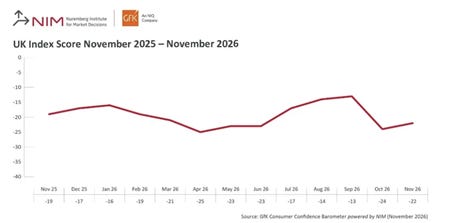
There was not much of a post-Budget boost to consumer confidence in the GfK survey as inflation fears continue to weigh. The press release highlighted larger increases among younger and households earning £50,000 or more – implying further falls for the not-so-young and those on lower incomes.
Friday 20 November
In contrast, October’s retail sales were a bit better than expected – up 0.7% – but this followed a fall of 0.6% in September (revised down from a 0.4% fall previously) and was flattered by emergency stockpiling!
The retail sales data will remain volatile, especially around ‘Black Friday’, But it is hard to see any strength being sustained given falling real incomes and low consumer confidence.
The latest data on the public finances were, of course, very close to the Budget forecasts made just a month ago! So, nothing new for the markets, or any policy implications. But the OBR’s detailed monthly commentary is always worth a read.
And finally…
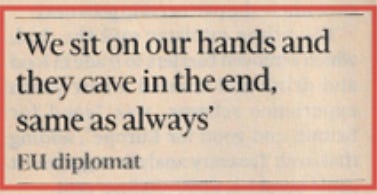
The EU’s verdict on the ‘reset’ says it all, really (via the FT)…
You can also follow me on X (formerly Twitter) @julianhjessop and on Bluesky @julianhjessop.bsky.social.

