
Including thoughts on why Andy Burnham is wrong about “austerity” and Brexit, on bonds and the Budget, and on why the construction sector is such a good bellwether of the success of Labour’s policies…
Theme of the Week
On Tuesday Andy Burnham addressed MPs on the direction in which he hopes to lead the country. This appears to be back to the halcyon days of the 1970s.
The new Prime Minister argued that the UK began taking wrong turns in the 1980s under his distant predecessor, Margaret Thatcher, whose influence apparently persists from beyond the grave. “Austerity” followed, and then Brexit “compounded the damage, ushering in a decade of low growth”.
These might be good soundbites. But a much better take is that so-called “austerity” – in other words, sound money and fiscal discipline – and Brexit – leaving the failing EU behind – are part of the solution to the UK’s economic problems, not their cause.
By happy coincidence, the Institute of Economic Affairs has just published a book on “The Great Stagnation”, which seeks to explain why Britain’s economy has stopped growing. I contributed a chapter on austerity on Brexit.
Let us start with austerity. Critics have long argued that “savage cuts” in public spending, especially under the Coalition government between 2010 and 2015, weakened the foundations of both the economy and society.
There are many problems with this narrative. Most obviously, public spending was not, in fact, “cut”, let alone “savagely”. Even allowing for inflation, total spending was little changed in real terms between 2010–11 and 2019–20.
It could still be argued that spending failed to keep pace with a growing and ageing population, or that the burden fell disproportionately on capital budgets, on local authorities, or core government functions such as the justice system. (I discuss these arguments more fully in the IEA book.)
Perhaps the mix was indeed wrong in some areas. But in aggregate, the spending restraint of the early 2010s did help to stabilise the public finances after the explosion of borrowing in the wake of the Global Financial Crisis.
The 2010s were also a rare period of relatively rapid growth in productivity in public services, meaning that money was better spent.
The spending restraint was also necessary. Britain may not have been facing a Greek-style financial meltdown, thanks to retaining monetary sovereignty outside the euro. But UK interest rates could not have been expected to remain low indefinitely.
We only have to roll the clock forward to 2026 to see what happens when fiscal credibility is lost. The cost of government borrowing is now surging almost everywhere, due to global worries about inflation, interest rates, and bond issuance.
But yields are far higher in the UK than in other countries – even Greece. This is at least partly due to specific investor concerns about the Labour government’s fiscal plans.
Blaming Brexit for the UK’s economic problems does not make a lot of sense either.
A decade ago, the British people voted to leave the EU and restore more sovereignty to the UK government. Westminster has since regained control over laws and borders, run its own trade policy, and saved tens of billions of pounds in contributions to the EU budget. On this basis, Brexit has been a success.
Indeed, multiple polls show that support for rejoining the EU crumbles when people are presented with the costs and conditions of membership, and that most still want key decisions to be made by politicians who they can actually vote out.
This democratic choice has also laid the foundations for a stronger economy. Benefits can already be seen in those areas where the government has begun to use the Brexit freedoms.
Examples include agriculture, where subsidies are now better targeted, and animal welfare, with UK bans on live animal exports and industrial sand eel fishing.
The financial services sector was nervous about Brexit. But after seeing the benefits from pro-growth reforms, the City is now campaigning against closer alignment with EU rules.
Outside the Customs Union, the UK has used its independence to secure faster, better trade deals worldwide, and to cut tariffs unilaterally.
Just this week the Labour government was trumpeting the benefits of securing full access to the £13 trillion CPTPP trading bloc of Asia-Pacific nations.
Outside the Single Market, the UK has gained greater freedoms to “buy British” and provide state aid, for good or ill, and to reduce VAT on domestic energy bills.
Looking ahead, there is enormous potential to benefit from smarter regulation of new technologies, including AI, outside the EU. There have already been important Brexit wins in fields such as gene editing – crucial for raising drought-resistant crops.
The savings on contributions to the EU Budget will also only grow.
It is nearly impossible to isolate Brexit’s impact from other factors, notably the UK’s relatively high energy costs. But studies claiming that the UK economy has taken a hit of “as much as 8%” fail to do so miserably.
The bewildering array of zombie statistics includes the Office for Budget Responsibility’s assumption of a 4% Brexit hit to long-run productivity. This was based on a crude average of the results of external studies mostly done a decade ago before the final shape of the exit deal was even known.
The OBR also assumed that the UK’s global trade in goods and services would be 15% lower than otherwise. This hit simply has not happened.
Worst still are the “top down” or “doppelgänger” models. These assume that any divergence in the UK’s economic performance since 2016, compared to mismatched groups of other countries, can only be due to Brexit. This is a tragic case of “confirmation bias”.
The “bottom up” models, which attempt to isolate the impact of Brexit on particular sectors, are not much better. These typically fail to recognise the temporary nature of the adjustment costs. In particular, business investment was initially held back in the years after the vote to leave, but it has since rebounded as Brexit uncertainty has eased.
A more balanced view is that Brexit has had little overall impact on the economy, so far. Whether it ultimately leaves the economy weaker or stronger will depend on the choices made by the UK government – which is as it should be.
Some still describe Brexit as a slow puncture for the British economy. In reality, it may turn out to be little more than a bump in the road. And if that road leads us further from the EU’s continuing failures, so much the better!
Monday 31 August
I had a piece in the Telegraph commenting on the new data suggesting that UK productivity may finally be picking up. In short, it is too soon to be sure, but if this improvement is sustained it could ease the pressure for increases both in taxes and in interest rates.
Tuesday 1 September
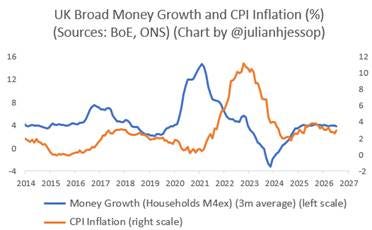
Some bad news on UK inflation from the latest BRC survey: shop price inflation rose to its highest in over two years in August, partly due to the continued pass through of the higher costs of energy and other commodities.
On the other hand (yes, I know economists say that too often!), the latest money and credit data from the Bank of England showed that broad money growth (M4) remained relatively subdued in July. This should help to keep a lid on overall inflation.
Wednesday 2 September
I went on TalkTV to discuss the surge in global bond yields and what this might mean for the UK Budget. This prompted a scary thought: the rise in cost of UK government borrowing still doesn’t include much of an extra “Burnham premium”: yields have risen by similar amounts elsewhere over the last month, and the last year. But once the markets really start to worry about Burnham too… 🙄
In any event, whatever the precise cause of the rise in yields, it is bad news.
In March the OBR assumed (based on what the markets were also expecting at the time) that 20-year gilt yields would be just over 5% now, rising to around 5½% by the end of the decade. They are currently around 5¾%.
If gilt yields remain ¾ percentage points higher than anticipated over the forecast horizon, this alone will add about £6-8bn to the annual deficit (based on the OBR’s ready reckoner below).
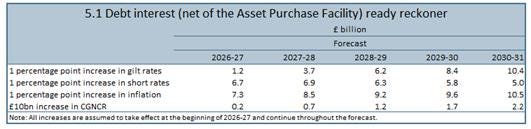
In a worst case, a sustained one percentage point increase in gilt yields, official (short) rates and inflation would together add around £24-26bn to the annual cost of servicing the national debt by the end of the decade. This would completely wipe out the current fiscal headroom, making further tax increase even more likely.
Thursday 3 September
The final S&P Global UK PMI Composite Output Index for August (covering manufacturing and services) was confirmed at 52.5. Not great, but still better than looked likely a few months ago and consistent with decent GDP growth in Q3.
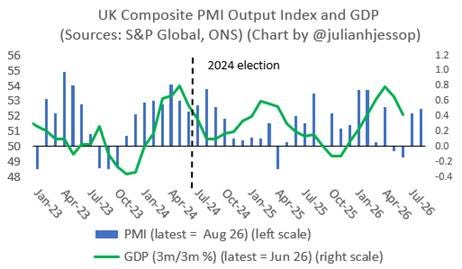
Three caveats:
- “average cost burdens across the private sector economy increased at a sharp and accelerated pace in August” (the MPC will be alert to this);
- the employment components suggest that the private sector is still shedding jobs, albeit at a slower pace;
- ministers may try to claim credit for the pick-up in activity, but this is surely a case of “despite” rather than “because of” government policies.
Friday 4 September
Ouch…
The S&P Global UK Construction PMI activity index fell back again to just 44.3 in August, extending the slump since Labour came to power in 2024. The residential component was just 37.6.
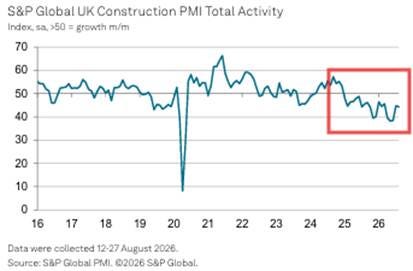
As I’ve noted before, the construction sector is a good bellwether of the success (or failure) of Labour’s policies, as it covers the priority areas of housebuilding, infrastructure, and commercial investment, and is highly sensitive to overall economic confidence.
But to end the data week on less negative note, the Bank of England’s latest Decision Maker Panel (DMP) survey was reassuring on the risks of “second round” effects from the energy shock. In short, there is little evidence here at least that higher commodity prices are having a big impact either on inflation expectations or wage growth.
And finally…
One for fellow Gooners!

You can follow me on X (formerly Twitter) @julianhjessop and on Bluesky.
I also post regularly on Substack


Julian
I am enjoying Plain Speaking Economics, particularly your line on the economic impact of Brexit. On this latest one, you say the expected 15% hit on Britain’s global trade did not materialise. Could you tell me what the figure turned out to be?
Many thanks.
Christopher
LikeLiked by 1 person
Thanks Christopher. Obvious its impossible to be sure what would have happened if the UK had remained in the EU, but the trade intensity (the total of all exports and imports as a share of GDP) has barely changed at a time when global trade has been weak. Certainly no sign of a 15% fall! See the OBR chart I shared in the previous weekly wrap… https://julianhjessop.com/2026/08/30/weekly-wrap-lies-damn-lies-and-brexit-exclusives/
LikeLike