Including thoughts on why young people aren’t working, the folly of rent controls, the outlook for energy bills, the possibility of a 2027 general election, and more “fake news” to call out in The Independent.
Theme of the Week
I have spent a lot of time over the last few years trying to debunk “fake news” about the economic costs of Brexit. Indeed, there is still a lot of about.
This week’s lowlight was a news story and accompanying editorial published in The Independent, which formed part of its increasingly desperate “Europe – the Way Back” campaign. These pieces were riddled with flaws, but I will pick out just two.

First, The Independent reported that a “major new survey shows that 98.2% of businesses want access to the EU single market restored”.
That would indeed be newsworthy. Even Syria’s Bashar al-Assad only claimed 97.6% support in a rigged Presidential vote in 2007. But surely a figure this high might be worth checking?
Doing some basic due diligence, this “major new survey” was in fact published by the European Movement way back in May 2025. At best, then, the poll is old news.
But it’s worse than that. This is not an objective poll. Instead, it was based on a self-selecting panel of businesses which were always likely to be more favourable towards the EU. In the words of the European Movement, “we sent emails to our business contact list across the UK…”.
This is like asking Arsenal fans which is the best team in North London – although in that case of course you would get the right answer!
More seriously, I am not aware of any credible survey which come remotely close to this level of business support for anything to do with the EU.
Second, the Independent claimed that “Brexit is costing the UK £11.7bn a year in lost exports, stark new figures show”. Here it cited research from Logistics UK.
Again, anyone remotely familiar with economic data would immediately smell a rat. The UK’s total exports are worth about £950bn, so £11.7bn would barely be a rounding error.
I had to do some digging to discover what was going on. In turns out that the figures in the article did indeed come from Logistics UK, whose commentary on trade issues is generally very good. But they were first published in June on the 10th anniversary of the 2016 Referendum and were also widely covered elsewhere at the time. So, this too is neither “new”, nor “exclusive”.
The Independent has plenty of form in this regard. The newspaper often regurgitates old lines from pro-EU groups, notably the European Movement and Best for Britain, or from LibDem or SNP MPs. (I found some more examples here and here.)
Even then, the lines are often mangled. The Independent reported the £11.7bn headline figure as if it were a measure of the fall in exports, which never made any sense. In fact, it was an attempt to estimate of the cost of the lost trade in terms of overall economic output. Ironically, if £11.7bn was the right number here, it would be far lower than the estimates of £100bn plus that anti-Brexit campaigners usually trot out!
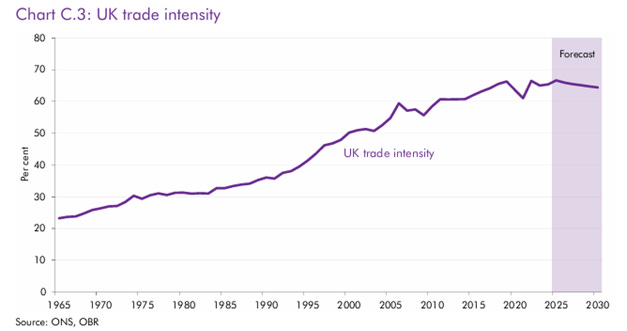
But this number is still based on some shaky economics. The £11.7bn was derived from official data on the “trade intensity” of the UK economy, which is the sum of both exports and imports as a share of national income. The difference between the UK’s trade intensity in the 2019 and more recently was then used to quantify the economic impact of Brexit.
This is not a sound approach, for many reasons. But suffice to say that the UK’s trade intensity has barely changed since 2019 (as the OBR chart below shows) at a time when global trade has been relatively weak. And any fall that might be attributed to Brexit is unlikely to have a significant impact on productivity or growth in an advanced economy, like the UK, which remains relatively open.
In short, The Independent has allowed itself to be suckered yet again into recycling dodgy statistics. Either that, or the editors just don’t care, and are willingly misleading readers with old news and fake “exclusives”.
But the problem goes wider than the declining standards at just one newspaper. Unfortunately, this slop is then lapped up by all the usual suspects.
It looks like I’ll have to keep plugging away. This Wednesday (2 September) MPs will debate the “Impact of the 2016 EU membership referendum on the UK” in Westminster Hall. The House of Commons official briefing includes a link to a blog I wrote in May, “Explainer – debunking the dodgy stats used by Project Rejoin”, which gives me at least some encouragement!
Monday 24 August
Lots of commentary on new data from the recruitment website Adzuna. These headlines were typical: “Graduate job vacancies drop by almost 50% in a year, survey suggests” (BBC) and “Graduate jobs market slumps to new low” (CityAM). So, I wrote a blog.
This began with a health warning over the Adzuna data, which probably exaggerate the extent of the problem. Nonetheless, there is no doubt that university leavers face a perfect storm: general economic uncertainty, competition from AI, the erosion of the graduate premium – and a series of bad government policy choices that look set to get even worse.
Tuesday 25 August
I went on TalkTV to discuss what might be in the October Budget. If you have the appetite, here is a 72 second clip explaining why taxes are likely to be hiked again.
My eye was also caught by yet another serious analysis of rent controls – this time from economists at The IFS – which came to exactly the same conclusions as every other serious analysis of rent controls…
In summary, rent controls can lower rents and reduce uncertainty for some tenants, but international evidence shows they also shrink the supply of rental homes and worsen property quality.
They tend to make it harder for renters to find suitable housing, increasing overcrowding and reducing mobility. Lower-income tenants, who have fewer alternatives, are typically hit hardest by these unintended consequences.
The IFS concluded that rent controls are a costly and inefficient way to help renters, and that boosting housing supply or using the tax and benefit system would achieve similar goals with fewer downsides.
Wednesday 26 August
Not a good economic news day.
The latest Citi/YouGov survey provided another reminder of why it is too soon to sound the “all clear” on UK interest rates: public inflation expectations are picking up again. Renewed rises in petrol prices and further increases in the Ofgem cap on domestic energy bills won’t help here either.
Meanwhile, the latest CBI Distributive Trades survey (for August) suggested that the boost to retail sales from hot weather has run its course. Consumer confidence may be picking up, but positive vibes alone don’t pay the bills, and real wage growth is now slowing sharply.
Thursday 27 August
Ofgem confirmed that the cap on domestic energy bills will rise by another 4% in October, as predicted by Cornwall Insight. The independent energy specialists are also expecting a further 9% increase in January (though as they acknowledge, much could still change between now and then).
I would just add three points.
1. Energy pricing is a mess, and successive governments deserve much of the blame. However, the latest increases are driven by market forces: supply is still being disrupted by the fallout from the Middle East crisis, pushing up wholesale costs, and higher prices remain the least-bad way to balance supply and demand;
2. the government will still be under huge political pressure to provide more support for the most vulnerable households, especially as the VAT cut failed to prevent prices from rising. But remember that someone still has to pick up the bill – this is most likely to be other customers or taxpayers, and probably both;
3. most of the remaining options would not prevent higher energy prices from feeding through into higher inflation, as measured by the ONS. This is because discounts on bills are generally treated as a transfer payment which raises income rather than reduces either expenditure or prices. So, any further policy intervention is unlikely to ease the Bank of England’s worries about “second round” effects.
Friday 28 August
The ONS published the latest official data on the number of young people (aged 16-24) who are not in education, employment or training (NEET). I broke these down into those who are “unemployed” (looking for work but unable to find it), and those who are “economically inactive” (not looking for work).
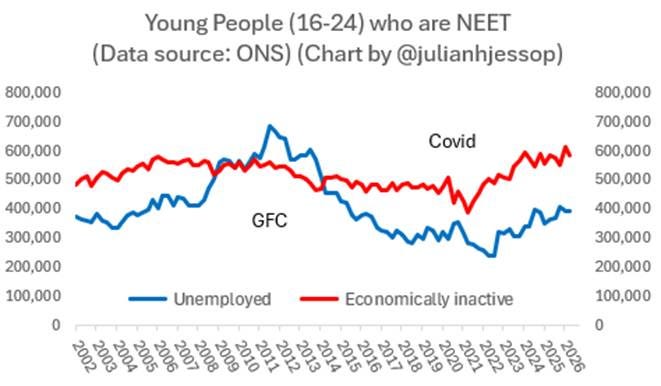
The number unemployed is largely driven by the usual economic factors – the overall level of demand, labour costs, and other problems often more specific to younger people (such as skills mismatch).
This component was already rising before Rachel Reeves hiked employer NI and minimum wages. But these cost increases have hit young people relatively hard, especially when combined with more labour market red tape which is disproportionately affecting entry-level jobs.
The number economically inactive is usually more stable because it is more about societal factors, such as the number of young women staying at home to look after children or other relatives.
But there has been a notable surge post-Covid in the number of young people who are not looking for work because of disability or ill health, especially mental health. More obviously needs to be done to reverse that trend too.
Overall, I would not take much comfort from the fall of 30,000 in the headline number of NEETs in the latest quarter. That’s well within the margin of error for this survey-based measure, and the total of 981,000 is still close to a million.
Drilling deeper, the % of those aged 18-24 who are NEET is still an alarming 15.2%, and among those who are 23-24 it is 17.9%. Not a great start to life for too many young people.
Saturday 29 August
The FT led with “Healey to shelve his own defence spending target of 3% of GDP by 2030”, which has since been confirmed by other sources. Politically, of course, this is awkward, especially for the new Chancellor himself. But perhaps this is telling us something important about the bigger picture too.
A theme may be emerging: difficult choices are being deferred until next year, when they might form part of a fundamental spending review and a 10-year plan. This same may also apply to reforms of property taxes, business rates, infrastructure spending, council housebuilding, foreign aid, and funding of social care, among other areas.
I don’t think that this cautious approach is a bad thing: there is a lot at stake, and it is important to get it right. But despite the Prime Minister’s recent denials, this could also still leave the door open for a 2027 general election – if the economy improves, if the spending and tax changes are substantial enough to require a new mandate, and, above all, if Andy Burnham thinks he can win one.
And finally…
One from Private Eye