
The jump in UK inflation from 3.0% to 3.3% in March is obviously bad news but not quite as bad as some had feared (or at least no worse). In particular, the Bank of England had expected this number to be “close to 3½%” when interest rates were left on hold last month.
Moreover, this jump can be entirely accounted for by the increases in transport costs (mainly motor fuels), which is hopefully a one-off. The higher prices of oil and gas have bitten everywhere, including in the rest of Europe.
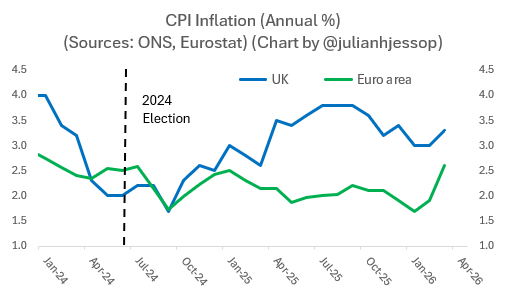
The Bank’s Monetary Policy Committee may also be reassured by the news that core inflation (excluding food and energy) ticked down from 3.2% to 3.1%.
Nonetheless, these numbers are too high for comfort, and the headline rate is moving even further away from the MPC’s 2% target.
This is also just the early stages of the latest inflation shock. It will take several months for the jumps in the costs of fuel and other commodities to be passed through in full to the prices of other goods and services.
It is also too soon to judge whether there will be any other second round effects, notably a sustained increase in inflation expectations.
In the near term, inflation will probably fall back in April, reflecting the reduction in this month’s Ofgem cap on domestic energy bills and some favourable effects from other regulated prices. Indeed, UK and euro area inflation could converge as the latter continues to climb.
But pipeline pressures are still building and, unless the UK government intervenes further, the Ofgem cap is going up again in July.
That said, two factors should prevent inflation from taking off – and mean that the Bank can keep interest rates on hold despite the inflation risks.
First, demand is weak. Firms have little pricing power, other than on essential goods and services, and the softness of the labour market means that wage growth is likely to remain subdued.
The unexpected fall in the headline rate of unemployment in the three months to February does not change the big picture here. This fall mainly reflected an unwelcome jump in economic inactivity (i.e. people not looking for work so not counting themselves as unemployed), rather than more jobs.
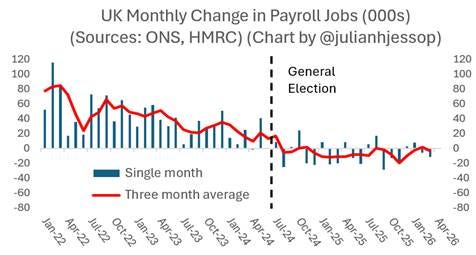
The rest of the labour market report was weak, with vacancies dropping to their lowest level in nearly five years (discouraging some people from trying to find work), and payrolled employment still falling.
The second factor which should prevent inflation from taking off is that the supply of broad money (specifically, “M4ex”) has been growing at a subdued pace of around 4%. This means that increases in the prices of the goods and services most affected by the Iran war are more likely to be offset by falls, or at least smaller increases, in the prices of others.
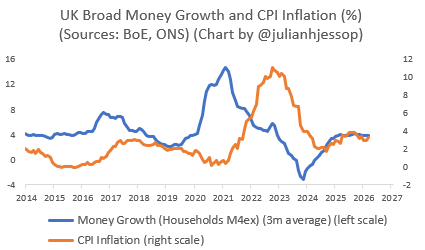
In contrast, growth in broad money peaked above 15% in 2021 as the Bank of England monetised the surge in government borrowing during the pandemic. This then helped to fuel the spike in inflation in 2022 as energy prices jumped following Russia’s full scale assault on Ukraine.
In short, unless the Middle East crisis escalates further, UK inflation will probably be capped at around 4% this year and then fall sharply next year.
But this is still a major shock, with the economy set to flatline at best in the second quarter and possibly the third as well.
You can follow me on X (formerly Twitter) @julianhjessop and on BlueSky.
I also post regularly on Substack.


Useful reminder of recent low money growth constraining inflation and keeping bank rate stable and not over-reacting to CPI headlines against tight fiscal policy and increased recessionary force from raised trade deficit in oil.
Re. US/Gulf states etc. new swap facilities – useful for PSE to explain the rationale (see Tooze Report today)? Stabilising Treasury market and/or geopolitics?
Roger Brookhouse
LikeLike