
The Green Party has unveiled another set of policy proposals designed to “end the affordability crisis”, including universal support with energy bills this winter, free school meals for all, the introduction of rent controls, and joining a customs union with the EU.
I would happily challenge any of these proposals. But the one that caught my eye today was the “introduction of a 10:1 pay ratio which would help increase wages for those on lower incomes while limiting the salaries of high-paid executives”.
This is not a new idea. Indeed, the IEA published a review of the arguments for and against pay caps back in 2019, which you can read here. And last summer, the Green Party pushed for an amendment to the Employment Rights Bill calling for a “maximum pay ratio within companies of 10:1 between the top and lowest-paid person”.
Green MP Ellie Chowns said back then: “such a ratio would end obscene salaries for greedy CEOs while pulling up wages for the lowest paid in organisations – those essential to the success of a business. It would show workers the respect – and grant them the pay – they deserve.”
This may be good politics, but it is terrible economics.
For a start, no-one with even a basic grasp of economics or business would see “limiting the salaries of high-paid executives” as a sensible policy objective. Indeed. caps on executive pay are almost certain to backfire.
Based on current pay for a full-time worker on or just above the minimum wage, a 10-1 ratio would probably cap top pay at around £250,000 a year. That would not be enough to attract and motivate the most senior professionals and other top talent.
It would also further undermine the global competitiveness of the UK economy. Just think what this cap would mean for any internationally-mobile business. The Greens may not care about, say, financial services, or high-tech manufacturing, but what about a more relatable example like the Premier League?
I wonder too if the Greens have thought through all the other implication of capping high earnings, including for tax revenues? And which companies would be covered? For example, limiting the cap to firms whose shares are quoted on UK markets, or headquartered in the UK, would further undermine the incentive to base a business here.
The economic reality is that the “greedy CEO” has far more influence over the success or failure of a business than any individual worker. He or she would also be far harder to replace. If the market (and a company’s shareholders) decide someone is worth £5 million a year, why should anyone else have a say?
For much the same reason, the footballer Erling Haaland is paid far more – perhaps a thousand times more – than the people who sell the scarves at Manchester City’s ground.
Nor is there much more scope to raise the wages of the lowest paid by fiat, instead of by policies that actually improve labour productivity and make workers more valuable to their employers.
In particular, the UK’s national minimum wage (now targeting two-thirds of median hourly earnings) is already relatively high compared to other countries. And as the Resolution Foundation has acknowledged, inequality in the bottom half of the hourly pay distribution is the lowest since at least the mid-1970s.
Moreover, a 10-1 ratio could not be achieved simply by redistributing the savings from cutting the wages of the highest paid. This is because there just are not enough CEOs to make the numbers add up. Campaigners and headline writers like to focus here on the very highest earners at the top companies. But these, by definition, are a tiny minority.
A 10-1 pay cap would not help much with the “cost of living” either, because a higher wage bill will inevitably be passed on in higher prices (as well as job losses). The fallout from the recent increases in employers National Insurance contributions provides a real world example here.
Further government-mandated increases in labour costs might also accelerate the replacement of lower-paid workers with new technologies. And the economic illiteracy of this proposal could contribute to a general loss of confidence in the UK economy, weakening the pound and actually increasing the cost of living.
Finally, any such cap would be a nightmare to administer.
Firms would try to find ways around it, such as increasing other elements of the remuneration of the highest paid (including share options, pension contributions, and other allowances) and by contracting out the lowest-paid jobs. This could result in lower pay for many workers, and less secure employment.
The cap would also presumably have to apply to hourly rates rather than annual pay, to tackle the mix of full-time and part-time workers. But this would add further complexity (especially for more flexible managerial roles, or where senior professionals work for several employers simultaneously – known as “fractional employment”).
Based on current minimum wage rates, a 10:1 ratio would cap hourly pay at around £127. That would be a lot of money for most people, but not for senior executives and professionals.
Perhaps the calls for a 10-1 pay cap are just another populist pitch to “bash the rich”, rather than a serious policy proposal. Unfortunately, they chime with YouGov polling last year which suggested that a “wealth tax” would still be popular even if it lost money (meaning the not-super-rich would have to pay more tax, or public services would have to be cut…).
In short, this is yet another example of a Green Party policy that would fall apart on first contact with reality. But it may still play well in the polls, and that seems to be all that matters now.
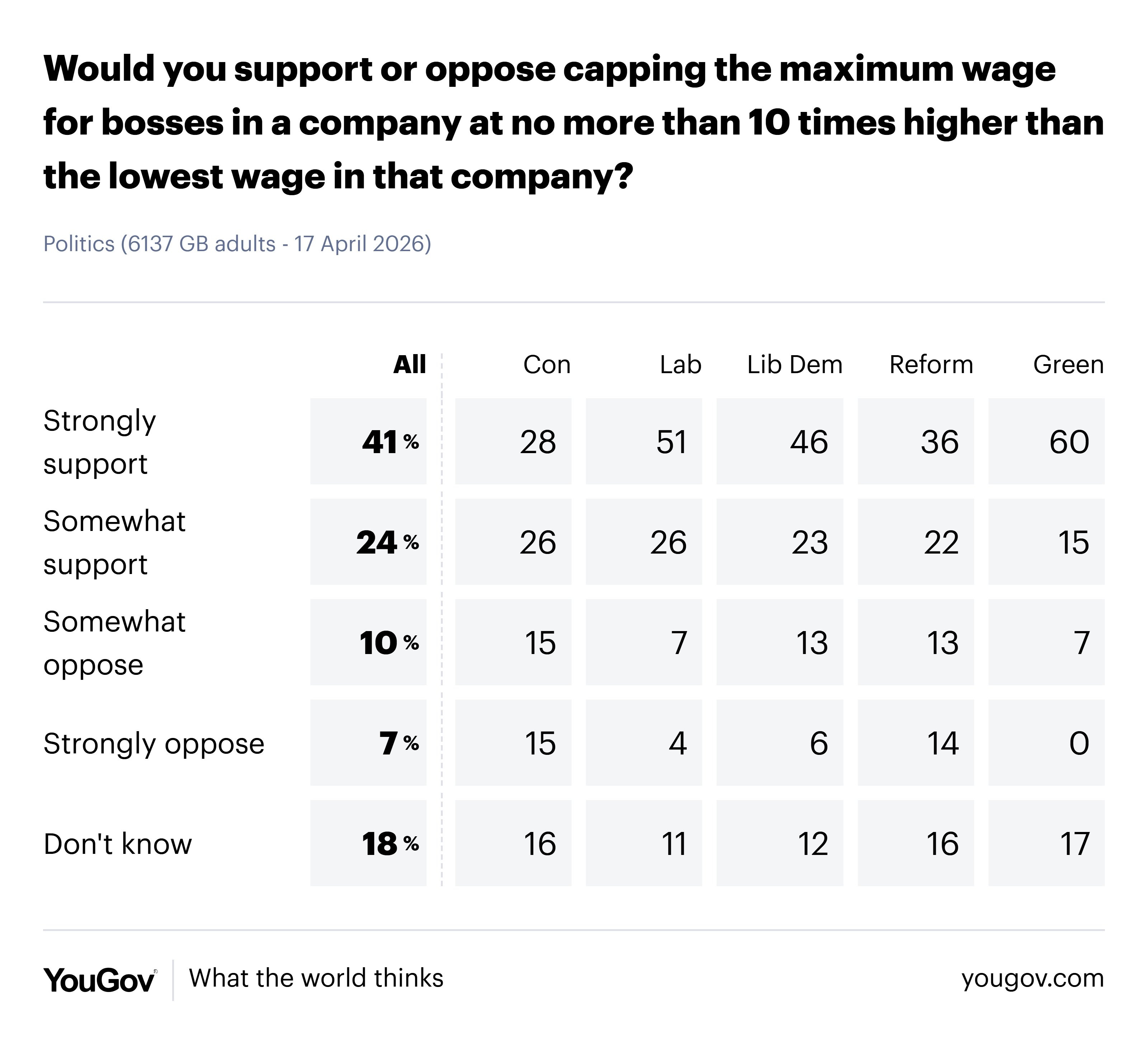
ps. (added 17 April) New YouGov polling has confirmed that this policy would indeed be popular, with 65% of respondents in favour (and broad cross-party support)…
You can follow me on X (formerly Twitter) @julianhjessop and on BlueSky.
I also post regularly on Substack.

