
Including thoughts on UK GDP, “rocket and feather” pricing at the pumps, should the BoE follow the ECB, US bond market intervention, German defence spending, and the latest UK evidence on “second round” effects…
Theme of the Week
The reassuringly strong GDP data added to evidence that the UK economy is holding up better than most were expecting – me included – after the outbreak of the US-Iran war.
In particular, the private business surveys had suggested that growth was stalling. As the chart below shows, the composite PMI output index had tailed off sharply and was below the key 50 level in both May and June. So, what’s going on?
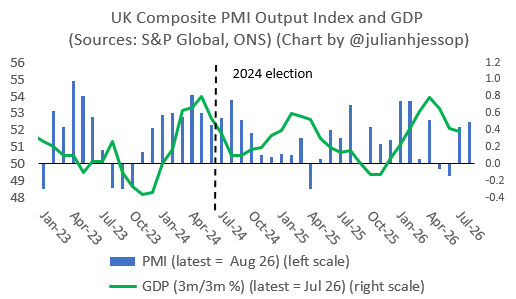
For a start, some temporary factors have flattered the official data. The recent strength in services partly reflects some tailwinds that are already fading, including the initial boost to consumer spending from the hot weather. (The PMI survey does not cover retail.)
Other tailwinds may last longer, notably the surge in spending on AI-related goods and services (before the machines kill us all, obviously). This goes some way towards explaining the recent improvements in the productivity data, which I discussed here.
However, other parts of the economy are still struggling. In particular, the persistent weakness of the construction sector confirms that the Labour government has yet to “fix the foundations”.
Finally, any good news could soon be blown away by the fresh headwinds coming from energy prices and the bond markets.
The surge in the cost of government borrowing will heap more pressure on the Chancellor, who is far more likely to respond by raising taxes further than by cutting spending.
It is also hard to see how the Bank of England can continue to keep official interest rates on hold when inflation is set to rise further above target.
In my view, the government needs a much bolder strategy to boost growth by freeing up the supply side of the economy, rather than adding to the burdens of tax and regulation.
John Healey did say some of the right things in his “Growth Speech” on Monday, which I reviewed in more detail here. But the chasm between rhetoric and reality seems as wide as ever.
Monday 7 September
I had a piece in the Daily Telegraph on energy policy, which you can also read here. In short, successive governments have layered subsidy upon subsidy for renewables, while hitting fossil fuel companies with additional taxes that bear no relation to any sort of economic reality. No wonder so many of them are giving up on the UK.
A more pragmatic approach would be to ensure that the prices of different energy sources reflect all the costs involved, including any environmental and social costs, and then let the markets decide how best to meet the UK’s energy needs.
Meanwhile, I posted two charts on what the renewed surge in the cost of crude oil (Brent is now back above $100) might mean for petrol and diesel prices.
First. oil and petrol prices move together in a predictable way: petrol is a relatively competitive market where demand is more price-sensitive than for diesel, and there is little evidence of “price gouging”.
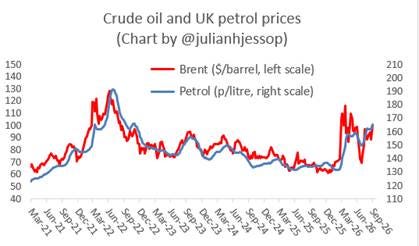
If anything, this chart suggests that the price of petrol at the pump rose by *less* than might have been expected when the US-Iran war kicked off in the spring. But motorists may not get off as “lightly” this autumn.
Second, the relationship between oil and diesel prices is messier, with more evidence of “rocket and feather” pricing (quick to rise, much slower to fall), especially in 2022-23.
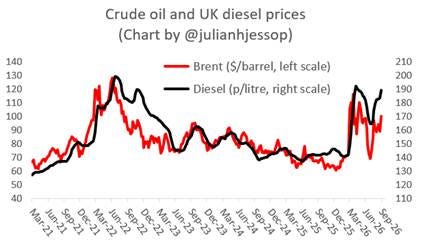
This reflects many factors that differentiate the market for diesel from the market for petrol, including reliance on heavier oils, the lack of refining capacity, and the lower price-elasticity of demand (diesel has more industrial and commercial uses).
Indeed, the price of diesel has already risen by *more* than might have been expected, which should limit the upside from here.
But if the price of crude oil rises much further, the average price of diesel could soon top £2/litre. And even at current levels, this is adding to the cost burden for many businesses.
Tuesday 8 September
Both the leading surveys now suggest that August was a disappointing month for retail sales.
The CBI Distributive Trades survey was first out of the blocks, with “Retail activity slumps in August”. This downbeat message was then reinforced by the BRC’s latest poll, which led with “Consumer demand cools as summer ends”.
Wednesday 9 September
Ryan Bourne had a good piece in The Times on Next’s victory in its equal pay case. As he put it, “the eight-year battle over pay for shop and warehouse staff may be over, but such disputes are inevitable without dismantling the absurd ‘equal value’ framework”.
This paragraph nailed it… “market pay rates reflected important supply and demand factors that job evaluations missed. Things such as how many people wanted a job, how appealing the working conditions were and how urgently Next needed staff, given trends in shopping habits. Next even offered shop workers the chance to transfer to warehouses. Few did and one claimant admitted warehouse work did not appeal unless it paid considerably more. Despite all this clear evidence, Next was found in breach.”
I agree. Pay should be set by market forces, not well-meaning but misguided judges.
Thursday 10 September
The ifo institute published a report which concluded that the “German government misappropriated more than a third of additional debt for defence spending in 2025” Another reason why bond markets are sceptical when politicians say, “don’t worry about all this extra borrowing, it’s for X…”.
The European Central Bank hiked its key interest rate by another ¼%, to 2½%, as widely expected. But I was still struck by the commentary justifying the decision, which made several points which could equally apply here:
· “The Middle East conflict keeps driving up prices” (UK ✅)
· “Inflation is likely to be above our 2% target for quite a while” (UK ✅)
· “The risks to the inflation outlook are to the upside” (UK ✅)
· “The economy is holding up better than expected” (UK ✅)
Food for thought as I mull my vote for CityAM’s Shadow Monetary Policy Committee. Watch this space…
Friday 11 September
I covered the key points on the GDP figures earlier. Just a couple more…
For those asking, “how much of the latest burst in growth is due to government spending and borrowing?”, the answer is … “not a lot”. The breakdown showed growth is being led by professional and support services in the private sector, especially AI-related.
And for those asking, “what about GDP per head?”. The ONS does not publish monthly GDP per head. But both headline GDP and GDP per head increased by 0.4% in the quarter from April to June, and I suspect that there wasn’t much difference for May to July either.
The big picture here is that the UK population is now barely growing, reflecting declines both in net inward migration and in birth rates (another challenge for the Chancellor in the Budget).
Muddying the waters further ahead of next week’s MPC decision, here are two points for the doves from the latest Bank of England surveys.
First, on a like for like basis (Savanta’s polling in both periods), the public’s one-year ahead inflation expectations fell to 3.2% in August, from 3.6% in May, and two-year ahead eased to 2.9%, from 3.1%.
Second, on wage pressures, the Bank’s agents reported that “limited intelligence on 2027 pay settlements continues to suggest they will be broadly in line with or lower than 2026”.
These points are of course important because they address two of the main concerns about potential “second round” effects from the surge in energy costs.
The FT had a decent take on Treasury secretary Scott Bessent’s attempts to steady the US bond market. It argued that these had backfired, with “investors warning that the opening shot was too timid to halt a surge in yields and instead dented his credibility”.
I would go further. Direct intervention in financial markets is only ever likely to work if prices have become detached from fundamentals. That’s not the case now. Investors are right to be worried about inflation, short rates, and bond issuance. In my view, governments need to address those concerns first, and central banks should leave them to it.
And finally…
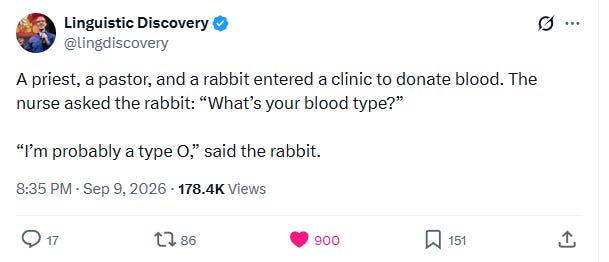
Happy New Year to all my Jewish friends, who probably got this joke some time before I did… 😀
You can follow me on X (formerly Twitter) @julianhjessop and on Bluesky @julianhjessop.bsky.social.

