
Including thoughts on the latest news from the labour market (not all bad), signs that the economy retains some positive momentum, and what could still go wrong – including autumn hikes in both taxes and interest rates.
Theme of the Week
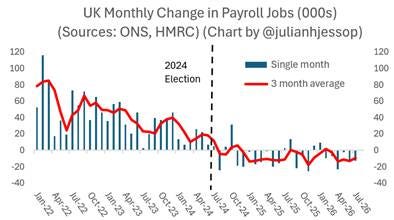
This week’s official labour market data were grim. The UK economy continues to shed payroll jobs, with net losses of 94,000 over the 12 months to July and 188,000 since July 2024. The unemployment rate also remains stubbornly high, with a big jump in the single month figure for June. Vacancies fell further.
Reflecting the weakness of demand for labour, regular pay growth in the private sector has slowed to less than 3%, which will not be enough to keep pace with inflation in the second half of the year. In contrast, pay growth in the public sector is running above 6%. This divergence is clearly unsustainable.
Several factors are at play here. Most obviously, labour costs have increased because of higher employer National Insurance, the higher minimum wage, and the growing burden of regulation. It should be no surprise that private businesses are responding by hiring fewer people and holding down wages.
This drag looks set to continue as the government rolls out more policies which undermine the flexibility of the labour market, including the latest assault on “zero-hours contracts”.
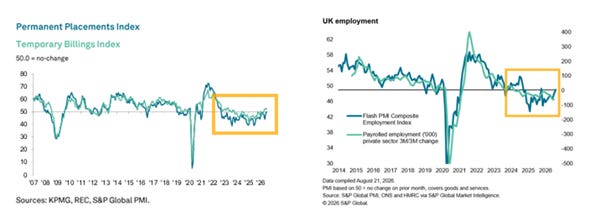
Some other headwinds are more likely to be temporary. In particular, the weakness of demand for labour also reflects general economic uncertainty. The more timely surveys for August suggest this may already be easing: both the KPMG and REC UK Report on Jobs (a recruitment survey) and the employment components of the latest composite PMI suggest that the labour market may be bottoming out.
Even so, the government could still derail any recovery here too. Speculation ahead of what is expected to be another tough Budget already looks likely to revive economic uncertainty.
But in the meantime, the weakness of payroll employment might be telling us something positive about labour productivity. Take a look at this chart, which shows two measures of UK productivity (explained further by the ONS here and in more technical terms here).
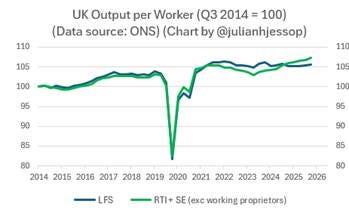
In short, the blue line draws on employment data from the Labour Force Survey (LFS), while the green line is based mainly on more reliable figures from the HMRC payroll data. Note the better trend in the green line over the last few years.
This can be seen as the flipside of the recent falls in payroll employment. Given that output has continued to increase, this suggests that those still in work are more productive than before.
Why is this important? Lots of reasons. But if the OBR can be persuaded to give more weight to the data that tell a better story on productivity, the Budget forecasts for economic growth and hence the public finances might all be a little rosier – reducing the pressure for tax hikes.
The Bank of England might also be a little more confident that rising productivity will keep underlying inflation in check.
However, the apparent improvement in labour productivity might just be an illusion and/or temporary, for example because more of the least productive jobs have gone or because businesses are working their remaining staff harder. The jury is still out on this.
Of course, Labour-supporting economists (notably former Reeves advisers John Van Reenen and Anna Valero) have been quick to credit the government for the improvement, citing factors such as planning reforms and increased public investment.
I think that’s quite a stretch, not least given the time lags involved. Increased private investment in productivity-enhancing IT and AI is more likely to be a key driver.
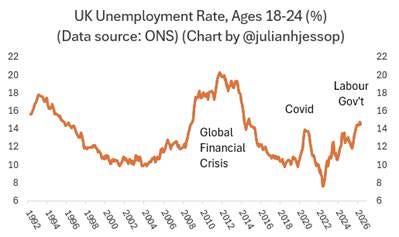
And of course, there is a downside too. Falling payrolls mean job insecurity is increasing and unemployment is trending higher, especially for younger people.
This is an important topic which I will return to later. For now, though, I’m not sure the government can trumpet this improvement as a great success.
Sunday 16 August
Another early start. I went on BBC Radio 4 shortly after 9am to discuss the use of emergency alerts and whether the previous Friday’s “wildfire” warnings were proportionate. My view is that this case failed to meet what is supposed to be a “very high” threshold of immediate risks to life, or the test of providing information that most people would not already have known. A lower level text message alert – without the screeching alarm – would have been much more sensible.
This story was then picked up on the BBC website, which led with the potential risks to victims of domestic violence with hidden phones. For what it’s worth, I don’t think it’s realistic to expect advance warning of what are supposed to be emergency alerts. But the government should remind everyone again that they can opt out.
Monday 17 August
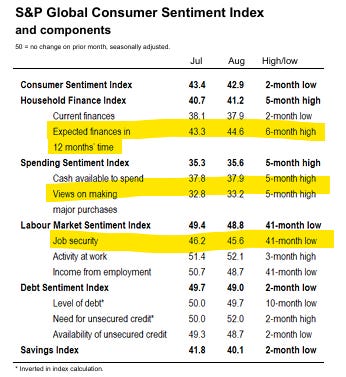
The data week started with some mixed signals on any “Burnham bounce” from the latest S&P Global UK Consumer Sentiment Index. Households are less pessimistic on future income and on spending, but much more worried about job security.
Tuesday 18 August
Labour (data) day, covered in the “Theme of the Week”. I’ll just add a chart of a chart of youth unemployment, with the major shocks marked…
Wednesday 19 August
Andy Burnham announced that responsibility for national economic growth policy will move from HM Treasury to No.10 North.
I was surprised that this announcement did not attract more attention. As the PM says, it looks like a “huge transfer of power”, and the significance of No.10 North will become “more and more apparent as we go forward”. So I wrote a blog, partly to defend “Treasury Orthodoxy”.
In short, this shift could amount to something big, or it could simply reshuffle responsibilities with no material change in the outcomes. Most likely, it will fall somewhere between.
Arguably, the combination of the current fiscal rules, a strong independent watchdog in the Office for Budget Responsibility (OBR), and the discipline of the bond markets is a much bigger constraint on policy than HMT. But as a former Treasury wonk myself, I will keep following developments here with particular interest…
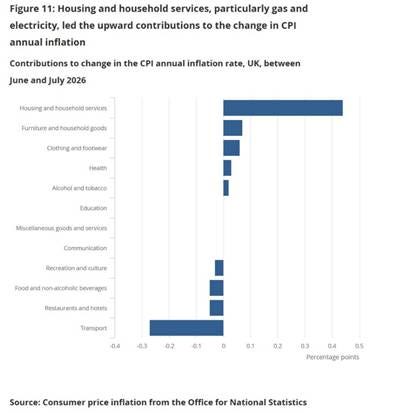
Meanwhile, CPI inflation jumped to 2.9% in July, from 2.6%, but most components were little changed. This should help to reassure the Bank of England that the risks of “second round” effects from higher commodity prices are small, especially when combined with the current weakness of the labour data.
As expected, the bulk of the action was in energy prices. The increase in the Ofgem cap drove up household bills, partly offset by the falls in the prices of motor fuels. Otherwise, there is not a lot else going on, apart from a further and welcome fall in food price inflation.
However, domestic energy bills are now forecast to rise by another 4% from October according to Cornwall Insight’s final forecast for the Ofgem price cap. This would be a bit more than anticipated by the Bank of England. And it would come despite the removal of VAT on electricity. Awkward…
Thursday 20 August
The i paper is now reporting that Burnham and Miliband have privately committed to reversing cuts to the UK’s aid budget. This is an issue that came up last month when Miliband was appointed Foreign Secretary, and I commented at the time (for GDP read GNI, though the difference between these two measures is small in the UK)…
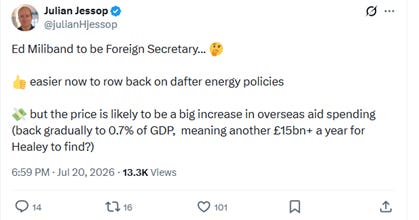
I wrote more on the political and economic issues around overseas aid spending in my weekly wrap dated 25 July.
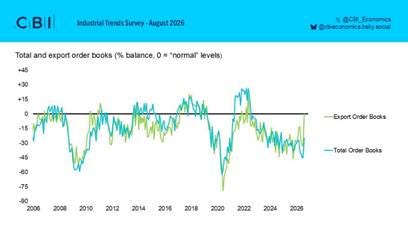
Meanwhile, some more signs of life in UK manufacturing? The latest CBI Industrial Trends Survey for August showed a marked improvement in order books, albeit heavily dependent on global demand (export orders far stronger than total orders).
Friday 21 August
Another big day for economic news.
Government borrowing was £2.3 billion above forecast in July, and £0.7 billion higher than in the same month a year ago. Most worryingly, spending growth – notably on benefits – outpaced revenues despite a bumper month for income tax receipts.
Nonetheless, it’s also worth reading the OBR’s relatively sanguine take on the data. As the OBR doesn’t quite say, a few billion either way this early in the year is not a big miss in the context of overall tax and spending.
More positively, the flash S&P Global UK PMI composite output index (covering services and manufacturing) picked up to a 4-month high of 52.5 in August, which suggests that the UK economy still has some decent positive momentum heading into the Budget.
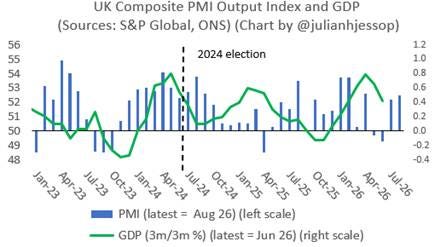
The detail suggests the key drivers are tech-related services spending and the boost to leisure activities from the warm weather. But firms are more optimistic about the next 12 months too, and the pace of job losses is slowing, so this recovery may have legs.
One other caveat: the PMI also shows that inflation pressures are still strong which, combined with the firmer activity and employment components, might still be enough to tip the Bank of England into hiking rates in the autumn. Will the recovery survive both higher taxes and higher interest rates?
The GfK measure of consumer confidence also picked up further in August, up another 3 points to -14, the highest level in two years. However, it was -13 in both July and August 2024, during the brief Starmer honeymoon, before falling away again. And of course, positive vibes don’t pay the bills.
Retail sales volumes fell by 0.5% in July, but this followed chunky gains of 0.7% in June and 1.3% in May. As a result, sales still rose by 1.1% in the 3m to July compared to the 3m to April, meaning the trend still looks good. The question now is can this last, despite the sharp slowdown in real wage growth?
And finally…
Yet more evidence that fiscal incentives matter. (I understand California is mulling a new wealth tax as well…).

You can follow me on X (formerly Twitter) @julianhjessop and on Bluesky.
I also post regularly on Substack

