
Including more on the Budget, what’s really happened to UK exports to the EU, who’s ready to tackle the welfare bill, another piece of worrying news on inflation, and another dig at Mark Carney…
Theme of the Week
As expected, John Healey’s first Budget was largely a non-event and, as such, a missed opportunity.
Leading think tanks all gave it poor reviews. In particular, the IFS criticised the “fiddly tax rises”, the Resolution described it as a “scattergun Budget that did little to address the sharp challenges facing Britain”, while the IEA (where I am a Fellow) lamented “A Budget of sweeteners and stealth taxes”.
The business community was also unimpressed. The CBI went with “Budget does not meet scale of government’s ambition”, the IoD with “Budget meets the brief, but is no game changer for growth”, and the BRC with “No breathing space for retail as Budget keeps costs climbing”.
My response was unenthusiastic too, summed up as “Wary Chancellor presents a Ming Vase Budget”.
But of course, the Budget was not a pitch to economists, or even businesses. Instead, the target audience was voters, with the aim of providing as much temporary support to consumers as possible without rattling the bond markets.
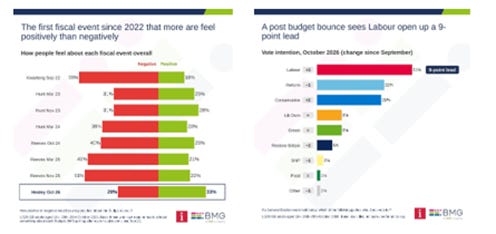
Healey did at least achieve that narrow objective. Early polling by BMG Research (for the i paper) suggests that the Budget has landed relatively well with the public – and that Labour has extended its overall lead.
This brings me to the electoral timetable. Despite the denials from Andy Burnham, there are three good reasons to believe that he will call an early general election – perhaps for May next year.
First, most of Burnham’s big ideas will require a new mandate. Some carry a hefty price tag, including a much larger role for the state in providing social care, infrastructure, utilities, and housing, while others would cross existing manifesto red lines, notably by seeking a much closer relationship with the EU.
Second, the polling is mostly favourable. The threat from the Greens is fading, Reform is slipping and, while the Conservatives are recovering well under Kemi Badenoch, the Tories still lag some way behind.
Labour therefore has a decent chance of retaining a majority, or at least governing in coalition with the LibDems. Ed Davey would be a willing junior partner, especially with the carrots of electoral reform, some sort of return to the EU, and more focus on social care.
Third, the economy would be unlikely to get much better in the second half of a full five-year parliament. The OBR is now forecasting that real household disposable income per person will be just 2% higher in 2030 than its pre-pandemic levels. For now, Labour can blame the economic woes on the energy shock – and President Trump – but this narrative will wear increasingly thin.
That said, an early election is not a done deal. The economy could deteriorate more sharply than expected in the coming months. Attempts to realign more closely with the EU are likely to prove toxic. Many backbench Labour MPs will not want to lose their jobs. Ironically, John Healey’s own seat is particularly vulnerable (to Reform).
Nonetheless, Andy Burnham appears to have almost messianic faith in his abilities and is eager to press ahead with his 10 Year Plan. The chance of a renewed injection of political capital from a General Election victory could prove irresistible.
Monday 26 October
I pushed back against claims (repeated by Angela Rayner on Sunday’s media round) that exports to the EU have fallen by 20% as a result of Brexit.
The charts below show what has actually happened. Exports to the EU have not fallen by 20%, even in volume terms or as a counterfactual (i.e. relative to what might otherwise have happened). This is due, in large part, to the continued strength of exports of services.
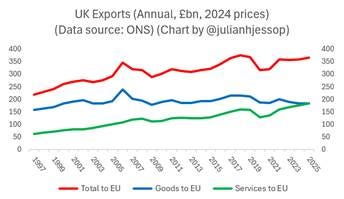
Presumably, Ms Rayner meant to refer only to exports of goods, ignoring services (even though these are more important for the UK economy).
Exports of goods to the EU have indeed fallen in volume terms since 2019, but not by anywhere near 20%. What’s more, they were never strong in the first place. As the chart below shows, there has been hardly any growth in exports of goods to the EU for decades, even when the UK was a full member of both the Single Market and Customs Union.
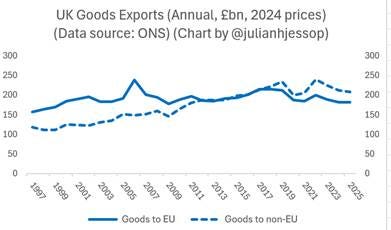
As the chart also shows, exports of goods to the rest of the world have also been relatively weak since 2019, so this is not just about Brexit. Other important factors include the UK’s relatively high industrial energy costs and the general weakness of world trade.
I could go on (and I did, here). But for now, I’ll just note that it would be great if journalists started to challenge politicians and pro-EU campaigners whenever they parrot these dodgy claims about the impact of Brexit.
Tuesday 27 October
The day started with another piece of worrying news on inflation and for interest rates. The latest BRC survey found that shop price inflation jumped to 2.1% year on year in October, from 1.4% in September. In the words of the BRC, “the dam is starting to break on the huge wave of costs retailers have absorbed over the last two years.”
Meanwhile, HSBC’s latest results prompted fresh calls for an additional windfall tax on banks. I argued in a thread on X that these calls were misguided. In short, it is foolish to pretend that banks can be tapped for ever larger amounts of money without any wider economic costs.
Wednesday 28 October
The main event was, of course, the Budget, covered earlier.
But here are a couple of supplementaries.
First. some comments on scrapping standing charges on gas bills.
This move will be financed by increasing the unit price of gas, so while lower users will benefit, higher users will pay more. (The chart and table below are from a handy briefing from the House of Commons Library.)
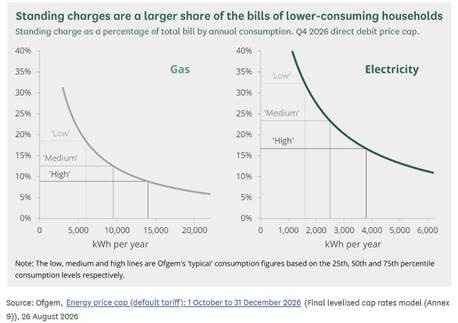
The Treasury reckons that 60% of household will be better off, saving an average of £45 per year, with bigger gains for those using the least amount of gas. However, the flipside is that up to 40% will be worse off than otherwise.
Moreover, most households will still see a huge jump in their energy bills next year as the increases in wholesale costs are passed through, even if standing charges were scrapped straightaway. In practice, this reform won’t come into effect until later in 2027, at the earliest, though the £100 bung to 20 million households will help fill the gap.
So why announce this reform now? The main appeal is that lower users tend to be on lower incomes, so this can be spun as a transfer from the ‘better off’ to the relatively poor.
But note this does not always apply. For example, housebound people with higher energy needs may now require extra help, though the government has said it will address these problems.
Raising the unit cost of gas will also encourage energy saving, though the government is less keen to say that bit out loud.
The government still needs to explain why, if scrapping standing charges on gas bills is such a good idea, why is not doing the same for electricity?
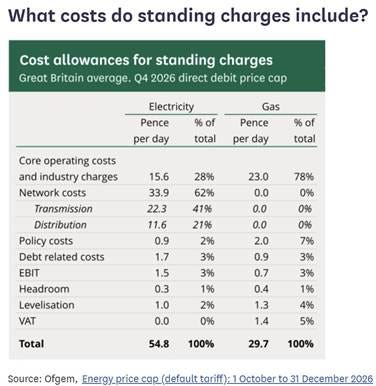
The standing charges for electricity are much higher, partly because the biggest component of fixed costs for gas – the network costs – have already been transferred to unit prices.
So, if the government now scrapped standing charges on electricity too, the swings in bills and the challenges to operators would be much greater.
Also, there is less environmental pressure to reduce consumption of electricity – at least some of which is produced from renewables – than there is for gas.
But none of this addresses the underlying reasons why UK energy bills are so high. Scrapping standing charges and raising unit prices will simply reshuffle the burden, albeit in a potentially fairer way, and most people will still see a big jump in their bills next year.
Second, a nerdier point on the OBR’s forecasts.
The OBR’s growth forecast of 1.2% for 2026 is almost certainly too low, because it does not take account of the most recent GDP data.
The OBR has assumed quarterly growth of 0.6% (Q1), 0.4% (Q2), 0.3% (Q3) and 0.2% (Q4). But we already know Q2 was revised up to 0.5%, and the monthly data for August were better than expected.
This is because the OBR did not update the numbers after the pre-measures economy forecast was completed on 8 September. The upward revision to Q2 was announced on 30 September and the August figures were released on 15 October.
The upshot is that (barring a collapse in the final months) growth is likely to be about 1.5% this year, rather than 1.2%. The OBR’s 1.0% for 2027 may be a tad low too.
Does this matter? Not really. Some people will use this as another excuse to bash the OBR (“if they can’t even get this quarter right…”), but this would be unfair.
For a start, most forecasters have under-estimated the recent resilience of the UK economy. More importantly, the OBR is not in the business of making short-term economic forecasts – and nor should it be.
The outlook for the public finances depends on medium- to long-term trends. A few tenths of a percentage point on growth in 2026 is little more than a rounding error.
Instead, it was perfectly reasonable for the OBR to focus on assessing the economic and fiscal implications of the nearly 100 policy measures in the Budget, rather than keep fiddling with the baseline.
Nonetheless, it is now more likely that the next set of economic forecasts (expected in the Spring) will paint a slightly rosier picture for both 2026 and 2027. This could also be handy for an early election (though if anyone cries ‘foul!’, remember that this is just a reflection of when the OBR closed the forecast rather than any political manipulation).
Thursday 29 October
The media picked up on some mixed signals from Healey on whether the benefits bill would be cut before the next election (whenever that may be!). The Telegraph went for “day of chaos in Parliament as Chancellor appears to backtrack on promise to reduce welfare payments”.
For what it’s worth, I think Labour is still likely to set out some welfare savings in the 10 Year Plan, due to be published ahead of next year’s Spending Review. The government is also waiting for the detailed proposals in the Timms and Milburn reviews, due to be published later this year
In the meantime, Burnham and Healey can at least point to some reforms, including more face-to-face interviews for disability benefits and tweaks to the Motability scheme. There has also been the tweak to the change to the triple lock on the state pension, though that’s for the next parliament.
But (and you probably guessed there would be a ‘but’), there are still huge questions over how the welfare budget will be controlled, when, and who is actually going to do it. The mixed signals from No10 and No11 since the Budget have not inspired confidence that Labour see this as a priority, especially as both Reform and the Conservatives have already set out some credible plans.
Friday 30 October
The Bank of England’s Decision Maker Panel survey is always worth a look, if only because the MPC watches it too. Inflation expectations remained above target in October, but there is still no sign of second-round effects in private sector wage growth, which remains subdued.
Overall, this is unlikely to sway next week’s interest rate decision. But if the MPC doesn’t raise rates in November, when will it ever do so?
Elsewhere, Mark Carney used the opportunity of the 21st EU-Canada summit to push the idea that Canada is well on the way to “becoming the European Union’s first Associate Member”.
This is pure fantasy. Remember there is no provision for ‘Associate Membership’ in the EU Treaties, and the earlier attempts by both Carney and von der Leyen to promote the idea were quickly rebuffed by other EU officials and governments.
This begs the question of why Carney is still flogging this dead horse. The charitable interpretation is that he is trying to stick two fingers up to President Trump, which is at least an honourable aim. But Canada’s Prime Minister seems to have set his country on the road to nowhere.
And finally…
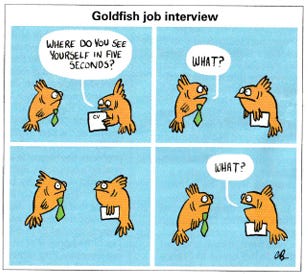
(With credit to Private Eye)
You can also follow me on X (formerly Twitter) @julianhjessop and on Bluesky @julianhjessop.bsky.social

