
Including thoughts on the Budget, government bond yields, the folly of reopening the Brexit debate, some better news on UK growth, the OBR 15 years on, and Zack Polanski’s grasp of basic economics…
Theme of the Week
Labour sources are suggesting that the new Chancellor, John Healey, is set to delay ‘difficult choices’ with a ‘breathing space’ Budget.
In my view, a ‘first do no harm’ approach might indeed be the best option right now, given the current market jitters. The UK economy certainly couldn’t weather another round of tax rises on the scale of the last two Budgets, and the Treasury does seem to have dialled down the usual kite-flying.
So far Healey hasn’t rocked the boat too much either: the damage to credibility from some daft ‘new’ policy announcements (such as reviving Help to Buy) has been more or less offset by a few better ones (notably tweaking the ‘triple lock’ on the state pension, though any savings from this change have probably been exaggerated).
It is worth repeating that UK gilts have recently performed less badly than the government bonds of many other countries, as the chart below shows (with the obvious caveat that the level of gilt yields is still the highest).
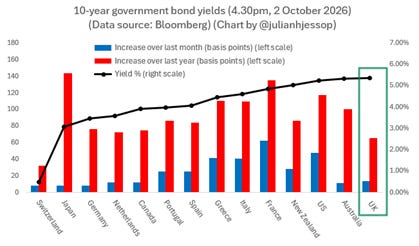
This relative vote of confidence might be enough to give Healey a little more ‘breathing space’ too, if investors are more willing to tolerate a temporary reduction in the fiscal headroom in response to what may only be temporary global shocks.
Nonetheless, there is very little margin for error. We are not quite there yet, but a sustained one percentage point increase in gilt yields, official rates and inflation could add around £25bn to the annual cost of servicing the national debt by the end of the decade – completely wiping out the current fiscal headroom.
What’s more, there is still a strong impression of drift and delay in UK policy-making, and the focus of Budget speculation may just move on to next year.
Some of the ‘difficult decisions’ may require a new electoral mandate, such as the big tax hikes that would be needed to fund Andy Burnham’s vision for a National Care Service. There is still no credible plan either for welfare spending, or defence.
Burnham’s misjudged decision to reopen the Brexit debate will also add to the uncertainty. If little else, it will tie up more government time in endless negotiations with the EU rather than tackling the real issues at home.
[For more on this, see my blog “Burnham’s U-turn on the EU is political and economic folly”. In short, reopening the Brexit debate is likely to prove toxic for Labour, and reviving uncertainty about Britain’s relationship with the EU could undermine investment again – notably in the tech sector.]
In the meantime, there are still a lot of things the Chancellor could do later this month which would not cost the Treasury a lot of money and may even save it. Examples include:
· abolishing some of the UK’s worst taxes (such as stamp duty on both property and share transactions)
· simplifying the tax and benefit system to tackle some of the most punitive marginal rates
· rolling back (or at least pausing) some of the most damaging government interventions in the labour, housing and energy markets
· stepping up market-based supply-side reforms instead
The latter two would be far more effective at reducing the cost of living than another package of short-term fixes which barely touch the sides.
Focusing on improving the productive potential of the economy, rather than just boosting demand, would also make the Bank of England’s job of controlling inflation a lot easier.
Last but not least, this would lower the cost of government borrowing too. Again, it is worth reiterating that the rise in gilt yields, as in other countries, has been driven primarily by expectations of higher central bank rates. (NIESR publishes a handy ‘term premium tracker’, which you can read here.)
Getting the cost of government borrowing down requires more work to improve the credibility of both fiscal and monetary policy, but also a much clearer (and better) overall strategy for the whole economy.
Monday 28 September
I wrote another blog on Labour donor Dale Vince’s plan for a (roughly) £3,000 increase in the personal allowance, which echoes proposals from both the LibDems and Reform (odd bedfellows!).
To recap, a large increase in the personal allowance would not be a good way to cut taxes, whether the goal is to boost economic growth or to help the poor, and regardless of how it would be financed. The claim that the Bank of England could save us ‘£30 billion’ by stopping paying interest to commercial banks doesn’t add up either.
Tuesday 29 September
Andy Burnham’s big conference speech did at least contain one surprise: the announcement of a plan to tweak the triple lock in the next parliament, if Labour is re-elected. (The details and the official costings, such as they are, have been published here.)
I could write a lot more on this and may still do so. For now, though, my initial reaction was positive. The proposed change will not necessarily save a lot of money – certainly not enough to fund a National Care Service. But most economists would agree that the ‘triple lock’ is unsustainable in its current form, and it would be churlish not to give Burnham some credit for grasping the nettle.
Meanwhile, the latest BRC survey suggested that shop price inflation eased back in September, including food inflation. Less positively, pipeline pressures are continuing to build. In the BRC’s words, “Retailers have absorbed wave after wave of extra costs, but there is a limit to what businesses can shoulder”.
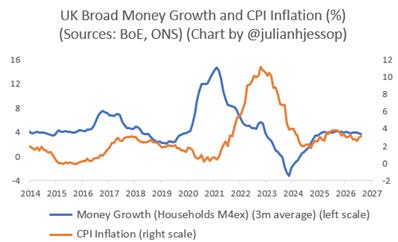
The latest money and credit data from the Bank of England showed broad money growth remains subdued at around 4%. In my view, this is too slow to fuel a prolonged surge in inflation – so no need for aggressive rate hikes – but not weak enough to sound the ‘all clear’ either.
Much further afield, the Reserve Bank of Australia (RBA) hiked interest rates for the fourth time this year, taking the policy rate to 4.6%. My take here was that most of the comments in the accompanying statement could apply to the UK economy too…
Wednesday 30 September
Revised GDP data showed that the UK economy grew faster than previously thought in the second quarter, increasing by 0.5% (nudged up from 0.4%), following an unrevised increase of 0.6% in Q1. Three more points…
First, the highlight was the strong growth in GDP per head in both Q1 and Q2, matching the headline number, as net migration has fallen back. The impact of the ‘Boris Wave’ is one of several factors that have distorted the economic performance of ‘Brexit Britain’ since the vote to leave the EU, but that distortion has now run its course.
Second, UK growth continues to outpace Europe’s other major (G7) economies, as it did in 2025; another narrative buster for those claiming ‘Brexit Britain’ is fall further behind. Business investment in particular has been recovering strongly from the initial hiatus after the vote to leave.
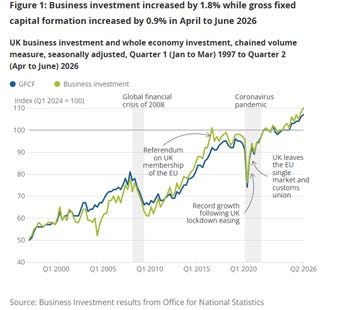
Third, the Q2 strength was not because of higher public spending and borrowing (government consumption of goods and services actually fell by 0.5%). If you want a simple story, I’d focus instead on the large contributions from “information and communications” and “professional scientific and technical activities“, including AI-related spending.
Thursday 1 October
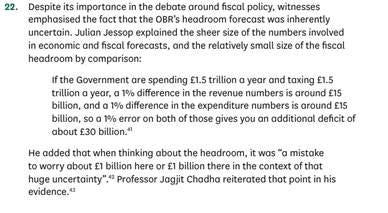
Better late than never, I caught up with the final report of the House of Commons Treasury Select Committee on the OBR “15 years on”. I had two mentions, one on the risk that the OBR’s forecasts are too conservative…
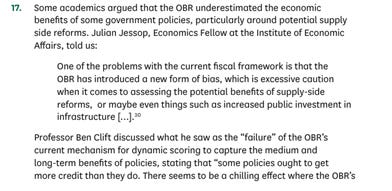
And a second on the spurious accuracy of the fiscal ‘headroom’…
Friday 2 October
I took one for the team and read Zack Polanski’s speech at the Green Party conference, so you don’t have to.
Three lowlights…
First, “Government ministers go on TV and talk down rent controls against the evidence. To see Jonathan Reynolds on Question Time say that no economists support rent controls is absurd.”
My response: there is overwhelming evidence that rent controls don’t work as intended, and that’s why you’d be hard pushed to find any serious economist who backs them.
Second, “We need to stop governments using the blunt tool of interest rates to control inflation. I meet mortgage holders who are constantly worried about renewing. They tell me they crave certainty about the future.”
Response: what’s the alternative? I’m guessing it’s using taxes to control demand instead – the standard MMT remedy – but there are many good reasons why monetary rather than fiscal policy is used to control inflation. And even using Polanski’s example, mortgage holders would then need to worry about the volatility in their tax bills instead.
Third, “Tax the very richest… Unlike Labour we will not hesitate in taxing extreme wealth. We will apply a windfall tax to obscene bank profits…”
Response: notable absence of any specific commitment on a new wealth tax here, e.g. a 2% annual charge – would be nice to think he’s has listened here to all the economists who are telling him why that wouldn’t work either!
The “windfall tax on obscene bank profits“ is just student politics and ignores any economic reality – like how much extra UK banks are already taxed, and how any increase would be passed on to customers including, er, “mortgage holders”…
In short, none of this is remotely credible.
If you really want more, the Green Party’s plan for a three-year emergency brake on rent increases is, of course, a terrible idea. Rents would not be allowed to increase by more than whichever is the *lowest* of CPI inflation, wage growth or 2% (a sort of ‘triple lock’).
Even ignoring the question of whether the state should dictate what people do with their own property, this policy would surely backfire.
For a start, the inevitable speculation ahead of implementation would prompt more landlords to sell up (reducing rental supply), while others would charge a higher rent now so that any future increase would be from a higher base.
Once the scheme is in place, it would distort the market even more.
Landlords would no longer be able to raise rents to cover cost increases above 2% (in contrast to how the Ofgem cap on energy bills works). This would make renting out property even riskier, reducing supply further.
Nor would rents (i.e. prices) be able to respond to changes in national or local demand. In effect, the market would be stuck for at least three years (and probably longer, because ‘temporary’ measures have a habit of becoming permanent).
A better solution? Allow markets to work properly and prices to adjust in line with supply and demand – exactly the opposite of what the Greens are proposing.
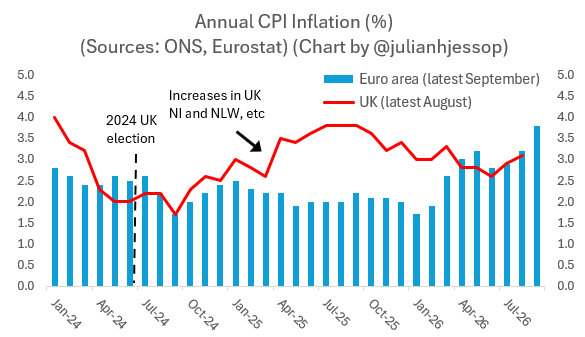
Meanwhile, back in the real world, euro area inflation jumped to 3.8% in September, from 3.2%, mainly due to higher energy costs. The Ofgem cap on domestic bills will delay some of the impact on the UK CPI until October, but inflation is about to jump here too.
And finally…
Maybe there is some hope after all… 😉
You can also follow me on X (formerly Twitter) @julianhjessop and on Bluesky @julianhjessop.bsky.social.

