
Andy Burnham’s first week as PM has coincided with some better economic news. The more positive tone from No.10 may help a little further, but the inflation and fiscal risks haven’t gone away.
Andy Burnham’s first week as Prime Minister has coincided with some better news on the UK economy and especially on business and consumer sentiment.
The highlights were on Friday.
For starters, the GfK measure of consumer confidence jumped six points in July, as respondents turned much less pessimistic on the “general economic situation”.
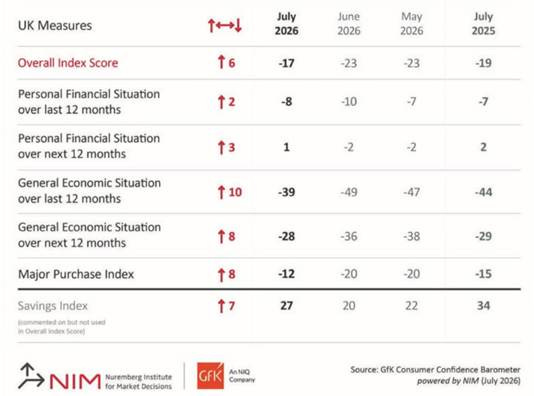
The hard data on consumer spending were decent too: retail sales volumes rose another 1.0% m/m in June, on top of a 1.2% increase in May. In Q2 as a whole, sales rose 0.6% (1.2% excluding motor fuels).
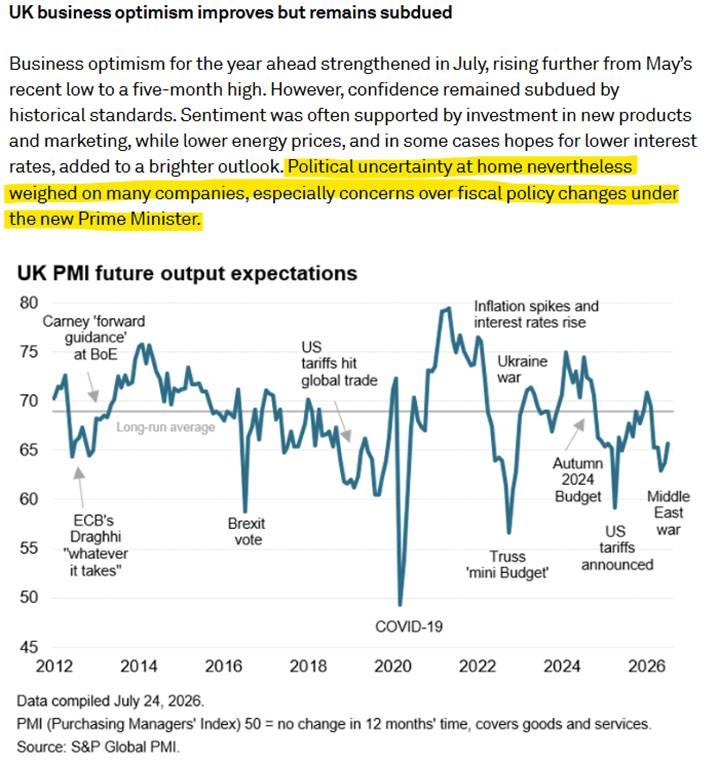
On the business side, the flash UK PMI Composite Output Index jumped to 52.1 in July (June 49.3), a 3-month high, with firms more optimistic about the next 12 months too.
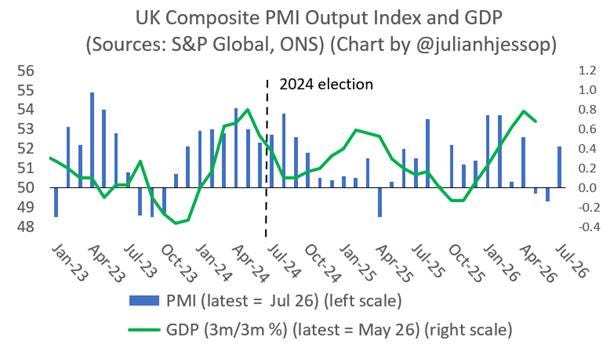
The economic data earlier in the week were more mixed (I will wrap these up as usual on Saturday), but they were not too bad either.
This begs the question of how far this better news can be described as a “Burnham bounce”. There are four points to make here.
First, Andy Burnham did not become Prime Minister until 20th July, so it is a bit of a stretch to give him much credit for the June retail sales figures! However, he won the Makerfield by‑election on 18th June and Keir Starmer announced his intention to resign on 22nd June.
It is therefore at least plausible that the prospect of a change in PM has already had some positive impact on both consumer and business confidence. The GfK survey was taken between 1st and 14th July, when Burnham’s coronation was already assured, and the PMI was taken between the 9th and 22nd.
Second, whatever you might think about the substance of the policy announcements so far (again, I will have a go at them in my weekly wrap), the Burnham team has managed the communications well.
The contrast between the doom and gloom “it’s even worse than we thought” messaging from the early days of Starmer and Reeves could not have been starker. Burnham’s first policy steps may have been gimmicky, but they have gone down rather better than the cut in winter fuel payments announced two years ago.
Third, though, there is little hard evidence of a specific “Burnham bounce” in either the consumer or business data.
The GfK press release noted that “the sense of a fresh start following the appointment of a new prime minister surely accounts for some of this bounce”, but that seems speculative. Other factors might have included the good weather, England’s decent run in the World Cup, and hopes – at the time – of an end to the crisis in the Middle East.
These other factors also appeared to be key drivers of the bounce in the PMI survey, along with others such as strong spending on AI. The significance of any “Burnham bounce” here is undermined too by the fact that there was also a big jump in the eurozone PMI, where the composite output index rose to 51.9 (June: 50.0), a 5-month high.
Indeed, the more detailed commentary on the PMI survey suggests that domestic political uncertainty (especially about tax) is still a drag on business optimism in the UK.
Fourth, and finally, one key driver of consumer and business confidence has definitely changed – for the worse. The renewed escalation of the crisis in the Middle East has already led to a surge in global energy prices.
Strong competition had helped to prevent UK petrol prices from rising quite as much as feared in the spring, but the latest jump in the cost of crude oil will keep them high.
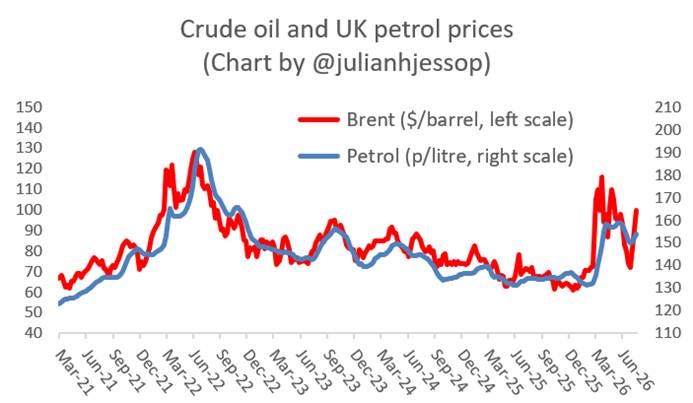
The latest jump in wholesale energy costs also means that the Ofgem cap on domestic bills is likely to be raised again in October. Any rise would be bigger without the cut in VAT on the electricity component. But the fact that bills are going up at all will undermine confidence – including in the new government.
Mortgage costs are starting to creep up again too as the markets reassess the outlook for official interest rates.
In summary, I wouldn’t bank on a “Burnham bounce” for the UK economy over the summer. Political uncertainty remains high, both at home and abroad, while the inflation and fiscal risks haven’t gone away.
You can follow me on X (formerly Twitter) @julianhjessop and on Bluesky.
I also post regularly on Substack.

