
My regular review of news over the past seven days, including thoughts on Burnham’s first policy announcements, overseas aid, “anti-social businesses”, and the latest economic data (good, in parts).
A week may be a long time in politics, but the new team at No.10 has navigated it well. A polished sequence of flashy policy announcements and PR stunts has given the impression of a fresh start. This word cloud posted by Luke Tryl makes the point well.
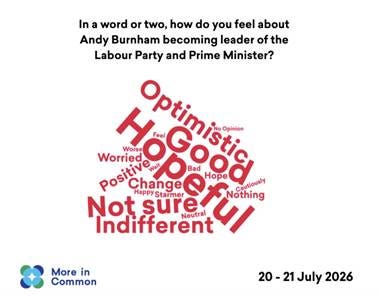
Obviously, good vibes don’t pay the bills, but I wouldn’t dismiss their importance entirely – either in terms of consumer confidence or the political capital to make much tougher decisions (such as on funding social care?).
Nonetheless, vibes aside, very little has actually changed in policy terms. For example, the three headline announcements are just more of the same.
First, VAT on electricity bills will be cut to zero for an initial six months. In a full year this might save the average household £45. However, Keir Starmer and Rachel Reeves had already switched £150 of costs from energy bills to general taxation.
Second, most bus fares will be capped at £2 in England. This simply returns the cap to the level that Labour inherited from the Conservatives, before Starmer and Reeves increased it to £3.
Third, business rates for pubs and live music venues will be cut by 20% in the next financial year. This is nothing new either. Starmer and Reeves had already reduced them by 20% this year, although the new cut will be on top of that.
Of course, this might not matter if these were good policies. But none of them make a lot of sense.
Removing VAT from electricity bills is not a particularly effective way to tackle the cost of living crisis. In part this is because most of the savings will go to richer people whose bills are generally bigger. Nor will this policy do anything to tackle the underlying reasons why UK electricity prices are so high – especially for businesses – or to provide help with gas bills. (I wrote more on this in an earlier blog.)
It is a little easier to justify a lower cap on bus fares. But someone still has to pick up the bill for the difference – and in this case most of the costs will be met by taxpayers. Even the official impact assessments suggest that caps on bus fares are poor value for your money.
The reduction in business rates is another vibes-based announcement which will barely make a dent in the cost increases that pubs are facing, often as a result of other government policies.
It will also complicate the tax system even further. The government is proposing to pay for this cut, in part, by reviewing reliefs provided to “anti-social businesses, such as vape shops”. This sweeping statement made me uneasy.
Obviously, the state should crack down on illegal activities that may take place in vape shops – or anywhere else. Zoning restrictions can also be used to keep certain businesses away for, for example, schools. But selling vapes is not intrinsically “anti-social”, and the business rates system is not the right place to address any problems that do arise.
Moreover, the idea that central government should dictate the mix of businesses on every high street sits uneasily with Burnham’s commitment to devolution.
Of course, others might say that the government is only trying to shape the high street in ways that people want. But consumers already have a simple way to influence which businesses thrive – by choosing where to spend their own money.
Sunday 19 July
The week started early, again. I was on Matthew Wright’s morning show on LBC to discuss reports that Burnham plans to restore overseas aid spending to 0.7% of national income.
This would be an odd priority in narrow political terms – polling consistently shows that the aid budget is a popular target for cuts.
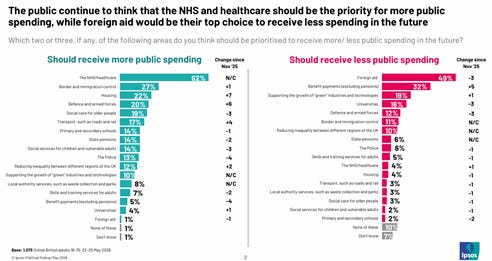
Perhaps this plan (if confirmed) would be part of a pitch to lure back voters who have defected to the Greens. Or it might be intended as a sweetener to persuade Ed Miliband to move to the Foreign Office. But my turf is the economics…
Starting with the money, overseas aid spending is currently about 0.5% of national income and the plan has been to cut this to about 0.3%, mainly to finance an increase in the budget for defence. Returning aid to 0.7% of national income might therefore cost as much as £15 billion a year, creating another headache for the new Chancellor, John Healey. I suspect this headache will be eased by setting the 0.7% as an aspiration for the next parliament, rather than making it a priority now.
But there is a more fundamental problem. If people want to support good causes overseas, they are already free to do so. Indeed, some of the most successful projects in developing countries – such as vaccine rollouts – have been funded by philanthropic billionaires.
In my view, it makes more sense for the government to focus on things that only the government can do – in this case, supporting developing countries by lowering barriers to international trade and finance. There is plenty of evidence that market- and rights-based solutions provide much longer lasting benefits.
Monday 20 July
I went on Times Radio to discuss what the markets might make of the cabinet appointments – especially the surprise choice of (another!) Healey as Chancellor. The immediate reaction was that this was a smart move.
In part this is because of the alternatives. In particular, Ed Miliband should now do less damage to the economy as Foreign Secretary – albeit at the price of a big increase in overseas aid spending – while picking Healey for the Treasury avoids the internal Labour tensions if either Miliband or Mahmood had got the job.
However, John Healey is largely an unknown on economic policy, except of course for his desire to increase the budget for defence. Moreover, he has strong union links (before becoming an MP, Healey held comms and campaign roles at the Manufacturing, Science and Finance trade union and then at the TUC). And while he has been a junior Treasury minister, he has no real business or private sector experience…
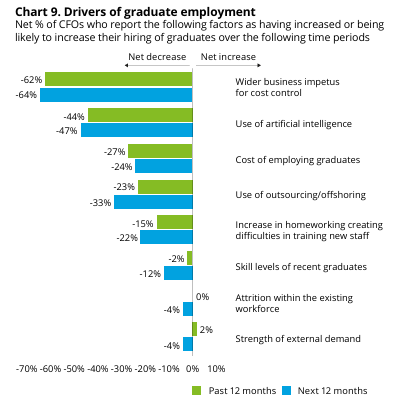
Meanwhile, the latest Deloitte UK CFO survey provides a bit more colour on the weakness of graduate recruitment – greater use of AI is a key factor, but wider cost pressures are the main headwind (hopefully the latter is only temporary).
Tuesday 21 July
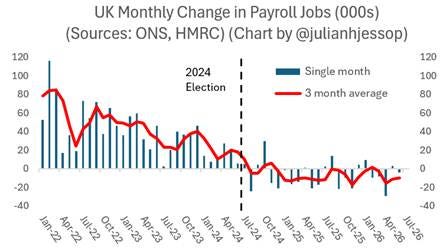
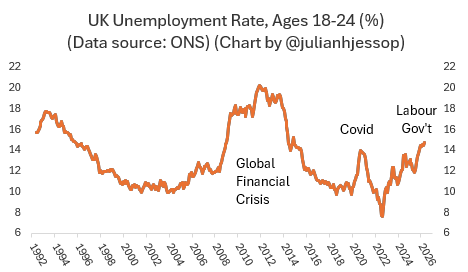
The latest official data added to survey evidence suggesting that the labour market may be close to bottoming out: payrolled employment “only” fell by 4,000 in June (#glasshalffull). But there are still 71,000 fewer jobs than a year ago, and 163,000 fewer than in June 2024.
Moreover, youth unemployment continues to climb. Here is the latest official data, with the major shocks marked.
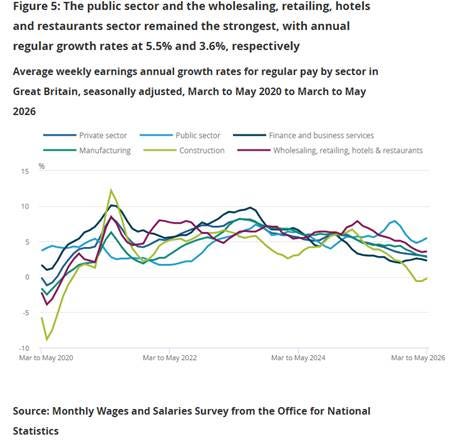
Many others also picked up on the continued divergence in average regular earnings growth between the public sector (5.5% in the 3m to May) compared to the private (just 2.9%). Digging deeper, the weakness in construction is also striking; weekly pay here is actually falling, providing further evidence of the crisis in the sector.
Wednesday 22 July
CPI inflation fell to 2.6% in June, from 2.8%, a bit better than expected. The key drivers were lower food and motor fuel prices, while core inflation was unchanged. Strong competition and discounting also helped in clothing and household goods, but services inflation is sticky.
Inflation is still set to jump to 3% or more in July (the increase in the Ofgem cap on domestic energy bills will add about 0.5%). It is also unlikely to return to the 2% target until next year. Overall, it’s far too soon to sound the “all clear” either on inflation or on interest rates.
Thursday 23 July
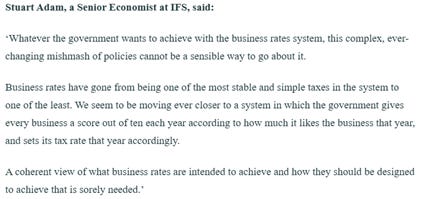
This was the day that the Burnham announced a 20% cut in business rate for pubs and live music venues. Not much more to say, except to note the near-universal thumbs down from economists and tax specialists, but I guess we are not the target audience!
This response from the IFS was typical
Friday 24 July
Some better economic news, though with some big caveats (which I discussed in a blog on hopes for a Burnham bounce).
The GfK measure of consumer confidence jumped six points in July, as respondents turned much less pessimistic on the “general economic situation”.
The hard data on consumer spending were decent too: retail sales volumes rose another 1.0% m/m in June, on top of a 1.2% increase in May. In Q2 as a whole, sales rose 0.6% (1.2% excluding motor fuels).
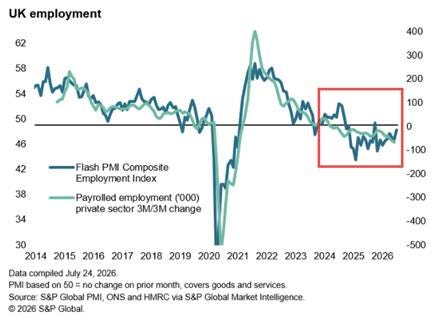
On the business side, the flash UK PMI Composite Output Index jumped to 52.1 in July (June 49.3), a 3-month high, with firms more optimistic about the next 12 months too. The detail suggested that private sector employment continued to fall in July, but at a much slower rate.
The main caveat? The renewed escalation of the crisis in the Middle East has already led to a surge in global energy prices.
Strong competition had helped to prevent UK petrol prices from rising quite as much as feared in the spring, but the latest jump in the cost of crude oil will keep them high.
The surge in wholesale energy costs also means that the Ofgem cap on domestic bills is likely to be raised again in October. Any rise would be bigger without the cut in VAT on the electricity component. But the fact that bills are going up at all will undermine confidence, including in the new government.
Mortgage costs are starting to creep up again too as the markets reassess the outlook for official interest rates ahead of next week’s Bank of England meeting.
And finally…
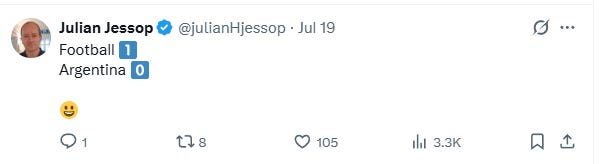
It’s always good to end on a positive note, so congratulations to Spain!
You can follow me on X (formerly Twitter) @julianhjessop and on Bluesky.
I also post regularly on Substack

