A small rate rise soon could be preferable to larger increases later – a case of “a stitch in time saves nine”. However, subdued money growth and strong competition should help keep inflation down.
The Bank of England’s MPC left UK interest rates at 3.75% today, as expected, but the 6-3 split was more hawkish. Catherine Mann joined Megan Greene and Huw Pill in voting for an immediate hike.
In short, Mann now agrees with the others that higher rates are needed to restore credibility, given the persistence of the energy price shock, the long period of above-target inflation, and elevated inflation expectations.
This is a reasonable position to take. Inflation has now been above two per cent every month for nearly two years and is unlikely to return to target for at least another year. In the near-term the Bank staff project that CPI inflation will average 3.2% in the fourth quarter of 2026, up from 2.6% in the month of June.
Meanwhile, activity has proved unexpectedly resilient and the labour market seems to be stabilising. This lessens the risk that an unexpected rate rise would push the economy into an unnecessary recession.
A small rate rise now could send a clear signal that the Bank is determined to prevent inflation from spiralling out of control again. It would also be preferable to larger increases later – a case of “a stitch in time saves nine”.
The MPC appears – rightly – to be giving little weight to the government’s attempts to massage headline inflation down with measures targeting individual prices, such as taking VAT off electricity bills. Any impact here would only be temporary and swamped by other factors.
Nonetheless, the majority view was that rates should be held. For me, that position was marginally stronger (as reflected in my vote on CityAM’s Shadow MPC). If anything, I think the case for raising rates to protect credibility has weakened since the last meeting.
There is still no sign of significant second-round effects from the surge in energy prices. Inflation expectations have fallen slightly, private sector wage growth continues to slow, and strong competition is holding shop prices down despite rising costs.
Broad money growth remains too weak to fuel a sustained rise in inflation (in contrast to the surge in 2020), while higher market interest rates are already leading to a tightening in financial conditions.
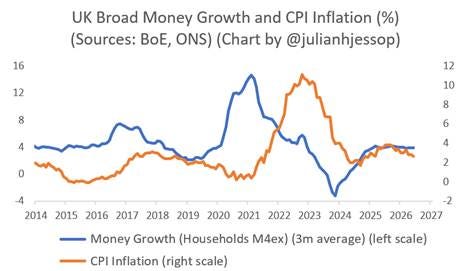
Indeed, it was good to see two MPC members (Sarah Breeden and Huw Pill) mention the moderate growth in broad money as one reason to keep rates on hold (even though this was not enough for Pill!).
The upshot is that the decisions at the next few meetings are also likely to be finely balanced.
The Bank may be one step closer to raising rates this autumn, but a hike is far from certain. Subdued money growth and strong competition should still help to keep both inflation and interest rates down.
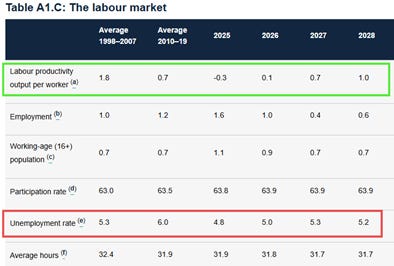
Ps, the Bank’s take on the labour market is interesting too…
The bad news is that the unemployment rate (4.9% in the three months to May) is expected to rise further, though this is because the working-age population is growing faster than employment, rather than because more jobs are expected to be lost.
More positively, growth in labour productivity (output per hour worked) is expected to pick up (helped by AI?), which should be good for wider economic growth and for real wages.