
Some thoughts on why contagion from France should be limited, what businesses really think about Brexit, and the latest on the UK labour market, inflation, consumer confidence and the public finances…
Theme of the Week
I’m recently back from a lovely break in southern France, where we experienced all the culture the region has to offer: hiking around Montségur, cassoulet in Carcassonne, and a light tear-gassing in Toulouse…
Seriously, we were only briefly caught up in the troubles, but I can confirm what most of the media is reporting. The protests about education and the cost of living had been hijacked by the far left and exploited by younger people looking for excitement, or simply for loot (often targeting shops selling tech or trainers, to shift on eBay and Vinted).
Nonetheless, outside the obvious hotspots, life was going on much as usual. Most of the locals seemed to be shrugging this off in the traditional Gallic manner, the cafes were busy, people were out jogging, or watching the rugby.
Of course, it may have been much worse elsewhere and some of the images from Paris and elsewhere were awful. But this still doesn’t feel like an existential crisis for France.
Unfortunately, once the smoke clears, the French economy and the public finances will remain in deep trouble.
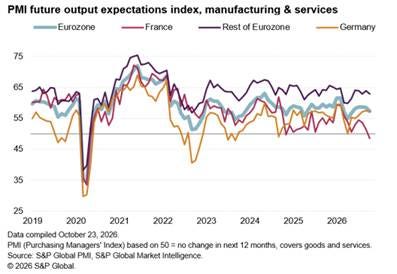
The latest PMI surveys confirm that France is cementing its position as the new sick man of Europe, replacing Germany.
Meanwhile, the cost of new government borrowing is still higher in the UK than in any other comparable economy, but the French sure are doing their best to catch up!
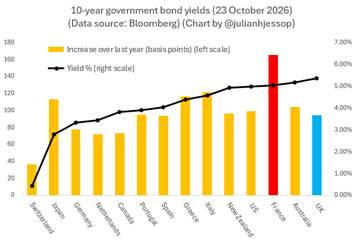
This will presumably drag on at least until the presidential elections in April next year.
There was a little relief on Friday when France avoided a ratings downgrade from Moody’s. This is a small surprise – both S&P and Fitch had already lowered France one notch and Moody’s was widely expected to follow. But it is not a big deal – rating agencies tend to lag rather than lead, and markets will make up their own minds.
The Moody’s statement suggests two factors kept France at Aa3 (the same as the UK, though the UK has a ‘stable’ outlook)…
“The Aa3 rating assumes that a deficit-reducing budget for 2027 will be adopted, while financing costs and social tensions will abate somewhat in the next few months.”
“France’s weighted average maturity of government debt of around 8.5 years entails that the increase in borrowing costs needs to be sustained over an extended period of time to have a meaningful negative impact on France’s debt affordability metrics.”
Nonetheless, the outlook for the French rating remains ‘negative’…
“A significant and sustained fiscal effort will still be needed beyond the presidential elections of April and May 2027 to bring France’s public finances onto stronger footing and stabilise a debt burden that will exceed 120% of GDP in 2027.
While we expect that the next president and government will seek to continue to narrow France’s deficit, our baseline expectation is that they are unlikely to be able to implement rapid fiscal consolidation in light of social tensions, a political environment that is likely to remain fragmented and muted GDP growth.
As a result, the debt burden will continue to rise through the remainder of the decade.”
In the meantime, though, contagion seems relatively limited. French bonds are increasing decoupled from other markets, especially over the last month, with German bonds in particular even benefitting from safe-haven flows.
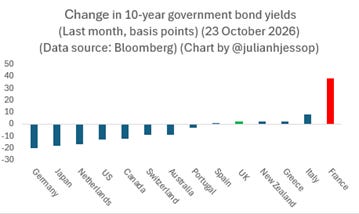
Moreover, in economic terms, the bad news from France is being offset by better (or less bad) news from elsewhere, again notably in Germany.
Closer to home, the UK economy is proving more resilient than expected, and the market still regard the UK’s fiscal plans as more credible (or less incredible) than those of France.
Last but not least, the UK is, in any case, relatively insulated thanks to being outside both the euro area and the EU. Long may that continue…
Monday 19 October
The S&P Global UK Consumer Sentiment Index fell in October to its lowest level in more than three years, weighed down by concerns about inflation and interest rates (echoed in the GfK poll released on Friday).
The only encouraging sign is that job security is improving, though from a low base. This is at least consistent with other surveys indicating that the labour market may be nearing its trough.
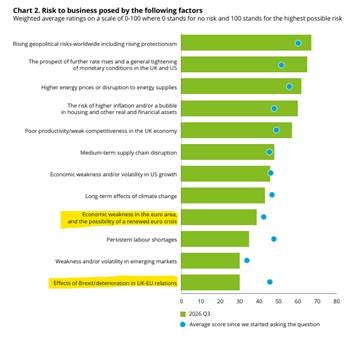
Meanwhile, I caught up with latest Deloitte CFO survey, which had two interesting charts relevant to the Brexit debate.
First, the ‘trade relationship with Europe’ ranks relatively lowly as a constraint on UK competitiveness; of course it might also impact others, but attempts to realign with the EU are more likely to increase ‘uncertainty’ and add to ‘regulation’.

Second, the ‘effects of Brexit’ remain rooted at the bottom of the risk list for UK businesses; indeed, ‘economic weakness in the euro area and the possibility of a renewed euro crisis’ are seen as bigger threats.
Tuesday 20 October
The slight improvements in the latest ONS data on the labour market were not a huge surprise if you have been following the employment components of the timelier PMI and recruitment surveys, which have been picking up.
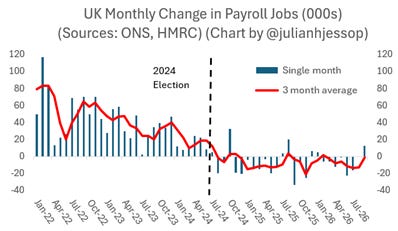
But the big picture is that the UK labour market remains weak In particular, there are still 66,000 fewer payroll jobs than a year ago, and 148,000 fewer than two years ago, despite the apparent strength of the economy (especially more recently).
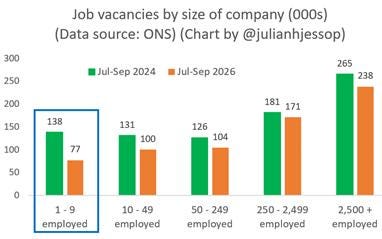
This is partly because the stronger GDP growth is being led by the rollout of AI, which is not as labour intensive as other activities. But more importantly, government policies continue to make it more expensive and riskier to employ people, especially the young and relatively inexperienced. The latest data on vacancies show this has hit job opportunities at small businesses particularly hard.
Wednesday 21 October
The main driver of the jump in CPI inflation to 3.5% in September was higher fuel prices, as expected, but core inflation excluding food and energy also picked up, from 2.6% to 2.8%.
The only good news is that food inflation held at 1.3%, thanks to intense competition in the supermarket sector, but this relief is unlikely to last.
Meanwhile, the run of bad news on the public finances continued. Borrowing was about £2 billion above the OBR forecast in September, mainly due to higher interest costs, and debt exceeded £3 trillion for the first time.
That said, while the ‘£3 trillion’ figure is helpful for focusing minds on the UK’s fiscal problems, it does need a couple of caveats.
First, this measure (PSND) is still relatively stable as a share of national income; it was about 94.0% of GDP at the end of September, which was actually 0.7pp lower than a year earlier and 1.2pp below the OBR forecast (the overshoot on new borrowing has been more than offset by faster-than-expected growth in nominal GDP).
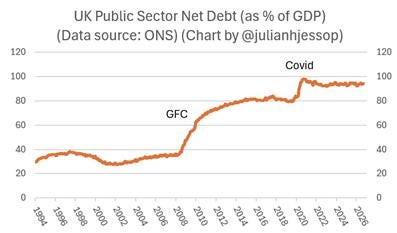
Second, the targeted debt measure is now PSNFL (public sector net financial liabilities), which has to be falling as a share of GDP from the third year of the OBR forecast.
For what it’s worth, his measure is still below £3 trillion (£2,643.4 billion, to be spuriously precise), as is the stock of gilts (£2,766.5 billion). There’s a good ONS summary of the different balance sheet measures here.
Thursday 22 October
I wrote a short piece on John Healey’s fantastical claim that Britain has ‘missed out’ on a trillion-pound sovereign wealth fund. In a nutshell, the UK is not Norway, and the idea that successive UK governments would have been happy to squirrel money away in US equities or Asian equities is just for the birds.
Friday 23 October
It was a big day for economic data, which I’ll summarise as the ‘good’, the ‘bad’ and the ‘ugly’.
The ‘good’ was the flash UK PMI Composite Output Index, which unexpectedly rose further to an 8-month high of 53.1 in October. This suggests that the recovery in services and manufacturing still has plenty of momentum.
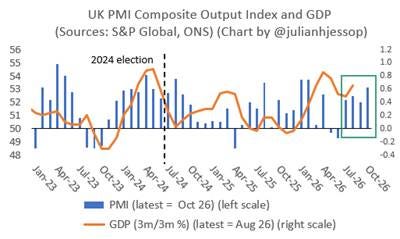
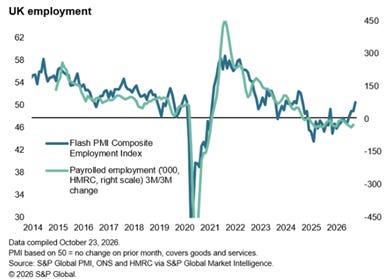
The employment component of the PMI also turned positive for the first time since hiring was hit by Rachel Reeves’ first Budget. This added to other survey evidence that the labour market is now bottoming out.
I would count the latest retail sales data as ‘good’ too. Volumes did fall by 0.4% in September, but this followed an upwardly revised increase of 0.7% in August, and the trend is still positive. However, it is hard to see this continuing as higher inflation and interest rates undermine confidence and spending power.
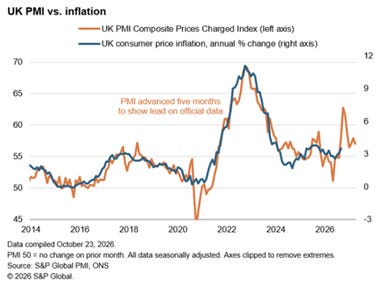
Turning to the ’bad’, cost and price pressures remain strong, and consistent with a further acceleration in headline inflation. A minimum of 4% now looks baked in for early in the New Year, double the MPC’s 2% target.
As for the ‘ugly’, the 11 point plunge in the GfK index of consumer confidence in October added to other evidence that rising fears about inflation and interest rates are taking their toll. Sentiment on the outlook for personal finances is at least relatively resilient, but it has turned negative again too.
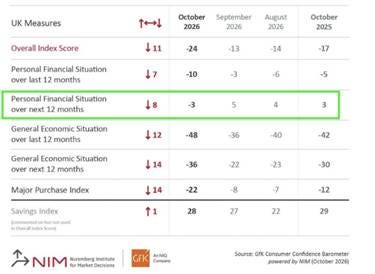
Reaching for anything positive to say, the 11 point slump in headline GfK measure matched the fall in July 2016 after the vote to leave the EU. But the index had fully recovered by September 2016, as the ‘Project Fear’ warnings of imminent recession were confounded.
It’s probably too much to expect such a rapid turnaround this time, but it is not impossible – depending on the latest news on inflation and interest rates, and on what’s in the Budget.
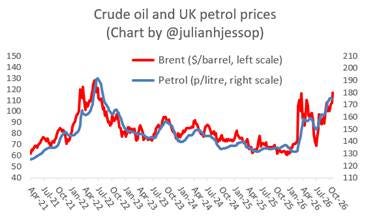
In the meantime, there has already been another blow: Brent crude has topped $116 a barrel on fears the US will resume strikes on Iran in the coming weeks. This might turn out to be another ‘TACO trade’ – would Trump really risk another surge in energy prices (and more casualties in the military) so close to the mid-terms? UK motorists will also be hoping that ‘Trump Always Chickens Out’…
And finally…
As ever, Chris Snowdon captures the mood perfectly….

You can also follow me on X (formerly Twitter) @julianhjessop and on Bluesky @julianhjessop.bsky.social.

