
Including thoughts on the OBR’s new forecasts and old Brexit assumptions, PuFIns, bank ‘windfall’ taxes, youth minimum wages, and why we actually need a ‘do some real good’ Budget.
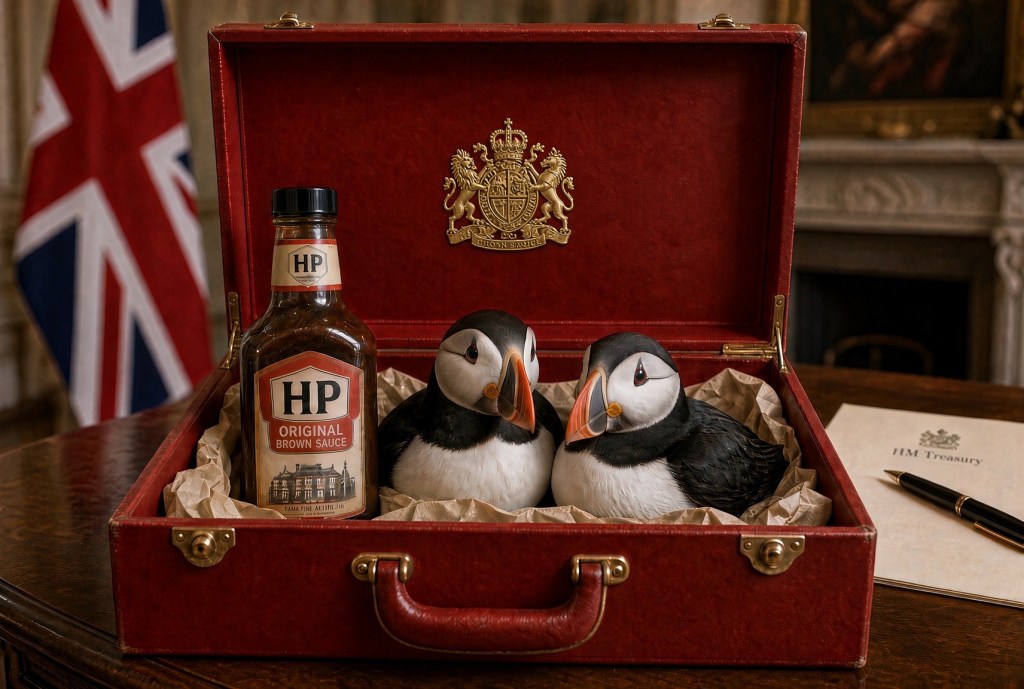
John Healey will probably be aiming for a low-key ‘do no harm’ Budget: a few treats for households and businesses, with no nasty surprises for investors and especially for the bond markets.
Here, the Treasury and the new Chancellor deserve some credit for keeping ‘kite flying’ to a minimum and avoiding the worst of the damaging speculation that undermined confidence under his predecessor.
Of course, this is much easier if you do not really know what you are doing and all the difficult decisions are being postponed. What is actually needed is a ‘do some real good’ Budget, but it seems unlikely that we will get that.
Andy Haldane has already dubbed this the ‘mañana Budget’. I am probably going to go with the ‘Ming Vase Budget’. Healey will not want to break anything – including Labour’s lead in the polls – in what might be the last major fiscal event before Burnham calls an early election.
Crucially, most of Burnham’s big ideas will require a new mandate. Some carry a hefty price tag, including a much larger role for the state in providing social care, utilities, and housing, while others would cross existing manifesto red lines, notably by seeking a much closer relationship with the EU.
For what it worth, though, here are seven things to watch for on Wednesday.
1. The new economic forecasts
The OBR’s updated growth forecasts should at least allow the Chancellor to start on a positive note. Back in March, the OBR predicted that the UK economy would expand by just 1.1% this year. The unexpected resilience over the summer means that this will probably be revised up to about 1.4%. Unemployment has been lower than the OBR feared this year as well.
However, that’s where the good news is likely to end. The March forecasts for growth in 2027 and 2028 (both at 1.6%) now look too optimistic, which partly reflects much higher inflation than the OBR and most others had been predicting. The projections for unemployment in coming years will probably be raised too.
2. Brexit and productivity
It will be surprising if the OBR says anything new about the impact of Brexit, or much at all about either the proposed UK-EU ‘reset’ or the options for a much closer relationship. In part this is because this whole area is a political minefield. The OBR can also hide behind the convention that it only assesses confirmed policy choices, rather than options.
Nonetheless, it will be interesting to see whether the OBR continues to defend its shaky ‘working assumptions’ about the impact of Brexit on productivity (a 4% long-term hit) and on trade (a 15% hit to the UK’s exports and imports of goods and services to the entire world). The 15% in particular is very hard to square with what has actually happened.
The OBR will surely have to say something about the new ONS estimates for labour productivity – specifically, output per hour worked – though the upside for economic growth and the public finances might be offset by lower estimates for hours worked and for net immigration.
3. The fiscal outlook
There are a great many moving parts in the forecasts for the public finances, and some are definitely heading in the wrong direction. In particular, the jump in the cost of government borrowing could take a big chunk (at least £10 billion) out of the fiscal headroom of around £24 billion that Healey inherited from Rachel Reeves.
But there are some factors that might still partly offset that, notably the positive impact of higher inflation on tax receipts. The upshot is that Healey might ‘only’ have to find another £5 billion or so to maintain the existing headroom – in the absence of any new spending commitments…
4. Cost of living support
In reality, of course, Healey will want to spend more, especially on support with the cost of living.
This might be possible within the existing fiscal rules if the additional spending is temporary, because the rules only bite in the third year of the forecast period, or if Healey is willing to risk running down the fiscal headroom. But the markets are not in a forgiving mood, so even a one-off package may need to be fully funded.
The likely measures include another increase in the Warm Homes Discount on energy bills for households on benefits, and yet another extension of the ‘temporary’ cut in fuel duty. There will also be some new wheeze to ensure that older people living solely on the state pension do not have to pay tax on it.
In total this could easily cost north of £5 billion a year.
We also already know that Healey intends to increase funding for the National Wealth Fund (by a reported £15.4 billion spread over several years) and the British Business Bank (£5 billion). These are two examples of Public Financial Institutions, aka ‘PuFIns’.
This has been criticised by some as ‘off balance sheet’ funding, or even ‘fiddling the books’, because borrowing offset by the acquisition of a financial asset is neutral for the targeted measure of debt (PSNFL). I do not think that specific criticism is fair: these activities are still very much on the balance sheet, and in a transparent way.
But there is a broader concern, which is that more borrowing is still more borrowing, whatever the purpose, and the state’s track record of investing your money wisely is pretty dismal. The only consolation here is that £20.4bn is not a huge amount in the bigger scheme of things, but this could still set a worrying precedent.
There are also some medium to long term spending commitments that will need to be funded, notably a credible plan to raise the defence budget.
5. More tax increases
This means that this Budget will raise taxes even further.
The Chancellor has at least ruled out some of the dafter ideas, such as the crude equalisation of capital gains tax and income tax, or a brand new wealth tax. Whatever the simplistic appeals of these proposals, both the Treasury and the OBR will have told the Chancellor that they would not have raised a significant amount of money.
Any tax increases are also unlikely to be anywhere near the scale of those implemented by Rachel Reeves, which totalled close to £70 billion a year.
Nonetheless, there will surely be another dog’s breakfast of smaller measures targeting ‘excess profits’ and any other activity that Labour deems ‘anti-social’, as well as some smaller tweaks to taxes on wealth, including property and other family assets.
An increase in the taxes on UK banks seems baked in, even though they are already more heavily taxed than other businesses (thanks to the 3% surcharge on corporation tax and the additional levy on their balance sheets).
This will be popular, but misguided. The obsession with the headline profits made by the likes of HSBC is misleading, both because these are global figures, not just a reflection of activities in the UK, and because cash profits are always likely to be hitting new highs because of the impact of inflation.
It is also not obvious what the ‘windfall’ is supposed to be. Banks have benefited from the normalisation of interest rates, but the key driver of the jump in HSBC’s profits was cost cutting and fewer one-off charges. Indeed, the results fell short of market expectations, and HSBC’s share price has dropped sharply today.
There is a separate debate to be had about the amount of interest that banks are paid on the reserves they keep at the Bank of England. But if that is the concern here it should be tackled directly, perhaps by a tiered system of interest rates, rather than an arbitrary increase in the tax on all profits regardless of their source.
Moreover, any windfall tax might be collected from the banks, but it will ultimately be paid by real people. Shareholders will bear some of the cost through lower profits and dividends, although many ‘ordinary’ people own bank shares through their pension funds.
But customers will also pay through higher bank charges, while employees will face lower wages. Everyone will lose if banks cut jobs and investment, or move activity overseas.
In summary, a further small increase in bank taxes might be the least-bad way to raise a couple of billion to help households with their energy bills, if there really is no alternative. But it is foolish to pretend that banks can be tapped for ever larger amounts of money without any wider economic costs.
6. Other announcements
The Chancellor will also use the opportunity to confirm some measures that have already been announced – or as good as.
This includes some further tariff suspensions on food, drink and fuel, which would not possible if the UK were still in the EU, or even just a customs union.
More importantly, The Times has reported that “John Healey will announce plans to increase the minimum wage by nearly 4 per cent but slow the rise for young people”. This is eminently sensible – and brave for a former union man.
There is ample evidence (including from the government’s own Low Pay Commission) that large increases in minimum wages have reduced job opportunities for young people, especially in sectors like retail and hospitality.
for those saying that lower wages for younger workers are ‘discriminatory’, remember that the national minimum wage is a ‘minimum’, not a cap; there is nothing to stop an employer from paying more if a younger person’s work is indeed of equal value.
It is also no coincidence that France, with one of the highest minimum wages relative to median earnings, has some of the highest rates of unemployment, particularly among young people.
But it is worth noting too that France also has relatively high employment taxes and excessive labour market regulation – a lesson that the UK government has yet to learn…
7, What’s missing…
That’s a good place to start. The measures in a ‘do some real good’ Budget would include rolling back the additional taxes and regulations which have increased the cost of doing business in the UK, beginning with employers NI and the Employment Rights Act.
The ‘do some real good Budget’ would also abolish some of the most damaging taxes – notably stamp duty on both property and shares – or at least simplify and improve the tax system in a revenue-neutral way.
We also need a much more credible plan to control public spending over the medium to longer term, which will involves some tough decisions on the size and role of the state and on the welfare budget in particular.
Unfortunately, these decisions will probably have to wait until the next parliament, and possibly for a different Chancellor.
You can follow me on X (formerly Twitter) @julianhjessop and on Bluesky @julianhjessop.bsky.social.

