
University leavers face a perfect storm: general economic uncertainty, competition from AI, the erosion of the graduate premium – and bad government policy choices that look set to get even worse…
There has been plenty of commentary today around new data published by the recruitment website, Adzuna.
These headlines were typical: “Graduate job vacancies drop by almost 50% in a year, survey suggests” (BBC) and “Graduate jobs market slumps to new low” (CityAM).
So, what’s going on?
As usual, it’s worth starting with a health warning about labour market statistics. The fall of “almost 50%” is based on just one month’s data from just one source. Specifically, Adzuna said it had only 8,383 graduate vacancies listed in July, down from 15,397 at the same point last year.
Adzuna is a key player in the industry and the market leader in the provision of vacancy numbers, which are widely used by government departments (including the ONS). But these data may still not be representative of the graduate jobs market as a whole.
The definition of a “graduate” job is also unclear, beyond covering adverts that include “graduate” in the title. Other roles may still be suitable for recent university leavers.
Moreover, although year-on-year comparisons are useful and these have been weak for some time, July is often a quiet month for graduate hiring. October’s figures may offer a better test.
Nonetheless, there is no doubt that the graduate jobs market is especially challenging this year, even if the true picture may not be quite as bad as some of those headlines suggest. Just ask almost anyone leaving university this summer!
This gloomy message is also consistent with the data from numerous other sources, including the official statistics on total vacancies and especially on youth unemployment.
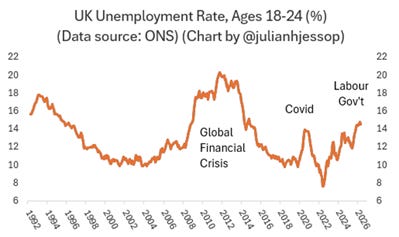
Turning to the underlying economics, a key but often overlooked factor behind the weakness in the graduate jobs market is general economic uncertainty and the broader push to control costs.
This is borne out by this chart, from Deloitte’s CFO Survey, conducted in early July.
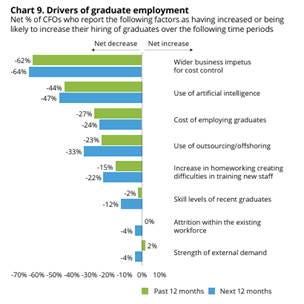
Graduates are not necessarily being singled here. Indeed, the latest available official figures suggest that graduate employment rates remain higher (and unemployment rates lower) than those for non-graduates. But as graduates tend to be younger than non-graduates, they may still be the first to lose out when there are hiring freezes.
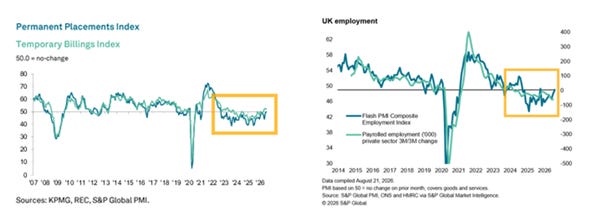
Hopefully this is only a temporary drag which will fade as economic confidence improves. More positively, the latest KPMG and REC UK Report on Jobs (a survey of recruiters) and the employment components of the latest composite PMI (both for August) suggest that the labour market may now be bottoming out. But the prospect of hikes in both taxes and interest rates in the autumn could derail any recovery here too.
Unfortunately, some other headwinds may last longer. The second most important factor in that Deloitte survey was the growing use of AI, which is another key reason why professional firms are cutting graduate recruitment. In time, AI should create or enhance more jobs than it destroys. But for now, we seem to be in an adjustment phase where the net effect is negative.
The third factor is the rising cost of employing young people. This is mainly due to some terrible government policy choices, including the large increases in employer National Insurance contributions and in minimum wages.
Tighter employment regulations are also hitting entry-level jobs especially hard. The clampdown on so-called “zero-hours contracts” is particularly unhelpful, as this flexible working model is especially important for younger people.
The relative importance of these factors will vary by sector. Economic uncertainty may affect hiring for any roles that graduates could fill, at least in the private sector. In contrast, AI may pose a bigger threat to entry-level professional jobs, while higher employment costs are more likely to hit lower-paid roles in sectors such as retail and hospitality.
Finally, of courses, the fact that many more young people are going to university means that a degree is no longer commanding the earnings premium that it did before. This at least still varies a lot by university and by subject, but for an increasing number of young people a degree is no longer financially worthwhile.
There’s a separate piece to write just on the “graduate premium” and I’ll turn to that soon. For now, I’ll just note the significant number of employers in the Deloitte survey who flagged concerns over the “skills levels of recent graduates”, which suggests that universities are failing students in more ways than one.
In summary, there are no easy solutions to the graduate jobs problem, which has many drivers. But a comprehensive approach would include removing the additional costs that have made it less attractive and more expensive to employ young people, reforming university finance, encouraging alternatives to a conventional degree, reforming the tax and benefit systems to help make work pay, and reducing policy uncertainty in the wider economy.
Now also seems a particularly bad time to agree a Brexit “reset” deal that would allow far more EU graduates to come and work here than the number of UK graduates who might head the other way.
For what it’s worth, I’m confident that the current government does understands at least some of these problems. But fixing everything would mean unwinding a lot of what Labour has already done, or promised to do.
You can follow me on X (formerly Twitter) @julianhjessop and on Bluesky.
I also post regularly on Substack
 Plain-speaking Economics
Thank you Julian. Good piece.Hopefully read
LikeLike