
Including thoughts on the PM’s “everyday fixes”, why we shouldn’t pick on mandarins, the downsides of emergency alerts, seasonality in the GDP data, and who is really “queuing up” to join the EU…
Theme of the week
Andy Burnham’s latest big idea is a series of “everyday fixes” to help with the cost of living. This is not daft – think of the successful strategy of accumulating “marginal gains” that helped Sky’s cycling team to dominate the Tour de France, or Tesco’s “every little helps…”.
But after a few announcements at the start of the week, the Burnham campaign seems to fizzle out. These announcements were lame too. They amounted to some small tweaks to consumer protection rules, notably those governing misleading advertising and subscription renewals. Moreover, these just built on, or accelerated changes already announced under the Starmer and Sunak governments.
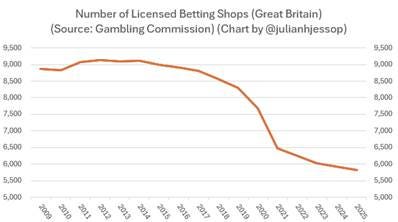
The new Prime Minister also took another swipe at bookmakers and vape shops, which are apparently taking over our High Streets. This is a perfect example of a vibes-based policy announcement which is completely at odds with the evidence.
For a start, here is what has actually happened to the number of betting shops…
What’s more, even a rather hysterical report from the Centre for Social Justice suggested that the number of specialist vape shops has risen by just 245 over the past decade, to “almost 2,200”.
These figures are almost certainly an under-estimate. But over this period the number of people vaping has more than doubled, partly driven by its official promotion as an alternative to cigarettes.
In other words, vape shops are just responding to demand, and it makes no sense to describe the activity of selling vapes as “anti-social”.
Of course, some may be a front for illegal activities (especially illicit tobacco, thanks to the UK’s excessively high taxes on legal products). But that’s a problem for law enforcement (and the tax system), not something to be addressed by planning rules…
In the meantime, if politicians are serious about tackling the cost of living, they should stick to the basics: rather than intervening even further, the government should free up markets to increase the supply of goods and services – including housing, food, and energy – and reverse the many policies which saddle businesses with lots of additional costs.
Sunday 9 August
I found myself arguing with Daily Mail readers after the paper ran a story about a senior civil servant. The online headline gives a flavour…
“Revealed: Mandarin who runs No10 North lives in £2.2million townhouse in trendy Islington, commutes by train to Manchester and stays in luxury hotel with 23rd floor bar and a pool”
I dislike this kind of reporting. No10 North may well prove to be a waste of money, but why personalise it by targeting a public servant?
In particular, what on earth has the value of his house got to do with it? Or the revelation that he wears “a pale blue shirt and maroon trousers”? Are we supposed to think he’s some sort of fat cat living the highlife with the taxpayer picking up the bill?
In reality, anyone this senior in the private sector would have the same perks and probably be paid a lot more. As the article grudgingly concedes, the mandarin himself paid to upgrade his tickets to “Standard Premium”. Moreover, the 4-star hotel mentioned looks unremarkable and bog standard for business travel.
Perhaps I’m oversensitive, as a former civil servant and current pensioner myself. But this sort of story is surely unhelpful if you want to attract top talent to the public sector.
Monday 10 August
Some more signs of life in the UK labour market.
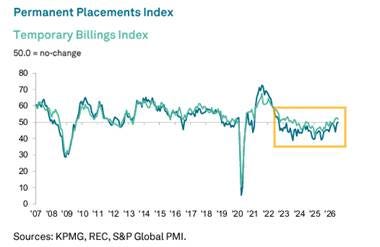
July’s KPMG and REC UK Report on Jobs suggests that the slump in permanent recruitment is levelling out and that temporary billings are already picking up (though note also that both are still weak by past standards).
Tuesday 11 August
In contrast, it looks like UK retail sales growth slowed in July. The BRC opted to headline its survey results with “consumer demand cools as temperatures soar”, but I’d have put “wilted” somewhere in there…
Wednesday 12 August
I was quoted in this piece in the i paper on what might be in the October Budge. You may find it paywalled, but in short…
“Unless the OBR can find a few billion under the mattress, it is highly likely that further tax increases will be announced in the October Budget.
The existing fiscal rules leave very little room for additional borrowing, even for investment, especially with UK interest rates already relatively high.
It is too soon to expect any fundamental reforms of the tax system this Autumn, though these will probably form part of the 10-year plan.
Instead, the Budget will seek to find more money from another dog’s breakfast of bitty tax increases. These are likely to target capital gains, pensions and property, all consistent with Burnham’s regional and redistributive agenda.
The Budget is also likely to target any business sector that Labour can spin as engaging in “anti-social” activities or making “windfall” profits.”
Thursday 13 August
The UK economy grew by 0.4% q/q in the second quarter, only slightly slower than the 0.6% in the first, with a strong finish too (GDP rose 0.3% m/m in June). These figures were much better than most (including myself) had expected at the start of the US-Iran war a few months earlier.
Given this, Rachel Reeves can be forgiven for seeking some credit for the strong growth numbers for the first half of the year, which she described as “not inevitable”.
Actually, though, perhaps it was? As my chart below shows, UK GDP growth has been strongest in the first quarter of each of the last four years, and second strongest in the second quarter.
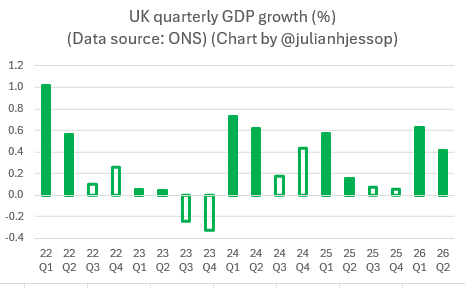
This might just be coincidence or, more likely, it reflects some residual seasonality in the data; either way, I bet the same happens this year.
The ONS and the Office for Statistics Regulation have both looked into this (see the commentaries here, here and here). In short, the jury is still out. The ONS methodology is fine, but there does appear to be some residual seasonality in non-official data too (such as the PMIs).
Everyone is struggling with this problem, which probably reflects a range of factors including the echo of Covid, the impact of Budgets, and the growing importance of the timing of online sales events.
It is worth noting too that the data are still pretty mixed – and it is hard to identify any way in which the government has helped. Indeed, the persistent weakness of the construction sector is a good bellwether for confidence in Labour’s policies overall: output fell here in every month of the second quarter.
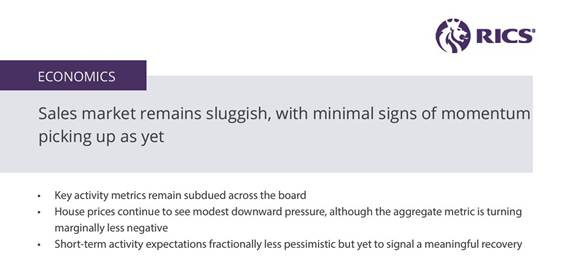
The latest RICS survey, also published on Thursday, is still not showing many signs of life in the housing market.
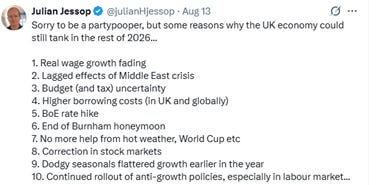
Finally, it is not difficult to think of reasons to be worried about the second half of the year. I posted a list of ten candidates on X…
Friday 14 August
A date for your diary: on 26 August the people of Iceland vote on whether to renew its 2009 application for membership of the EU, which was put on hold in 2013. I came across this good piece making the case for “no” by Hannes Holmsteinn Gissurarson (Professor Emeritus of Politics at the University of Iceland).
Indeed, this would have been another candidate for theme of the week. Other EU-sceptic pieces that caught my eye include a former Dutch Finance Minister asking “Will the Netherlands Accept Paying 12.5 Times More to the EU Than It Gets Back?“ and new polling showing strong opposition to full EU membership in Norway.
There’s an important point here. The countries that are “queuing up” to join the EU are typically much poorer economies who would be net recipients of support from the richer ones. In contrast, the UK (like Iceland, the Netherlands and Norway), would be a large net contributor, and thus better off out?
Meanwhile, almost all of us received another of the new emergency alerts on our phones, this one warning of the risks of wildfires.
This has divided opinion, but I agree with those (such as Alex Burghart) who are questioning whether this alert met what was supposed to be a very high threshold for their use based on strict criteria centred on an immediate risk to life.
I would just add two more points.
First, it’s not good enough to say that the fire service requested a national alert (despite the extra risks that their officers are undoubtedly facing). Politicians should decide and they should take the wider costs into account too (this didn’t happen with the Covid lockdowns either, partly because the medics insisted on them…)
Second, the costs here include people deciding to turn off alerts because they are disruptive and annoying, and the unnecessary alarm caused to more vulnerable people including the elderly or those in crowded public spaces.
And finally…
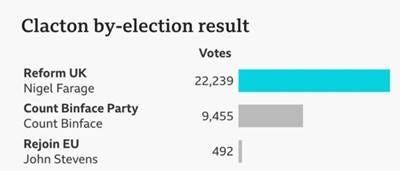
Joke candidate comes distant third in Clacton, with just 1.4% of the votes cast…
You can follow me on X (formerly Twitter) @julianhjessop and on Bluesky.
I also post regularly on Substack

