
Like many others, I spent much of the week both amused and angered by the Jason Arday scandal (mostly angered). But there’s also still plenty to write on the latest UK economic data and policy news.
Theme of the week
If you missed it (well done!), Jason Arday is a plagiarist, a serial liar and an incompetent fraud who nonetheless managed to find himself appointed Professor of Sociology at Cambridge University in 2023. He eventually resigned this week as the revelations mounted.
The Guardian published a handy list of the allegations against him and I am not going to dwell on the details. But if you want a sense of just how awful his academic work is, just try reading any of his published output, or watch one of the many excruciating videos of his media appearances and lectures which are now circulating online.
This story does at least have a few heroes, notably the handful of academics who have dared to speak out and the journalists who pursued the story doggedly, despite threats of legal action and even police investigation.
However, there are many more villains, including the people who promoted Arday and others who stood by. Many of his most vocal supporters have done more harm than good, while it is astonishing that a major publisher is still planning to release his book.
Last but definitely not least, there are victims too. I feel sorry for the better-qualified candidates who were overlooked, for Arday’s students, and for the many first-class academics of colour who may now feel unfairly tarnished.
But it goes further than this. The rot in academia is symptomatic of the “DEI crap” which has infected so much of our society – including the civil service, government procurement, the legal system, and many private businesses – with real economic costs.
What about Arday himself? Arguably, he fits in all three categories. If he was a “poster child” for DEI before, he has now done the rest of us an enormous favour by exposing the madness.
He is clearly a villain too. Arday was (and apparently still is) willing to exploit his position for personal gain, regardless of the costs to others, and to use threats to maintain it.
But while you would have to have a heart of stone not to laugh at his fantastical claims, even I find it difficulty not to feel a little sympathy too. Arday was clearly out of his depth and hopefully will get the longer-term support he needs.
End of rant…
Sunday 2 August
John Healey put his name to a comment piece in the Sunday Telegraph (I hope the new Chancellor didn’t actually write it), which was full of the usual platitudes and lazy soundbites. This paragraph in particular rightly drew a lot of flak.
“At home, we will be watching closely for any suggestions that customers are being taken for a ride at the pump or the till. Companies’ willingness to work with the Government throughout this crisis has been positive, and there has been no significant evidence of so-called price gouging, but I want to be blunt in reassuring the public that our regulators have the powers to clamp down on it if it happens.”
Where to start? Once again, a Labour Chancellor has chosen to have a pop at supermarkets – perhaps the most competitive sector in the UK economy, operating on wafer-thin margins.
Note also the mindset that it is government that keeps prices down, not market forces, and the failure to acknowledge that it is government itself, through numerous policy choices, which is adding to the cost pressure faced by retailers. And the playing to the gallery: “suggestions” alone will apparently be enough, no need for evidence.
Monday 3 August
Some more signs of life in UK manufacturing…
After recovering past the recent peaks seen in summer 2024, the headline S&P Global UK manufacturing PMI fell to a four-month low of 51.9 in July, with employment faltering again too.
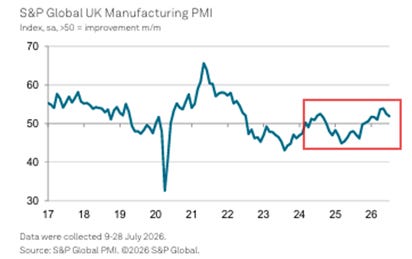
But this was partly due to the end of the temporary boost from stockpiling in the early stages of the US-Iran conflict. There were some brighter spots in the detail: output and orders were both up and price pressures are easing.
The underlying picture for manufacturing does also look a little rosier in the UK than in the euro area, where the headline index was also 51.9 but new orders, in particular, were weaker.
Tuesday 4 August
The Times ran a story with the eye-catching headline “Treasury seeks to kick-start economy with £9bn-a-year borrowing bonanza”. This needs some unpacking.
First, this does not mean that Burnham is already breaking his promise to stick to the existing fiscal rules. As The Times correctly explained, this is about making more use of the flexibility within these rules, rather than a changing them.
It was Rachel Reeves who switched the targeted debt measure from “net debt” to “Public Sector Net Financial Liabilities” (PSNFL), which must be falling as a share of GDP in three years’ time).
This change already allows some more borrowing for investment, as long as this involves the acquisition of a financial asset.
Second, though, the £9 billion figure is just a guess at the amount of additional spending that might be possible within the rules. The real figure could be very different by the time the OBR crunches the numbers for the Autumn Budget. There may well be no margin at all.
Third, even £9 billion would still be a relatively small number in the context of overall government spending and existing debt. It would certainly not be enough to “kick-start” the economy.
Finally, more borrowing is still more borrowing, whatever the purpose.
Investors will probably look more favourably on borrowing to invest in assets that create a financial return (such as housing and stakes in private companies), rather than borrowing just for day-to-day spending.
But the track records of successive governments are poor here, and the appetite for even more gilts is already limited.
In short, this is not as much of a story as some have suggested. Nonetheless, it is the sort of thing that will keep markets nervous ahead of the Autumn Budget.
Wednesday 5 August
Louise Haigh announced plans to strip back procurement rules to focus on job creation, which were well explained here. In short…
“Suppliers will be assessed on their commitment to back British jobs, skills and opportunities, specifically targeting support for young people not in education, employment or training (NEETs), care leavers and individuals with long-term health conditions.
This will replace the current model, which considers economic, social and environmental value including: promoting innovation; fair working conditions; the wellbeing of the workforce; protection of the environment; habitat creation; energy efficiency; and combating climate change.”
I think this merits two cheers, but not three: government spending should not prioritise “job creation”, which can just mean diverting employment from more productive activities and is less likely to be value for money.
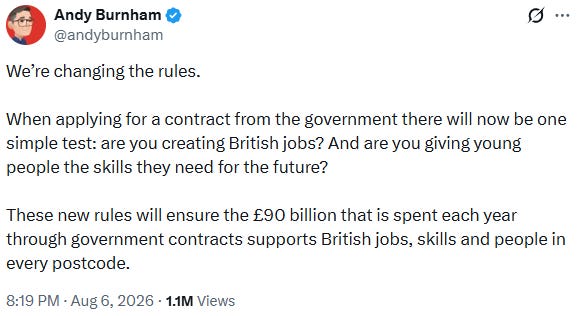
Burnham then reinforced these concerns with the take below. If this means what he says, expect a big hit to labour productivity. Apparently the more people a project employs, the better…
Meanwhile, the final S&P Global UK PMI Composite Output Index (covering manufacturing and private sector services, excluding retail) jumped to 52.2 in July, with greater optimism about the next twelve months too.
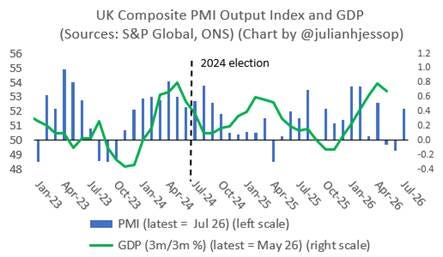
Good news, but I would not call this a “Burnham bounce”: respondents cited lots of factors which are unrelated to the change in PM, notably an easing in global inflation fears, with domestic political uncertainty still seen as a drag.
Thursday 6 August
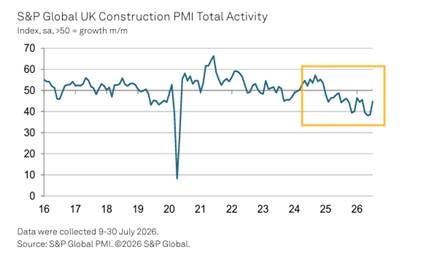
Continuing the somewhat better tone in the latest economic data…
There was also a decent bounce in the S&P Global UK Construction PMI Total Activity Index in July, up to 44.7 from 38.4 in June. Business expectations for the next 12 months are recovering too. However, a sub-50 reading means that current activity is still weak/falling, and well below the peaks seen in the summer of 2024.
Friday 7 August
The latest ONS data show that total public service productivity continued to recover in 2025, increasing by 0.9%. But it was still 2.5% lower than before Covid, and 5.8% lower in healthcare. The only sustained period of meaningful growth was from 2010 to 2019, during the so-called “austerity” years.
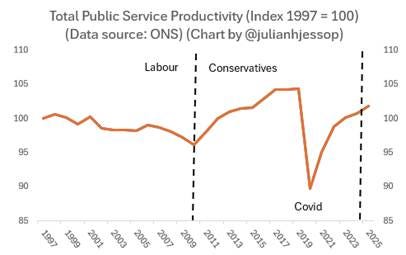
Just to be clear, I do think that the government under-spent in some areas in the early 2010s (including on “public goods” such as the justice system and flood protection, as well as the NHS and school estates).
To be precise, I think halving net investment from 3% of GDP in 2009-10 to 1.5% of GDP in 2013-14 (or from £73 billion to £37 billion in 2025-26 prices) went too far, especially given the relatively low cost of government borrowing at the time.
Nonetheless, public investment did pick up again over the rest of the decade, employment continued to increase, and the recovery in productivity did last long enough to suggest there was more to it than just sweating assets (including people) harder.
Last but not least, the broader point still stands: we need to look at how productively resources are being used, alongside trends in demand, rather than just focus on the amounts being spent.
And finally…
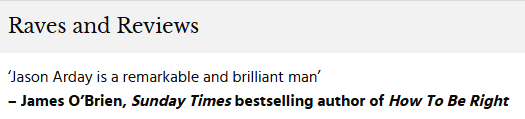
Simply glorious (from the publicity material for Jason Arday’s book)…
You can follow me on X (formerly Twitter) @julianhjessop and on Bluesky.
I also post regularly on Substack.

