
Including more on inheritance tax, the latest mixed signals on the health of the UK economy, the state of the labour and rental markets, and why rejoining the EU would need another referendum…
Theme of the Week
Few will be reading this for my political views, but I believe this was a good week for Kemi Badenoch. The Tories have published ‘The Right Way’, a paper which sets out the ‘Conservative principles’ which would guide how the Party governs if returned to power. Suffice to say I think it is excellent. You can judge for yourself here.
Badenoch’s plans to reform and eventually abolish inheritance tax (IHT) illustrated the push to put more ‘clear blue water’ between the Conservatives and Labour. These plans were announced on Wednesday and I responded then with a blog which gave them ‘two cheers’.
I couldn’t quite stretch to ‘three’, because I’m not keen on the bit about exempting the family home immediately, which is potentially distortionary. But I also get why the family home might be seen as a special case.
Two follow-up points.
First, the debate about IHT illustrates a clear philosophical divide. One camp prioritises the redistribution of wealth. For them, IHT is a fair way to address inequalities between families and between generations. People are simply being ‘asked’ to make a further contribution for the greater good.
The other camp focuses on the creation of wealth and the right of people to pass it on to their loved ones. It does not seem fair that the state can simply take a large chunk of your family wealth when you die and then do with it whatever the state likes.
Needless to say, I’m in the second camp, and if ‘asked’ to make a contribution in this way I would prefer to opt out!
Second, the plans for IHT have been criticised on more economic grounds. I have some sympathy with the critics here, but still think the proposals are reasonable.
One line of attack is that reducing the burden of IHT should not be a priority and that other tax cuts would deliver a bigger boost to growth. My response here would be that the abolition of IHT is only a long-term ambition. In the meantime, raising the tax-free allowance is a fair way to address the problem that many more estates are about to be caught in the IHT net.
The reduction in IHT is also only one of several tax cuts that the Tories are proposing. Others include scrapping stamp duty on property transactions and reducing employers NI for workers aged between 21 and 24 – both sound economic policies.
Another line of attack is that the analysis used by the Tories may have underestimated the costs to the Treasury, because it may not have taken enough account of the likely behavioural responses.
In particular, the carve out for family homes could reduce revenues further by encouraging people to remain in their homes for longer and move other wealth into housing. This is a point made by Dan Neidle’s Tax Policy Associates in a note here.
However, the authors of the analysis, Oxford Economics, have since pushed back in a response here. In my view, their arguments are stronger but, again, you can judge for yourself.
My takeaway from this is that there is room for reasonable people to disagree on the numbers. But the final call should be left to politicians. If a tax is fundamentally ‘unfair’, then abolishing it makes sense, even if there is some uncertainty about the precise costs to the Treasury.
Monday 5 October
More evidence that the UK economy retains some positive momentum, albeit with some big caveats…
The S&P Global UK PMI Composite Output Index (covering manufacturing and services) fell to 52.0 in September, from 52.5 in August, but this was a touch better than the flash estimate of 51.7 and still consistent (at face value) with decent GDP growth.
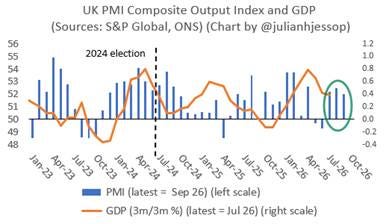
Now for the caveats:
📈 cost inflation was the highest since June, driven by energy prices
👩🏭 the employment index suggests that the private sector is still shedding jobs
🤔 business optimism (12-month output expectations) eased from August’s six-month high
Tuesday 6 October
Another lacklustre construction PMI…
📈 the activity index rose a little further in September but was still well below the 50 mark (indicating contraction), extending the slump since Autumn 2024 (Reeves’ first Budget)
🏠 house building again the weakest performer
🔮 new orders and business optimism are both falling again
As I have noted before, construction is a good bellwether of the success (or failure) of Labour’s policies, as it covers the priority areas of housebuilding, infrastructure, and commercial investment, and is highly sensitive to overall economic confidence.
Still, it could have been worse: France’s Construction PMI Total Activity Index was just 39.8 in September, compared to the UK’s 46.1.
Wednesday 7 October
Kemi Badenoch made her announcement on inheritance tax, discussed earlier.
Thursday 8 October
More survey evidence that the labour market may be stabilising, though this is yet to show in the official data…
The latest KPMG and REC UK Report on Jobs suggests that both permanent and temporary recruitment picked up in September. But the recovery is still fragile, and wage growth slowed again.
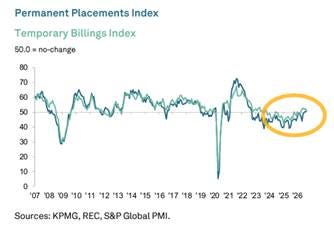
What’s more, this next chart (from the PMI surveys published earlier in the week) provides some important context.
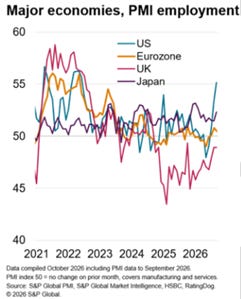
In short, the UK has underperformed on private-sector jobs since the autumn of 2024, when Reeves’ first Budget raised employment costs, which was then compounded by the burden of new ‘workers’ rights’.
In my view, the Tories are right to respond by proposing to cut employers’ NI for younger workers and to repeal Labour’s most damaging employment ‘reforms’.
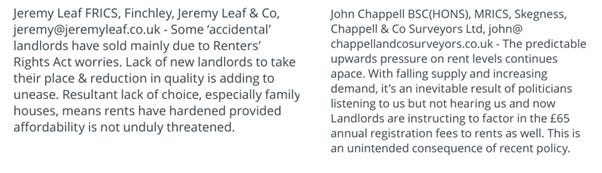
Less positively, the latest RICS Residential Market Survey shows that demand for rental properties continues to outpace supply as private landlords exit the market (I wonder why… 🙄). This is also continuing to add to the upward pressure on rents (and hence on overall inflation). In the words of the report…
“Across the rental market, a net balance of +23% of survey participants reported an increase in tenant demand over the month (based on the non-seasonally adjusted monthly lettings dataset). Interestingly, this marks the third consecutive monthly reading in which tenant demand has accelerated in net balance terms.
Alongside this, the flow of landlord instructions remains subdued, with the corresponding net balance firmly entrenched in negative territory.
Looking ahead, a net balance of +37% of contributors expects rents to rise over the next three months. While this is somewhat lower than the +44% recorded in August, it remains comfortably above the +27% average seen during the first half of the year.”
The comments from individual agents are always worth a read as well. Here are two that caught my eye…
But one of the most depressing stats of the week was this: as many as 23% of respondents to this YouGov poll believe the UK government should be able to take us back into the EU without another referendum…
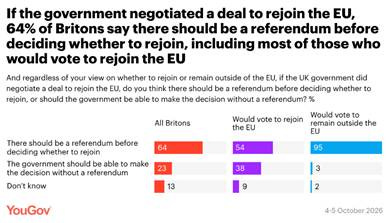
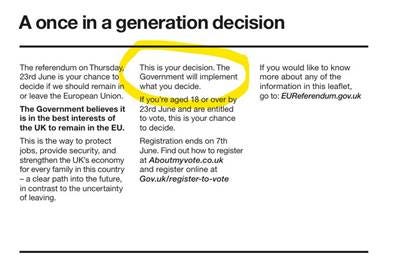
in my view, the legal nicety that referendums are “advisory” does not mean it would be OK to disregard the results, especially if the government had repeatedly said this is a “once in a generation decision” and that it would “implement what you decide”…
Moreover, it would not be enough to put ‘rejoin’ in a manifesto for a general election and gain a ‘mandate’ that way. Elections are fought on multiple issues and governments can be formed with just a third of the vote. That surely cannot be allowed to trump an outright majority in a single issue referendum.
Friday 9 October
I was quoted in the Mail on the case for axing stamp duty on shares. The full comment is here:
“Stamp duty on shares should be abolished. Many studies show that this would boost GDP and might even increase tax revenues.
The case for abolishing stamp duty on shares is similar to the case against stamp duty on property: like all transaction taxes, it acts as a brake on economic activity.
The case for using the tax system to promote home bias in portfolio investment is less convincing. Instead, the government should focus on improving the UK economy’s fundamentals so that people and businesses want to invest here without additional tax incentives.”
And finally…
From Private Eye

I am now on holiday until Wednesday 21 October. Normal service will resume then.
You can also follow me on X (formerly Twitter) @julianhjessop and on Bluesky @julianhjessop.bsky.social.

