
Inheritance tax is a fundamentally bad tax and raising its threshold makes economic as well as political sense. But exempting “family homes” entirely is more problematic and potentially distortionary.
Kemi Badenoch announced today that the Conservative Party “would abolish Inheritance Tax on the family home and raise the individual threshold to £500,000. This will mean that a couple can pass on their main home to direct descendants inheritance tax free, and a further £1,000,000 to anyone without any inheritance tax liability.”
“This will replace the current thresholds of £325,000 per person, and a £175,000 further allowance for residential property.”
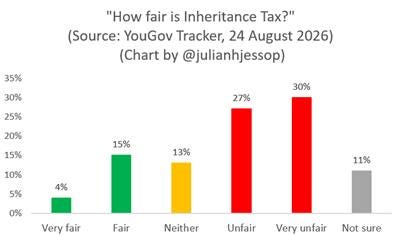
This should be a popular move. Opinion polls, such as this YouGov Tracker, consistently show that most people think that inheritance tax (IHT) is “unfair”, or even “very unfair”.
The latest YouGov polling today has also shown decent support for the direction of travel set out by Kemi Badenoch, with 16% of respondents backing a reduction in IHT and 36% supporting outright abolition.
Of course, just because a policy is popular does not make it right. But in this case, I am happy to give today’s announcements two cheers.
For a start, I agree that IHT is a fundamentally bad tax (one cheer!).
It is a form of double taxation that discourages wealth creation and is especially unfair because the super-rich can more easily reduce their liabilities with expert advice.
Some might respond that IHT is not double taxation, because it is the first time a beneficiary is taxed on the money they receive. But the person leaving the inheritance will already have paid a lot of tax in the process of accumulating the wealth, and this will reduce the amount that they are able to pass on – aka, ‘double taxation’.
Others argue that “IHT deters people from hoarding wealth”, but I’m not even sure what this means! People don’t just keep money under the bed, or as a mountain of gold. They save and invest it for future generations.
And in the process of accumulating that wealth, they contribute some of it to help others (both directly as tax and indirectly as stronger growth).
The evidence here is summarised in this review by the OECD and there are good points on both sides. Other tax cuts might also deliver more ‘bang for the buck’ in terms of wider economic benefits. But there are enough examples to make a strong case that reducing IHT can be positive for growth.
The experience in Sweden is just one, explained further here…
“Overall, we conclude that the abolition of the gift and inheritance tax in Sweden encouraged and enabled firms with potential next generation owners to adopt a long-term horizon, be growth-oriented, and to create transgenerational value, which in turn benefitted society by increasing recurring corporate tax revenues and employee salaries – suggesting the reform’s positive consequences extended beyond the firms themselves.”
Finally, some argue that it’s unfair that people can just inherit money they haven’t earned. This ignores the family bond. Parents support children, and vice versa. It is natural to share assets and wrong to dismiss any benefit as ‘unearned’.
It is also odd to make a distinction between support that children receive from parents when they are alive and gifts when they die. Surely it is fairer to say that your assets belong to your family when you die, rather than to the state – to do with whatever the state likes.
Even if you still support the principle of some form of inheritance tax, many more people are about to dragged into the net.
Currently, IHT is paid by just 5% (1 in 20) of estates. But that figure is set to increase sharply, because of increases in asset prices (including property) and because of Labour’s decisions to extend IHT to private pensions and family farms and businesses.
Dan Neidle has estimated that by April 2027, 20% (1 in 5) of pensioner households in England and Wales “will have enough assets to have an inheritance tax liability if the pensioner and any spouse were to die at that point”.
The Conservatives’ proposal addresses that problem by raising the threshold at which people start to pay IHT. In my view, this is the simplest and fairest way (hence ‘two cheers!’).
In particular, raising the tax-free band is better than the alternative of cutting the main rate of IHT from the current 40%. This is because it ensures that more of the benefit of the tax cut then goes to smaller estates rather than the ‘super rich’. This is not, at heart, a giveaway to ‘multi-millionaires’, let alone for ‘billionaires’.
Oxford Economics has helpfully run the numbers in a report commissioned by the centre-right think tank Onward:
· In the no-policy-change baseline, IHT liabilities are projected to rise to £12.6 billion by 2029/30 (0.37% of GDP), covering 52,100 estates (8.2% of deaths).
· This compares to just 0.15% of GDP and 2.7% of estates in 2009/10, when the current £325,000 nil-rate band was introduced.
· Combining a full exemption for primary residence with an increase in the nil-rate band to £500,000 sees liabilities fall to £6.6 billion in 2029/30, with around 22,000 estates facing IHT (so less than half the 52,100 in the baseline).
So, why only ‘two cheers’? This is because I’m not sold on the idea of a carve out for the ‘family home’. It is distortionary to tax different types of assets differently at the same event (in this case, death).
Wealth accumulated in family homes is arguably under-taxed already, mainly because of the capital gains tax (CGT) exemption for primary residences. The difficulty of getting on to the property ladder is also one of the biggest barriers to social mobility.
Moreover, the carve out could incentivise investment in property rather than in more productive assets, including businesses.
Some older people might now choose to stay longer in their ‘family home’, rather than downsize and free up the property for those who might need it more.
Others might choose to sell other financial and business assets to buy a much larger and more expensive property to pass on tax-free (though the scope for reducing the liability in this way will depend on the details of the new system, including how long you might have to own a property for it to count as the ‘family home’).
Nonetheless, I don’t think this part of the announcement merits a ‘boo’.
The unintended consequences here should be reduced by the increase in the thresholds for other assets and by other planned policy changes, notably the abolition of stamp duty on property transactions and serious market-led reforms to boost housing supply.
I also get why the home where your family has grown up might be seen as a special case, regardless of who legally owns it. Treating it just like any other asset might not feel right.
In summary, most already agree that more people should be allowed to accumulate wealth for their family and pass it on to their children, rather than have a large chunk claimed by the state on death.
By tackling a looming problem in a sensible way and by setting out a longer-term ambition to abolish IHT completely, the Conservatives have also put more ‘clear blue water’ between themselves and Labour.
So, two cheers for Kemi Badenoch’s announcements on inheritance tax, even if I can’t quite stretch to three.
You can follow me on X (formerly Twitter) @julianhjessop and on Bluesky @julianhjessop.bsky.social.

