
The spotlight is on Andy Burnham, but the immediate prospects both for UK markets and for the economy may depend more on events in the Middle East than in Westminster for quite a while yet.
Welcome to the latest summary of news that caught my eye over the past seven days.
Theme of the week
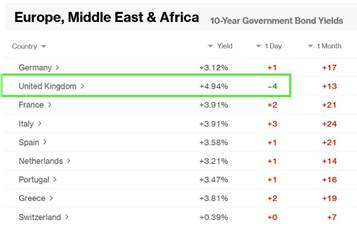
The renewed escalation of the US-Iran war may not be getting as much media attention as it deserves, but the markets are certainly taking notice. In particular, the main driver of the latest jump in UK gilt yields has – thus far – been the rise in global oil prices, rather than worries about the fiscal implications of a Burnham premiership.
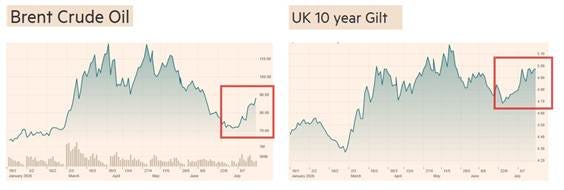
As I write this (on Saturday 18 July), the US has just completely its seven successive night of air strikes against Iranian targets, while Iran continues to lash out across the region. The Strait of Hormuz is effectively closed. And once again, Iran’s Houthi proxies have threatened to block the Bab el-Mandeb passage to the Red Sea, disrupting shipping on the crucial Asia-Europe route.
The upshot is that the immediate prospects both for UK markets and for the economy may depend more on events in the Middle East than in Westminster for quite a while yet.
Monday 13 July
Back to Burnham though…
On Monday I published a blog on what a Burnham premiership might look like. He might be lucky. Some better news from the Middle East and on UK inflation could ease the upward pressure on bond yields, regardless of the changes in Downing Street (both in No.10 and No.11). A handful of surveys already suggest that the labour and housing markets may be levelling out, and they could both start to recover if uncertainty eases.
The new PM will also still have up to three years before the next general election, allowing him more time to develop proper long-term plans – including for defence and social care, and for fundamental reforms of capital and business taxes.
But the risks could also come to a head much sooner. There is now talk of a blockbuster Budget in the Autumn, combining big tax increases with a spending review. This threatens a repeat of the harmful pre-Budget speculation that unnerved investors and damaged the economy under Rachel Reeves.
Burnham’s honeymoon could then be over almost before it has begun, and the nation would be left footing the bill for the crash that follows.
Tuesday 14 July
Another reminder of the heightened geopolitical risks and uncertainty. President Trump dropped his plan for a 20% fee on Strait of Hormuz shipping, which was never credible. But instead, he ”threatened to bomb bridges and power plants unless Iran resumes talks”. The indiscriminate destruction of civilian infrastructure would of course be a war crime, raising the stakes even further.
Wednesday 15 July
Shabana Mahmood emerged as Burnham’s expected pick as Chancellor – though nothing is yet certain and she might prefer to stay on at the Home Office. Not much is known about her views on the economy. But the bond markets at least seemed relieved that Ed Miliband might not be getting the job.
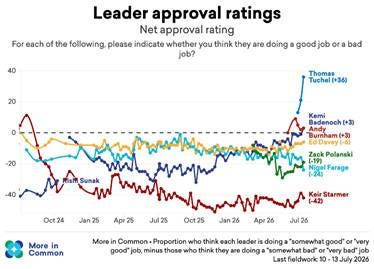
Talking of popularity, the latest polling from More in Common showed that Kemi Badenoch had a positive net approval for the first time on +3. But the other striking feature was the surge in enthusiasm for Thomas Tuchel. What could possibly go wrong…
I may have jinxed English football even further by writing a piece on “Should there be an extra Bank Holiday if England win the World Cup?”. Sorry…
Thursday 16 July
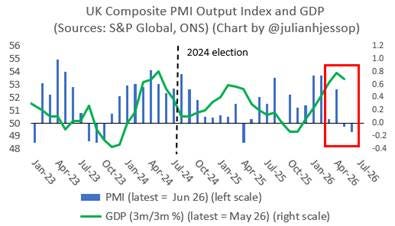
Rachel Reeves could at least point to some better news in her last days as Chancellor. The UK economy grew by 0.7% in the three months to May compared to the three months to February, which was a little stronger than expected and back to the growth rates that Labour inherited in 2024.
However, the 3m-on-3m comparison concealed a marked slowdown in the single month data: GDP shrank by 0.1% in April and grew by just 0.1% in May. The more timely surveys (such as the PMIs) also signal a tricky summer, reflecting the increased political uncertainties both abroad and at home.
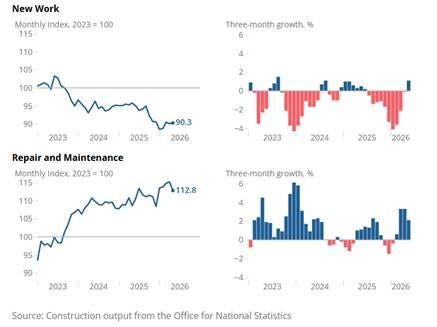
Looking at the detail of the GDP release, the apparent resilience of construction activity may be a surprise, given the gloom in the sector (output is estimated to have increased by 1.6% 3m on 3m). But the official data have been flattered for a while by “repair and maintenance”. In contrast, “new work” has slumped further under Labour, and it remains weak.
Friday 17 July
Andy Burnham’s speech accepting the Labour leadership was as thin on economics as all his others. His thesis seems to be that more “public control”, by which he actually means state control, is the answer to everything, including the cost of living crisis. Or as he put it, “if we do not have sufficient public control over the cost of the essentials, how can we have control over inflation?”.
In reality, prices have risen much more sharply in sectors with greater state intervention than in those led by market forces (see this IEA paper, which is perhaps a little simplistic on the goods/services split but which makes the main point well enough). For example, one of the main reasons for high housing costs is that planning rules have held back supply.
Moreover, the overall level of inflation is a matter for monetary policy and hence for the Bank of England. The government might be able to tinker with individual prices, but the combination of sound money and market forces should be far more effective at keeping the cost of living down.
And finally…
How on earth did I miss this angle on the rise of Andy Burnham?

You can follow me on X (formerly Twitter) @julianhjessop and on Bluesky.
I also post regularly on Substack

