Andy Burnham is now a shoo-in to replace Keir Starmer as PM. Indeed, he has already U-turned almost as often. But his pick as Chancellor and any talk of new fiscal rules could still move markets.
Welcome to the latest weekly wrap of the key points from my social media posts.
Monday 15 June
On Monday I responded to a superb example of ‘confirmation bias’. Many of the usual suspects jumped on this (poorly constructed) FT chart as ‘proof’ of the benefits of being part of the EU’s Single Market.
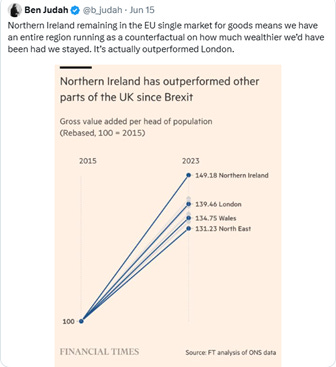
This is a lazy take. For a start, Northern Ireland’s main area of outperformance has been in services (notably business services), not goods, as you can easily verify by looking at the NISRA dashboard.
The diversion of trade in goods under the Windsor Framework may simply muddy the picture, especially given the additional frictions imposed at the NI-GB border.
The faster growth in the region’s per capita GVA has also been flattered by a relatively low starting point (incomes are still lower than most other regions, and far lower than in London), and by more government support (both in terms of the size of the public sector and larger fiscal transfers).
More positively, Northern Ireland has lots of homemade advantages which are unaffected by Brexit either way, including a relatively well-educated and skilled workforce.
This is therefore a complicated picture. But the one thing you can conclude is that Northern Ireland is not a good ‘counterfactual’ after all.
Tuesday 16 June
CityAM’s Shadow Monetary Policy Committee voted 7-2 to leave UK interest rates on hold this week. I was one of the two dissenters preferring a quarter point hike, along with Professor Jonathan Haskel (a former member of the “real” MPC).
I wrote a longer piece on my thinking, but here is the short version…
There are many good reasons to keep rates on hold. Monetary policy is already more restrictive here than in most other countries, and the labour market is deteriorating more sharply. Uncertainty is also exceptionally high. An unexpected increase in rates could just tip the economy into an unnecessary recession.
Nonetheless, there may be one even better reason to hike. In a word, “credibility”.
Inflation has now been back above 2% for more than a year and a half, and Bank staff do not expect it to return to target any earlier than the end of 2027. Nudging rates up by a quarter point, to 4%, would still leave them at a historically low level. But it would send a clear message – including to the next Prime Minister – that the central bank will not allow inflation to spiral out of control again.
Wednesday 17 June
In the event, the latest CPI data provided a little bit of reassurance on inflation, but this would not have changed my vote!
The headline measure was unchanged at 2.8%, against expectations of a rise to 3%, while food price inflation actually fell. The underlying picture was relatively simple: upward pressure from higher transport costs (mainly motor fuel and airfares) was offset by falls in inflation almost everywhere else.
This was consistent with the survey evidence – notably from the CBI and BRC – that weak demand and strong competition are keeping corporate pricing power in check, despite rising costs. Market forces are far more effective in controlling inflation than any amount of government tinkering.
Nonetheless, inflation has now been back above the 2% target for more than a year and a half, and it is still likely to rise further. It may not even return to the 2% target before the end of next year. This is pushing the boundaries of what could reasonably be downplayed as a “temporary” overshoot.
In short, May’s data gave the Bank of England a little more breathing room, but it is far too soon to dismiss the upside risks either to inflation or to interest rates.
In the meantime, Liberal Democrat MPs were out in force to parrot Ed Daveys’ claim that Brexit is costing the UK “£90 billion a year” in lost tax revenue. Just a reminder that this is based on the “8% hit to GDP” in the research published by the NBER, which has now been widely debunked – even by Bloomberg Economics.
Some also claimed that the “£90 billion” is based on research by the House of Commons Library. This is grossly misleading. HoC staff were simply asked to guess what an 8% hit to GDP might mean for tax revenues. Garbage in, garbage out…
Thursday 18 June
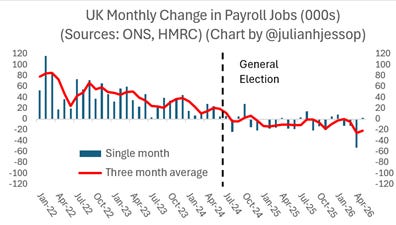
The latest official data on the labour market were at least a bit firmer than expected: the unemployment rate fell, headline pay growth was steady, and payrolls little changed with a big upward revision to last month (now -53k, was -100k).
But there are two important caveats, First, annual growth in regular pay was 5.1% for the public sector but just 2.9% for the private sector.
Second, even after the favourable revisions, the trend in payroll jobs is still down, with 119,000 fewer employees in May than in the same month a year earlier – and 187,000 fewer than two years ago.
To nobody’s great surprise, the Bank of England’s Monetary Policy Committee (MPC) voted by 7–2 to hold rates at 3.75% (the same split as the CityAM’s Shadow MPC). But as you might also have guessed, I have a lot of sympathy for what the two official dissenters said…
32. Two members (Megan Greene and Huw Pill) preferred a 0.25 percentage point increase in Bank Rate at this meeting. These members were less confident in the pace of the Bank of England Page 8 underlying disinflation pre-conflict. They were more concerned that households’ and firms’ greater attention to inflation outturns than in the past would lead to larger second-round effects for a given energy price profile. And they noted that the tightening in financial conditions could reverse in the absence of an increase in Bank Rate. Given significant uncertainty about the extent of second-round effects, they preferred to raise rates as part of a risk management strategy.
Or in lay terms, “a stitch in time could save nine” (or at least several more).
Friday 19 June
The headlines were dominated by the result of the Makerfield by-election, which has cleared the way for Andy Burnham to replace Keir Starmer as PM. It is still unclear what this will mean for the economy or the markets – indeed, Burnham has already U-turned on key policies almost as many times as Starmer himself. But here are three initial thoughts.
First, Burnham is reported to be listening to some relatively credible people – including former Bank of England chief economist Andy Haldane and former OBR chair Richard Hughes. They are certainly far more serious than those helping the Greens, or even those around Starmer now.
But we do not know how much influence they will have in practice, especially as the names being mentioned for more permanent roles – such as Zoe Billingham of the IPPR – are far more to the left. Will the big names stick around, or is this just cover for the first few days?
Second, who will Burnham pick as Chancellor? It sounds like Rachel Reeves’ time has now passed. The worst case scenario would be for someone like Ed Miliband to be given free rein at the Treasury. But the latest gossip is that Burnham is more likely to pick Wes Streeting for No.11 and shuffle Miliband off to MHCLG. Hopefully, he would not do to housing policy what has done to the energy markets.
It has also been suggested that John Healey will be back at Defence, meaning Streeting’s first challenge would be to find the money for a big increase in military spending.
Third, will there be any changes to the fiscal rules? One near-certainty is that there will be more spending on infrastructure. This could be accommodated by switching to a target for net worth rule (which counts physical as well as financial assets) and/or by extending the horizon of the rules (thus allowing more time for the OBR to score any upside for growth, although the watchdog has been sceptical on the long-term benefits of more public spending in the past).
In any event, there are no easy ways out here. More borrowing would still be more borrowing, whether for infrastructure, or housing, or renationalisations.
New ONS data on Friday underlined the scale of the fiscal problems.
The UK government borrowed £23.3 billion in May, which was £5.4 billion (or 30.4%) more than the same month last year. Central government debt interest payable was £11.7 billion, a new record high for the month (not adjusted for inflation).
The OBR’s own analysis was a little more sanguine – it is still early days in the new financial year. But the room for manoeuvre is clearly vanishingly small.
And finally…
Imagine having to explain to a foreign visitor how the winner of this contest gets to be PM!