
Headlines from opinion polls suggest that a majority of Brits now want to reverse Brexit. But a deeper dive shows that this support is shallow and inconsistent, and sentiment could soon shift again.
Those seeking closer economic ties with the European Union often claim that this is what the British public want. At face value, most opinion polls do suggest that a majority would back the idea of the UK becoming a full member again.
The latest example is polling for the Daily Mirror, where nearly three in five respondents (59%) said they would back rejoining the EU in a new Brexit referendum
Similarly, polling by YouGov last September (for the pro-EU campaign group “Best for Britain”) found that 53% of respondents supported “Britain rejoining the EU”. This figure was slightly lower than the 56% in a similar poll that YouGov ran last June, but a YouGov poll last month put the number at 55%.
However, this evidence needs to be heavily caveated.
For a start, policy should not be run on the basis of headlines from opinion polls with a few thousand respondents. It seems reasonable to assume that most people who would vote to rejoin the EU would not be keen on the reintroduction of the death penalty, but public support for this policy is also running at around 55%.
A large number of obviously mad economic policies also tend to poll very well. Everyone can come up with their own examples here, but mine would be the Green Party’s call for a cap of 10:1 on executive pay.
More fundamentally, the support for rejoining the EU is shallow. Even the polls cited by pro-EU campaigners suggest that only a minority of the public “strongly support” this option, or consider it to be a priority.
The polling is also full of inconsistencies.
For example, one recent poll by More in Common found that most people are keen that the UK and EU should be able to trade more freely with each other (why would anyone not be?). However, only a minority want to “align more closely with EU laws and regulations”. The UK would, of course, be obliged to adopt all “EU laws and regulations” automatically if Britain rejoined the bloc.
Similarly, YouGov polling has suggested that 80% of Labour voters want a “customs union” with the EU. However, more sophisticated polling by the same company (for Queen Mary University London) has found that only 9% of Labour voters think that UK tariff policy should be decided by someone other than the UK government. Again, this is exactly what a customs union with the EU would entail.
Another reason to be wary of the polls is that public opinion has been swayed by a relentless barrage of scaremongering and exaggerated claims about the economic harm (allegedly) caused by Brexit. This process started in the run up to the 2016 referendum itself, when the Treasury predicted an immediate recession and a surge in unemployment if the UK voted to leave the EU. These shocks obviously failed to materialise.
This barrage has continued unabated since then. You can find some examples of the dodgy statistics used by Project Rejoin here. What’s more, blaming “Brexit” has become an easy excuse for any failing business or institution.
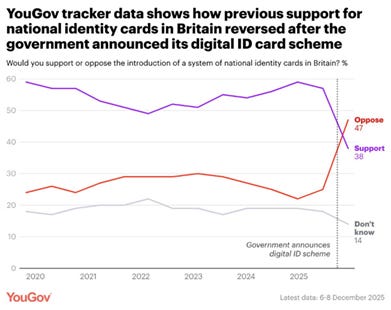
The upshot is the apparent shift in public opinion on Brexit needs to be taken with a huge pinch of salt. Indeed, it could still go the way of support for national ID cards, which collapsed the moment that Keir Starmer’s government announced plans to introduce them!
Above all, sentiment is likely to shift back again once the terms of any return to the EU are made clear – as long as the government is transparent about these trade-offs (something it has been very bad at so far).
Polling has consistently shown that existing member states would welcome the UK back, but not on the same terms that the UK had before. Indeed, YouGov concluded last year that “Europeans wouldn’t let the UK return [to the EU] with its previous opt-outs, and Britons don’t want to come back if it loses them.”
It would therefore be interesting to see more polling on whether Brits really want to rejoin the EU if this means losing the budget rebate, joining Schengen, or having to adopt the euro, or if any of the other costs were made clear…
You can follow me on X (formerly Twitter) @julianhjessop and on Bluesky.
I also post regularly on Substack.

