
Many commentators like to pontificate about the profits made by big energy companies. But this grandstanding reveals a feeble grasp of basic economics and numbers, and is ultimately counterproductive.
In case you missed it, some big companies selling products which are now in short supply have seen their profits rise because of higher prices. This is, apparently, “outrageous”.
Last week it was BP. The Daily Mirror led its coverage with accusations of “Blatant Profiteering”, attributing all (not just some) of BP’s first quarter profits to a “war bonus” and describing this as an “obscene windfall”.
Even the Energy Secretary rushed to social media. Ed Miliband at least had the sense to delete the first tweet below, but he then replaced it with another complaining about “excess profits” (without defining what “excess profits” means, of course). Many others, including Labour MP Clive Lewis, joined the pile on against “Big Oil”.
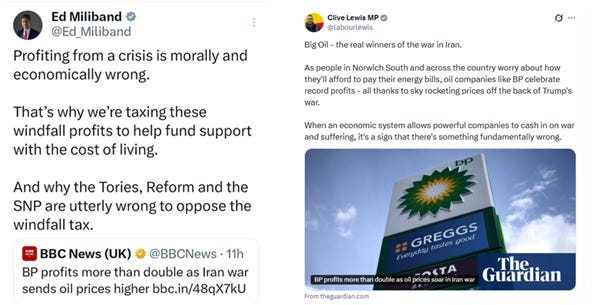
This grandstanding revealed a feeble grasp of basic economics and numbers.
For a start, BP is not making “record profits”. Indeed, the Guardian article cited by Clive Lewis included the following chart, which clearly shows that the first-quarter figure of $3.2 billion was roughly in the middle of the range over the last few years. Profits have more than doubled from the first quarter of 2025, but that was from a relatively low base.
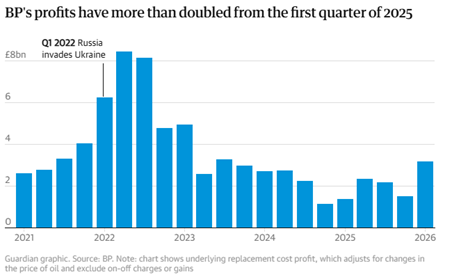
Moreover, these cash numbers are not that unusual for any global company as large as BP. The first-quarter profits of $3.2 billion compared to total revenues of $53 billion and total assets of more than $300 billion.
Ed Miliband’s moralising was particularly misplaced. The reality is that the market prices of oil and gas have jumped because of a supply shock – this is just Economics 101. This adjustment is necessary, regardless of the precise cause of the shock, in order to help balance supply and demand. And contrary to what Clive Lewis claimed, this is an example of something that is fundamentally right.
Ed Miliband’s comments about the “windfall tax” were daft, too. BP’s increased profits from global oil and gas trading are not subject to the UK windfall tax. Instead, the Energy Profits Levy applies only to BP’s profits from UK oil and gas extraction, thus penalising domestic production.
Personally, I care little whether our energy comes from fossil fuels or the wide variety of renewables, as long as the prices paid reflect all the costs involved. This includes the different environmental impacts, as well as infrastructure costs. Over time, market forces would then probably continue to increase the share from renewables, without the need for the massive subsidies many currently rely on.
Nonetheless, the reality is that UK will continue to need some oil and (especially) gas for the foreseeable future. Even Labour’s 2024 Manifesto recognised that:
“Crucially, oil and gas production in the North Sea will be with us for decades to come, and the North Sea will be managed in a way that does not jeopardise jobs.” (Page 52)
What’s more, rather than being inherently bad, profits create the incentive for companies to maintain investment and increase supply, as well as provide employment, tax revenues, and dividends for UK shareholders.
It is also madness to import oil and gas rather than use our own resources. Even if more North Sea production had zero impact on global prices, it would still be better for the public finances, the balance of payments, and UK jobs. It would also be more secure and probably have a lower carbon footprint than imports as well.
Above all, this grandstanding is counterproductive. Given all this abuse, it is no surprise that BP is reported to be considering abandoning the North Sea. Meanwhile, Norway is to reopen three fields closed down last century, with some of the new output set to be sold to – wait for it – the UK.
This week the focus shifted to Shell, where the same points apply. The Daily Mirror ran another story with boilerplate comments from Greenpeace, the End Fuel Poverty Coalition, and Friends of the Earth.
Chris Packham waded in too…
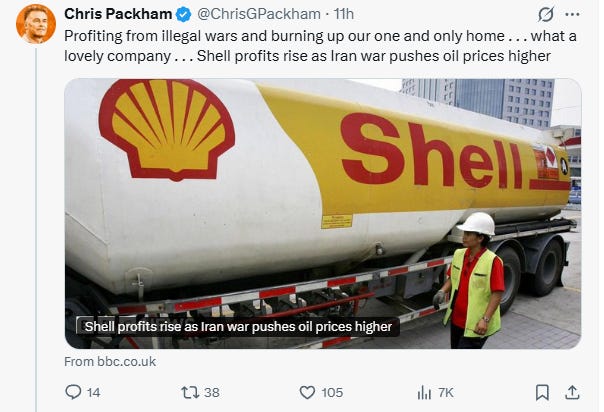
However, it is not obvious what Chris Packham is proposing here. Does he want Shell to sell fossil fuels below the current market price, thus subsidising demand for them? And given that we still need some oil and gas, who else is supposed to provide it? Even less “lovely” companies in Russia? Or Iran?
I have responded to Chris’ post with these questions. But he has not yet replied.
You can follow me on X (formerly Twitter) @julianhjessop and on Bluesky.

