
Last Friday the Daily Telegraph ran a story headlined “Farmers’ anger grows as Australian beef floods into Britain”. It took a couple of days for the usual suspects to pounce on this, but once a few did the rest piled in. Various halfwits and attention seekers rushed to trumpet this story as fresh evidence that the UK-Australia trade deal agreed after Brexit is “bad for Britain”.
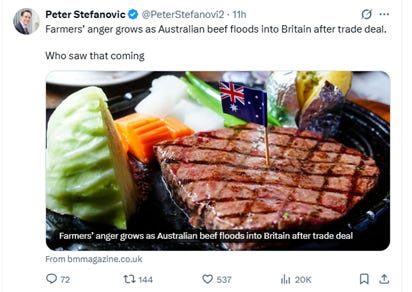
Normally, I ignore these people and would advise you to do the same. But this is a particularly transparent example of the nonsense being peddled by EU fanatics.
Here are the facts. The Telegraph article noted – entirely correctly – that Australian beef and lamb imports to Britain have surged following a free-trade deal between the two countries which came into effect in May 2023.
Indeed, data published by the Agriculture and Horticulture Development Board (AHDB) back in November showed that beef imports from Australia jumped to 9,700 tonnes in the first three quarters of 2025, from 3,800 tonnes in the same period of 2024. This was a rise of 155%. But that was still just a trickle compared to total UK imports of 223,000 tonnes, as this chart shows.
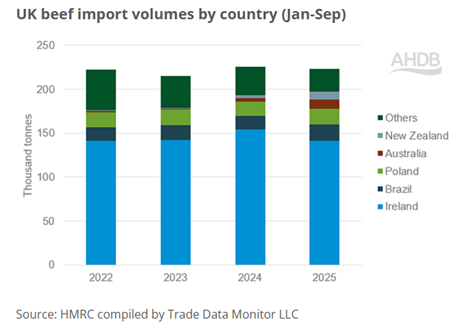
Crucially, the large percentage increase in imports from Australia was from a low base, meaning they still represented only 4.3% of total UK imports from January to September. Total UK beef imports actually fell slightly over this period, due mainly to lower shipments from Ireland.
Moreover, as much as 80% of the beef consumed in the UK is domestically produced, meaning that imports from Australia account for only about one percent of total supply. No-one seems to be up in arms either about the much larger amounts of beef that the UK imports from Poland or Brazil, let alone Ireland.
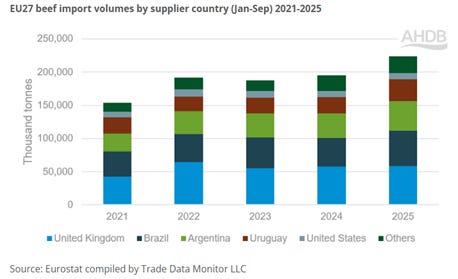
Interestingly too, the UK’s total imports of beef have been relatively stable compared to the rest of Europe. The EU’s beef imports from South America in particular have been steadily increasing, though ‘Brexit Britain’ remains the largest single supplier. (You can read more about developments in the EU here.)
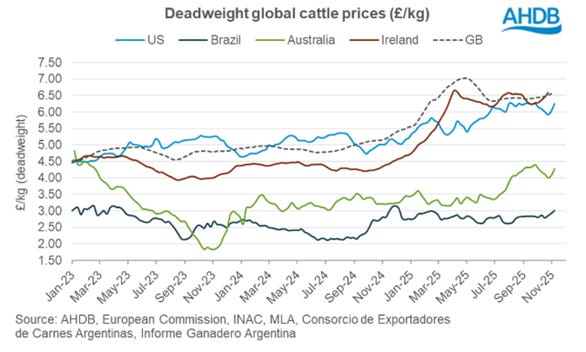
Finally, note that UK cattle prices have risen sharply and remain high. Of course, costs have risen sharply too, but this is also hard to square with the narrative that UK farmers are being undercut by a “flood of cheap imports”.
So, what’s going on?
First, the UK-Australia trade deal has significantly increased the amount of beef that can be imported tariff free, and this quota will continue to ratchet up over time. In 2025, for example, the tariff-free quota was set at 51,667,000 kg, or 51,667 tonnes, and this will more than double by 2032.
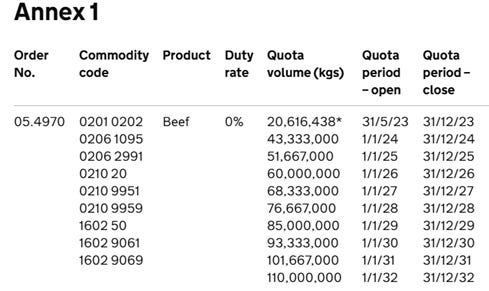
It is therefore absolutely no surprise that the amount of beef imported from Australia has increased to “record levels”. Indeed, this is the feature of a free trade deal, not a bug or a flaw.
The more interesting point is that actual imports are still falling well short of the quota limits. Australian sources suggest they will only have used about 30% of the quota in 2025. The simple economics of shipping costs and consumer preferences seems to matter rather more here than trade bureaucracy – which is how it should be.
The second important development is that there has recently been a marked shortfall in domestic supply both in the UK and across the rest of Europe, notably from Ireland, reflecting bad weather and higher costs. The additional imports from Australia have helped to fill this gap and thus prevented shop and restaurant prices of beef from rising even further, while increasing the variety of products on offer.
Strikingly, though, there is rarely any mention of these benefits in the coverage of this story. In fact, it never even seems to occur to critics of the UK-Australia trade deal that it might be a win for British consumers. Instead, producer lobby groups – like the NFU – get a free pass.
To be clear, I have a lot of sympathy for farmers, who are already under significant pressure from government policies. But if your reaction to this piece is to shout “don’t you care about British farmers?” my response would be “don’t you care about British consumers?”. There are much better ways to support farmers than by reducing customer choice and keeping prices artificially high.
Protectionists therefore have to fall back on arguments about “unfair competition”, often claiming that animal welfare standards in Australia are too low. But as long as products are clearly labelled, this judgment can be left to consumers.
In short, if you have something against Australian beef, don’t buy it. Unfortunately, some people would still like to deny you that choice.
 Plain-speaking Economics