
A week since the US and Israel attacked Iran seems a good time to take stock of the implications for the UK economy and markets. Here are six key points.
1. The energy markets are pricing in a relatively benign scenario
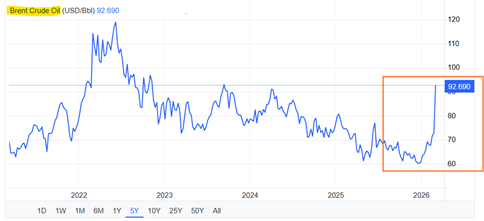
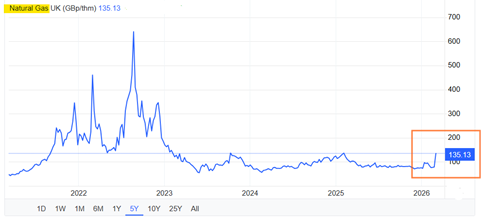
The energy markets appear to be banking on a short war, with only temporary disruption to Gulf production and to the supply through the Strait of Hormuz. Consistent with this, the prices of oil and especially of natural gas are still well below the levels hit after Russia’s full scale invasion of Ukraine in 2022. (The charts below are from Trading Economics.)
2. Is the current level of market composure justified? Yes, probably…
To be clear, I’m just an economist, not a military strategist or Middle East expert. But Iran’s remaining military does appear to be too weak to block the Strait for long, or to inflict serious damage on energy production in the rest of the region.
Iran may still be able to keep fighting using its highly effective drones. But the geopolitical realities are important too.
Iran’s surviving leaders may be reluctant to antagonise other Gulf states much further, if only because they will still want to have some influence in the region in future.
Indeed, President Masoud Pezeshkian has already apologised to his country’s neighbours and promised not to strike them again unless Iran itself is attacked from their territory.
Admittedly, this promise has not yet been met, with reports of fresh missile and drone attacks on Qatar, the UAE and Saudi Arabia on Saturday. But these strikes appear to be fewer in number than before.
Hopefully, this trumps the more worrying remarks from Qatar’s energy minister, reported in the FT on Friday. Saad al-Kaabi warned that Gulf production and exports could soon cease altogether, and that oil prices could hit $150 a barrel in two to three weeks.
That would cause significant harm to the global economy and is a plausible “worst case” scenario. However, Qatar has an obvious interest in pressuring the US and Israel to end the war as soon as possible and therefore in talking up the wider risks.
China may also have a positive role to play in easing tensions, given its dependence on energy imports and maritime shipping.
This still leaves the very real problem of the “fear factor”. The cost of shipping insurance has jumped, and some production facilities have been shut down purely as a precaution. The uncertainty alone may have lasting effects. But it seems more likely that these fears will now fade as the threat from Iran continues to recede.
3. The headlines could still undermine confidence
That said, worries about another energy shock could stamp out the few “green shoots” of economic recovery in the UK.
Business and household sentiment was fragile even before the escalation in the crisis in the Middle East. The most recent CBI Growth Indicator had suggested that private sector firms were already expecting activity to fall in the next three months, while the Institute of Directors’ survey had taken another turn for the worse. The GfK measure of consumer confidence also dipped (by three points) in February.
Some of the more apocalyptic reporting has not helped. A particularly dishonourable mention goes here to the Daily Mirror’s website, which has run clickbait headlines like “Petrol prices surge to 169.9p a litre with 90-car queues at pumps in Iran war chaos”, and “Petrol station ‘runs out of fuel’ as fuel crisis fears grow over Middle East war”. But some other outlets have been just as guilty. Bad news clearly sells.
4. Inflation will be slower to fall
There will be some more tangible damage, too. The Ofgem cap on domestic bills will protect most households from the surge in natural gas prices, at least until July. But the costs of motor fuel and heating oils are already rising (even if not as much as some headlines suggest). More businesses will feel the impact of higher energy bills straightaway.
The price increases currently in the pipeline should “only” add a few tenths of a percentage point to overall inflation. But this would probably be enough to prevent the CPI measure, which was 3.0% in January, from falling back towards the 2% target in April (as many, including the Bank of England, had hoped).
There is then the uncertainty about happens to the Ofgem cap in July. The experts at Cornwall Insight are my trusted source here. Their view is that the surge in wholesale gas prices – if sustained – could lift the cap to around £1,800 in July (up about £160, or 10%, on April’s cap announced early this month). This would keep inflation at around 2.5%.
But as Cornwall Insight also said, “We are still early in the assessment period for the July cap, and what happens in the energy markets over the next three months will be the key factor, rather than this spike alone.”
5. The Bank of England will be more cautious
Investors have quickly concluded that the Bank’s Monetary Policy Committee will now keep interest rates on hold at this month’s meeting (the announcement is on 19 March), and probably at the next meeting too (30 April). Some banks and building societies have already responded by raising mortgage rates.
This conclusion makes sense but is not certain. The MPC could still be willing to look through the temporary impact of commodity price shocks, especially if these are also likely to dampen economic activity. However, it will take some time to gauge both the direct and the indirect effects, including the impact on inflation expectations.
If I were on the MPC I would want to wait until the next quarterly set of economic forecasts in the April Monetary Policy Report.
6. A new headache for Rachel Reeves
The markets’ reassessment of the outlook for inflation and official interest rates has contributed to another jump in gilt yields. Indeed, the cost of government borrowing is already higher and has risen further in the UK than in the rest of Europe (or the US). The Table below (from Bloomberg) shows the moves on Friday.
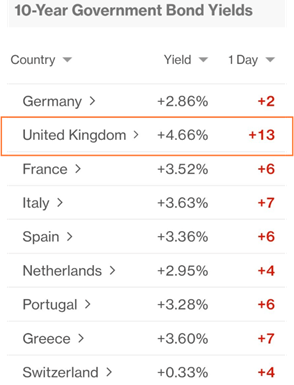
Investors are worried that the UK is particularly vulnerable to a further increase in energy costs which are already relatively high (no thanks to Ed Miliband). But they are also worried that a weak Labour government will feel under even more pressure to offset the impact on household bills. This could be done by topping up welfare payments and delaying planned tax increases, including the long-delayed hikes in fuel duty that are now supposed to begin in September.
The recent increase in “fiscal headroom” might give Rachel Reeves a little more leeway here. Nonetheless, the margin for error remains small, and higher borrowing could still put upward pressure on interest rates even if the fiscal targets continue to be met.
This is another big unknown to watch. For now, though, the surges in oil and gas prices are not yet severe enough to force the government to respond. The Ofgem cap has also bought some breathing space.
In short, the latest escalation of the crisis in the Middle East may prove to be a pivotal moment for the region. But the fallout for the UK economy and markets, while initially bad, is still likely to be both limited and temporary.
 Plain-speaking Economics