
President Trump has surely hit a new low with his threats to impose tariffs on European allies for daring to challenge his ambition to “acquire” Greenland. But the UK should not overreact and especially should not retaliate, whether with tariffs of our own or with other economic and financial sanctions.
For a start, Trump’s latest threats may well prove to be empty. The European financial markets certainly seem to think so, judging by the limited reaction on Monday morning. This is the familiar “TACO” trade, or “Trump Always Chickens Out”.
It is far from clear that Trump has the legal power to impose these tariffs anyway. The US Supreme Court is expected to rule as early as this week on whether the President’s emergency powers extend this far.
We have also been here before. Trump has often failed to follow through on threats to impose additional tariffs on other countries, including Canada, Mexico, and China. When the President first announced the new “reciprocal tariffs” on “Liberation Day” last April he promptly suspended most of them for 90 days.
Domestic political pressures are increasingly important too as the mid-term elections approach. Even in the US, the initial reaction to the Greenland threats seems to be that the President has gone too far this time, and that his stance is an existential threat to NATO. Trump’s own statements make it hard to escape the conclusion that he is making up policy on the hoof in a fit of pique after failing to be awarded the Nobel Peace Prize.
In any event, there are no obvious ways to retaliate that would not also hurt the UK economy or risk an even more extreme response from Trump himself.
The knee-jerk response might be to threaten new tariffs in return. The EU has already dusted off plans for retaliatory levies against the US. But one more “Brexit benefit” is that the UK would not be obliged to join a tit-for-tat trade war, with no winners.
It cannot be said often enough that tariffs damage the countries which impose them as well as the countries that they are targeting. British companies and consumers would end up paying higher prices, while any retaliation could wreck the new trade agreements that the UK has been able to make with the US.
There is also talk that European countries could retaliate by dumping US financial assets, or at least by sitting on their hands while the US government tries to cover its huge budget deficit.
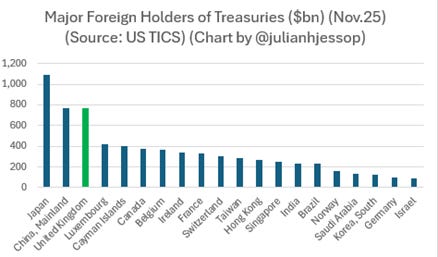
This might look like a powerful tool. Official statistics suggest that the UK is one of the top three foreign holders of US government bonds (known as “Treasuries”), behind only Japan and neck-and-neck with mainland China.
But the UK’s holdings of Treasuries are not controlled by the government. Instead, they mainly represent investments by private funds whose first duty is to maximise returns for beneficiaries, rather than to engage in geopolitics.
Moreover, these figures include assets held on behalf of investors based in other countries. This explains why Belgium, the Cayman Islands, and even Luxembourg, appear to be such big players in the Treasury market too.
Of course, this talk alone may hurt. Even without any official encouragement, Trump’s bullying is likely to backfire, and private investors will not need more prompting to sell US assets.
There is a recent precedent. Rumours of heavy Japanese selling contributed to a spike in US Treasury yields last April and probably helped to keep Trump in check.
However, even China has been reluctant to do more than just diversify slowly out of Treasuries, partly because of the losses this might trigger on the country’s remaining US holdings.
Finally, threats to reduce investment in the US would be a double-edged sword for the UK in particular, because the US is the largest foreign investor in Britain. The US could also play hardball on other important economic links, such as the supply of natural gas.
In short, the grown-up response to President Trump’s latest tantrum is to stay calm and attempt to talk him down. Existing agreements already allow the US to increase its military presence in Greenland substantially, if that is the real issue. Ramming that point home would make far more sense than retaliating in kind.
ps. you can follow me on X (formerly Twitter) @julianhjessop and on BlueSky. I also now post regularly on Substack.
 Plain-speaking Economics