
Frankly, I would prefer to ignore the economic forecasts from the IMF, or other multinational organisations like the OECD, because they add little value. However, the latest numbers for the UK have been trumpeted as a big win for the government, and for the embattled Chancellor in particular, as part of what appears to be a coordinated campaign involving senior Labour ministers and their allies in the media. So here are four key points.
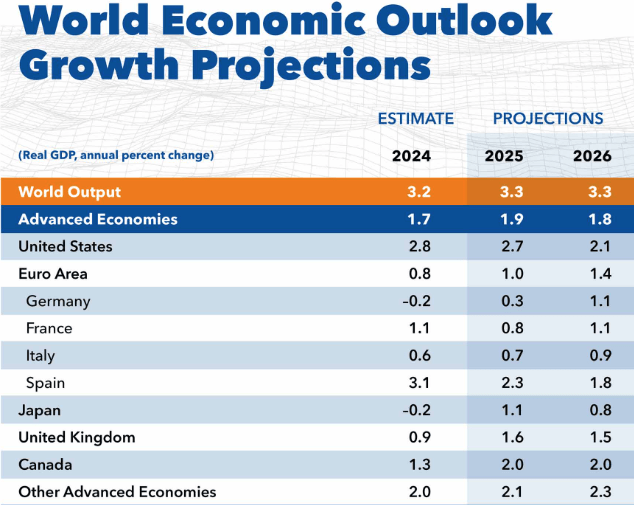
First, the good news: the IMF expects ‘Brexit Britain’ to continue outpacing the euro area in both 2025 and 2026 (which is a bit awkward for those who otherwise would be claiming that leaving the EU has been a disaster for the UK economy). But that is as good as it gets.
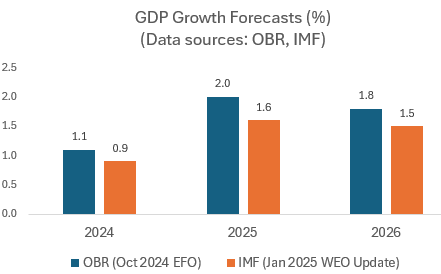
Second, the IMF’s UK GDP forecasts are still lower than the OBR’s assumptions for the October Budget, with a total shortfall of about 1% over the three years from 2024 to 2026. This would of course be more bad news for the public finances.
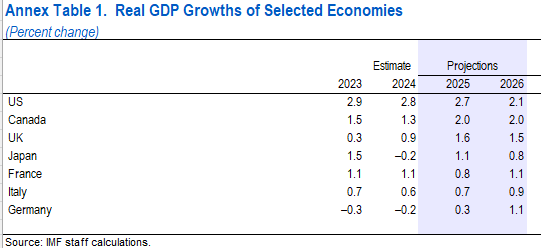
Third, the UK economy is expected to continue to underperform both the US and Canada this year and next. This is obviously too short a period to judge whether the Labour government will hit its target of achieving the “highest sustained growth in the G7”, but it is not looking great.
F(Inally, and most importantly, the IMF’s forecasts are wrong. Worst still, they are too optimistic.
The 0.9% projection for UK GDP in 2024 would require growth of at least 0.5% in the fourth quarter, which we know did not happen. The best we can probably hope for now is zero. And barring a miracle, growth in 2025 is more likely to be around 1.0% than 1.6%.
Why? In short, the IMF is not really in the business of economic forecasting. Like similar organisations, such as the OECD, its real focus is structural analysis and policy recommendations. Its forecasting processes are slow and, as appears to the case now, do not always reflect the latest available data. (Others may also suspect a political bias, but I prefer to look for cock-ups rather than conspiracies!).
It makes much more sense to follow the projections from independent forecasters in the City, who have real skin in the game and whose opinions help shape sentiment in the markets (especially important now, given the volatility in bond yields). The Treasury does a monthly poll and, in December, the averages of the latest UK growth forecasts were 0.8% for 2024 and just 1.2% for 2025. It would not surprise me at all if the January numbers are lower.
In summary, the latest IMF projections are not really “good news” for Rachel Reeves. They simply do not stand up to serious scrutiny, but even at face value they show economic growth falling well short of the Budget forecasts. Labour supporters may end up regret drawing so much attention to them.
ps. a widely-shared headline in the Independent claimed that that the “UK [is] set to be the fastest growing European economy as IMF forecast gives Reeves boost”. For the record, the IMF is forecasting that at least three European economies will grow faster than the UK over the next two years, namely the Netherlands, Poland and Spain. The headline was missing the important word ‘major’, which did at least make make it into the article, but it is the inaccurate headline which is being reposted.
 Plain-speaking Economics