
Over the last few days I’ve read some terrible takes on the jail sentences of four to five years handed out to five ‘Just Stop Oil’ protestors (aka ‘the Whole Truth Five’). Here’s my assessment of why the sentences were justified and where the critics have gone wrong.
First, the facts. If you have not already done so, I strongly recommend that you read the judge’s sentencing remarks, available here. In short, the activists were convicted of conspiracy to cause a public nuisance which resulted in major disruption on the M25.
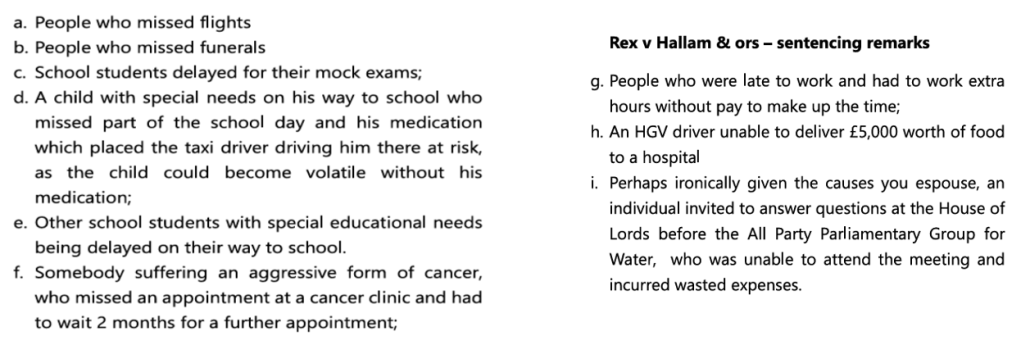
The jury that convicted the Five heard ample evidence of the significant harms done to members of the public, including the examples below. And it was clear that it could have been even worse – indeed, that was the stated aim of the conspirators.
Moreover, these were not first-time offenders. Each one had previous convictions for offences in relation to direct action protests. It was also reasonable to assume that if not imprisoned this time, they would simply carry on as before.
So, what to make of the criticisms of the sentences? I’ve picked out a number of themes, presented here with some rebuttals.
First, it has been argued that the protests were ‘peaceful’ and/or ‘non-violent’. This ignores the fact that you don’t actually have to hit someone in order to cause them significant harm. Many ‘non-violent’ crimes also carry long sentences, such as serious fraud. A non-violent act – like blocking a major road – can also cause death (and the sentences could and would have been longer if this had happened).
Second, the acts were done in a ‘good cause’. It has even been suggested (wrongly) that the issue of climate change was dismissed out of hand. Take this from the Guardian’s coverage…
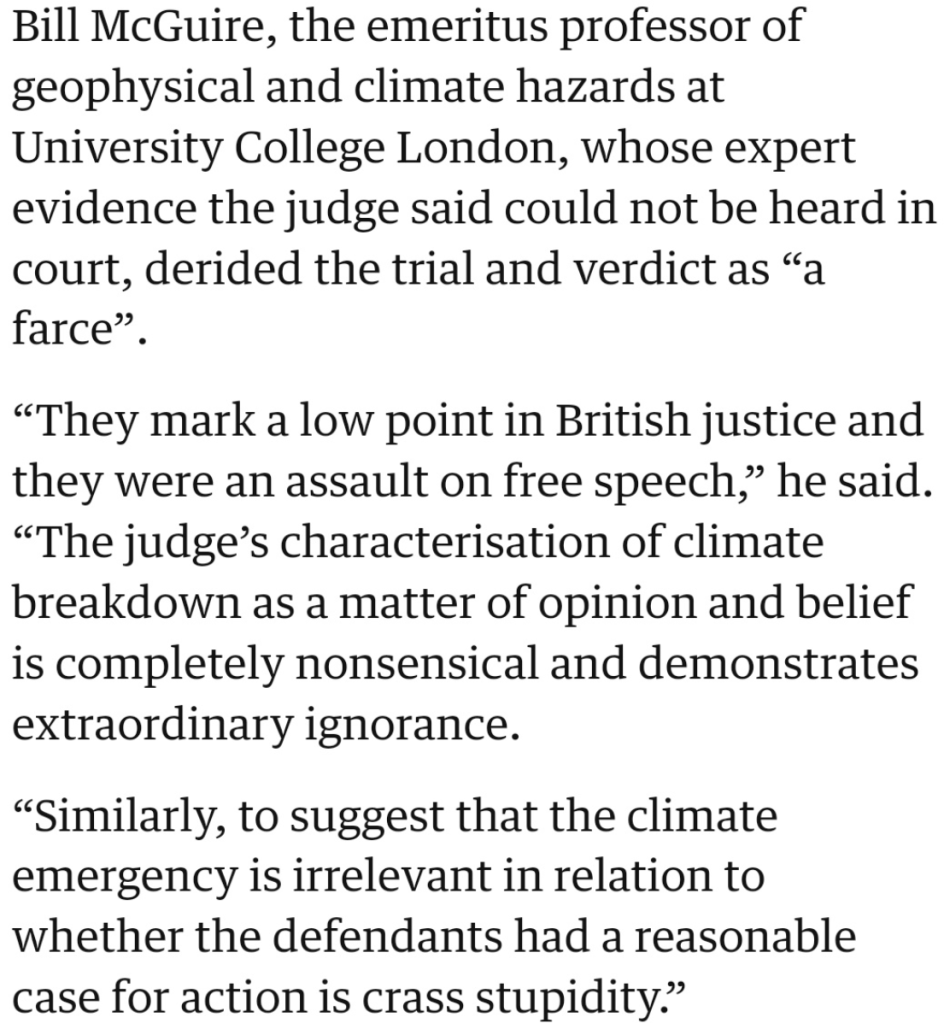
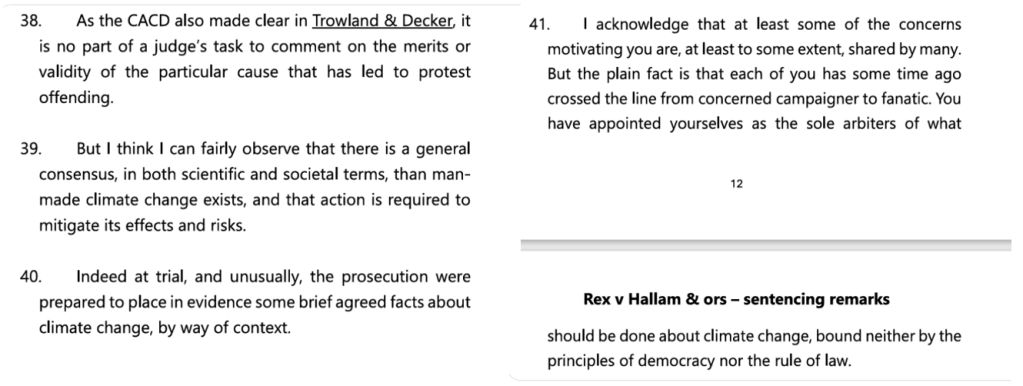
But the judge addressed this point in his sentencing remarks.
I would add that Just Stop Oil’s demands (summarised in this threatening letter to Keir Starmer) are unrealistic and impractical. But even if you sympathise with their agenda, these protests are counterproductive – they alienate the public and no government is likely to give in to such crude blackmail.
Most of the other bad takes are just variations on these two themes. But some are worth singling out.
Take this post from the (badly named) ‘Good Law Project’, which argued that the activists merely ‘planned a protest act but did not carry it out’. As anyone with the slightest grasp of the law will tell you, whether the five participated in the protests themselves is irrelevant to offences of ‘conspiracy’.

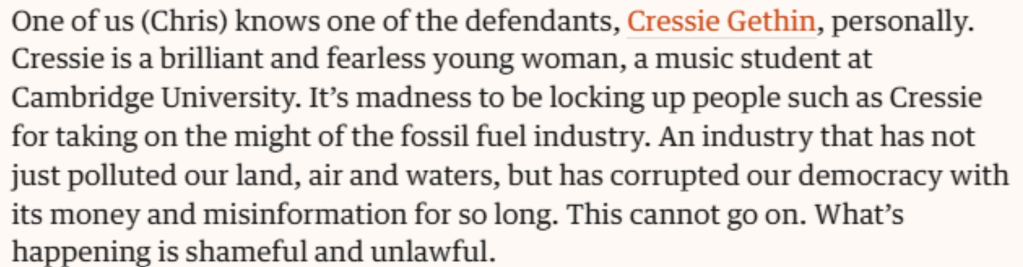
Or how about this pure snobbery (again from the Guardian)? These are not the sort of people we should be locking up, because one of them is studying Music at Cambridge! The social status of the activists is irrelevant to the harms caused here, as it would be for other crimes. (If anything, I would argue that a Cambridge student should know better.)
Others have made the argument that our prisons are full – shouldn’t we be locking up other people instead? We should indeed be locking up violent criminals too, but the Five were planning major disruption causing significant harms (and it was clear from the zoom call that they didn’t care if the consequences had been even worse). If prison overcrowding is indeed a constraint, just we should just release a few more lower-risk offenders to make room.
It has also been said that the protestors were simply trying to raise awareness about climate change. But is there anyone out there who is not aware of the issues here? We live in a vibrant democracy with a free press and social media – you don’t need to block the M25! (That, by the way, is my answer to those saying ‘what about the suffragettes? – they didn’t have the vote, nor did they do as much damage trying to get it.)
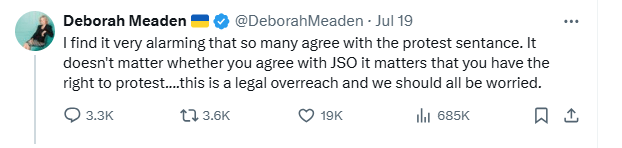
Deborah Meaden is one of many to worry that the sentences are an infringement on the right to protest. Well, yes. But surely no-one seriously believes that there should be no limits on the ‘right to protest’? Would this, for example, be a defence to murder? The harms done by these actions were totally out of proportion to any conceivable benefit.
Finally, many have compared the sentences unfavourably with those handed down for other offences (just one example below). Obviously, some violent crimes might have more impact on a single victim. But actions that cause a smaller amount of individual harm to a much larger number of people can be just as serious. The need to deter others is also particularly important in this case – remember they were planning to go after airports next.

Of course, it’s fair to say I’m no fan of Just Stop Oil, and I’m sure my (presumed) links to ‘Tufton Street’ mean the feeling is mutual. But I have reflected on this and would feel just the same way if the activists had some other policy agenda which I might actually support.
In short, I can see why the sentences handed down to the ‘Whole Truth Five’ may seem harsh to some. My initial reaction was surprise, too. But this is precisely what led me to dig deeper, starting with the trial summary. Again, do please read what the judge said and see what you think!
 Plain-speaking Economics
Excellent analysis as usual from this source.
LikeLike
Thanks! JJ
LikeLike
Protest is never without risk to protesters or society. Laws have increasingly shifted to criminalize protestwithout an equal degree of protecting society from those interests that threaten our environment and safety.
Disruption and inconveniencing of the public is part of the centuries long history of protest. Democracy and freedom inherently involve inconvenience to some if we hope to remain free. If we criminalize inconvenience we are engaging in rendering protest invisible. Sometimes all the powerless have available is putting their bodies in the way to gain media attention to their cause.
LikeLike
Thanks George – these are reasonable points, but where do you draw the line? In this case, the judge and jury decided that the cost of the disruption far outweighed any conceivable benefit. You may disagree, I do not. Most people would accept that there are limits on the right to harm others in order to make a political point. The question is where those limits lie.
LikeLike